Article: This Could Really Be Our Year (for Real Estate Disaster)

As the weather warms up, the season moves into full swing for Boston’s most lucrative spectator sport: real estate. People swap stories at bars and parties: I hear he paid six-fifty for a one-bed condo, there’s a basement studio in Davis asking four hundred grand, a ramshackle Victorian can’t be had for under a million. Every Sunday afternoon, it’s time to browse the open houses, whistling at prices and dreaming of appreciation, refinancing, and that ultimate luxury, off-street parking.

The statistics are familiar to anyone by now: the average median price for a single-family home in Cambridge passed half a million dollars last year, and three hundred grand for a condo. Somerville sold its first million-dollar single-family home this year. There are only two communities inside route 128 where a condo can be had for under $250,000. Prices keep rising, bids keep coming in over asking price and within days of opening. Winter is normally slower in the real estate market, but not this year, when the market barely paused. After all, this is a market which saw a penthouse condominium sell within fifteen minutes. For five million dollars. In cash.
Continue reading “Article: This Could Really Be Our Year (for Real Estate Disaster)”

Clean and Dry

It has not been very long now that I have owned dress shirts that I actually wear on a regular basis, and therefore take them to the cleaners rather than wash them myself. But I have a couple. And today I brought them to the cleaners down the street, where the old lady behind the counter knows me, despite the fact that I only bring in two shirts, and only every other week or so. But she had popped out for a moment– it was a bit after nine and I guess she’d taken a break after the pre-nine-am crowd had gone by. I went on by and dropped the shirts at the place near work, and now I feel horribly guilty for betraying her.

I’m such a freak.

I cannot spell

I’ve always been good at spelling, but I can never remember how to spell Apparel. As in “Don we now our gay” or American Apparel, maker of very nice t-shirts and other knitwear, who pay living wages, who offer after-work English classes and day-care for their employees. Although they’re not unionized, but whatever.

I’ve always felt that unions are a necessary friction, but that ethically avoiding them is probably good for all involved. The US auto industry is now seeing just how much it’s continuing to pay for its worker exploitation of fifty and sixty years ago and more: spiralling pension costs, concessions, inability to close a plant or exit a product line, inefficiencies, ossification. Unions help workers, but they don’t help The Company, and the company needs to survive to employ the worker who’s helped by the union… ideally it’s symbiotic but in practice it’s as imperfect as… well, it’s often still better than anything else.

Debt

I owe props to Daniel Gross, whose articles on Slate I’ve been reading while I spill last night’s leftovers onto my keyboard. I’ve been learning about recent Geenspan and Bush nonsense and how Bush owes what little credibility he has to Greenspan, while Greenspan owes his credibility to his interest-rate-related power to soften economic pain. That power will be sorely tested if the general consensus grows that we really are in a housing bubble that’s going to collapse any day now.

Then there’s one by Michelle Leder about really depressing high-interest short-term debt, a.k.a. “payday loans,” with a link to one about the legal grey areas surrounding loan sharking and usury.

Non-debt-related is one on gas prices and their effect on convenience stores, with a link to The National Association of Convenience Stores Fact Sheet on Gasoline Theft.

(Jackpot! Not only a trade magazine, but a trade magazine’s report on a weird crime whose frequency is affected by international relations! Obviously designed just to tickle my bizarre-data fetish.)

Standard Goods

The US National Institute of Standards and Technology does things like help define measurements and standards. Things like the exact volume of a gallon, or the official number of calories in the average tomato. Useful, very dry, stuff. Except they have the NIST Store, where you can buy things like, say, the government’s official standard peanut butter for your adhesion, peanut-butter-removal, and calorimeter tests. Or, say, a bag of official standard household dirt to test your vacuum cleaners with. Awesome.

Told You So

The Star Tribune (reg. required), apparently from Minneapolis/St. Paul, has coverage of the economic benefits of gay marriage. I know a trend when I see it: big parties are expensive, and expensive parties are good for the party business. Protest signs are mostly home-made, though, so that won’t get much. Lobbyists are having a field day, as are fax and printer toner salesmen.

As Seen On…

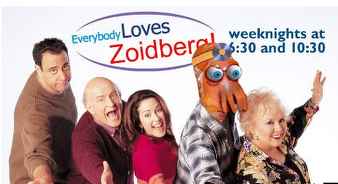
Everybody Loves Zoidberg WOULD be a really good show. I love Zoidberg anyway.

I’ve seen a few episodes of MTV’s MADE recently, and I think that, of the makeover reality shows, it’s really the best. It’s a simple concept: high school kid has some dream of personal accomplishment, and MTV shows up and helps them achieve it in 10 weeks. It’s always something difficult, and out of character, and good. A very femme young woman who wants to learn to skateboard because she’s tired of being so deliberately useless. A chorus nerd who wants to join the hip-hop dance team. An out-of-shape whiner who wants to run a triathalon.

These kids are not passively being “made over” by MTV. Instead, they’re becoming self-made, re-creating themselves in a quintessentially American narrative of self-invention, performative identity, and achievement.

Did I already say this? I can’t remember. I saw an episode in Germany and that’s when I began thinking of how the music videos on EuroMTV are local, but the shows are all bratty US kids, and how Made was especially US-centric. On the other hand, every child dreams of achievement and change. That’s what it is to grow to adulthood, really. The self-invention thing may be a very American twist, but everybody dreams of becoming somebody else.

You Don’t Have The Right

Someone asked recently:

If you buy a DVD movie, and then buy hardware (a DVD player on your computer) to play the DVD, don’t you have a legal right to watch it? There is open source software that allows you to watch DVDs, and also copy DVDs. If you are using the software to do legal activities (i.e. watch the DVD), and not to copy DVDs, isn’t that okay?

You’d think so, wouldn’t you. But it’s not. It’s legal to watch that movie. It’s legal to access that data. Just not with any tool you please. It’s like you’ve bought a car from Ford, but you are only allowed to use a Ford-approved wrench to open the hood. It won’t just void your warranty– they’ll track you down and sue you like the little rat you are. How dare you break into your property?

It’s been pointed out to me that it is possible to create a legal Linux-based software DVD player: you’d write one (closed source of course) and then pay the DVD Copy Control Association (DVD-CCA) a per-customer or per-year license fee to manufacture it. Then, you’d sell it. This is possible, but it hasn’t been done. There is not currently a legal way to watch a DVD on Linux. I guess you could use Crossover Office or some emulation layer and do it that way, but that’s not exactly the same.

And you can’t ever have a legal open source DVD player. Nope. No way. Same with MP3 players. Say what? A German consortium owns the rights to the MP3 encoding and decoding algorithym. Playing or ripping mp3s costs money. Try OGG instead.

Once, Mister Jack Valenti, the MPAA’s head lobbyist, tried to squash a popular piracy technology. He said it was “as dangerous to the motion picture industry as the Boston Strangler is to a woman alone.” What technology was that? The VCR. Because overwhelming consumer outcry forced it, it became legal over the objections of the industry, and the industry now makes billions just from videotape rentals.

Shortsighted? Yes. But he’s got the law on his side. Not justice, mind you. Not truth or the American way either. Just the law, and plenty of cash.

Value and Price

Great post over on Crooked Timber about Google, and how some things of great social worth are not worth buying… and how even some things of great economic worth are not necessarily worth buying. Google, for example, provides a heck of a lot of economic value to its users… but that doesn’t make Google any money, so that may not increase the monetary value of the company.

The general problem is that, in an economy dominated by public goods, like that of the Internet, there’s no reason to expect any relationship between economic value and capacity to raise revenue. Things of immense social value (this blog, for example!) are given away because there’s no point doing anything else. On the other hand significant profits can be made by those who can find a suitable choke point, even if they haven’t actually contributed anything of value. Assuming for the moment that SCO prevails in its attempts to extract revenue from Linux users, it won’t be because SCO’s code was better than some free alternative but simply because it was widely distributed before anyone found out it was copyrighted.

If the Internet continues to grow in economic importance, the central role of public goods in its formation will pose big problems for capitalism, though not necessarily to the benefit of traditional forms of socialism.