Level Up: Book Reviews

Over the past couple months I’ve read two very long fantasy/sci-fi series: Matt Dinniman’s Dungeon Crawler Carl, and Tao Wong’s Thousand Li. Both are video-game/RPG-inspired, both are thousands of pages long, and both were first self-published online.

Their roots in self-publishing and fanfic are obvious. In both cases there’s a single heroic man, a Regular Guy (seriously, like a default character build in a video game that the player hasn’t bothered to customize) who gets swept up into a complex magical adventure. Carl is a Coast Guard veteran and reluctant cat dad who must save the world from alien invasion; Wu Ying is a peasant who gets recruited into the legendary magic societies of Chinese fairy tales. As they gain experience, they gain skill and power, develop insight, learn about themselves and others, and do great deeds. It’s not an especially complicated narrative, but it’s quite enjoyable, full of humor and adventure. Both authors also get noticeably better at writing as they go along. The protagonists and secondary characters develop, grow, take shape and depth. Themes emerge. Interesting themes.

I haven’t read any of Wong’s newer pieces, but Dinniman’s newest novel, Operation Bounce House, shows his progress nicely. As in the Carl series, his protagonist is just a Regular Guy trying to defend his home. But I got the distinct impression that Carl’s backstory was added late in the game, while Bounce House is a more fully developed work from the very beginning. The secondary characters have full personalities from the beginning as well, and even some of the antagonists have a bit of depth to them, real concerns and regrets. In his newer book, the big ideas about xenophobia, capitalism, the nature of humanity, and gamer culture really have room to grow and thrive.

Still, they all pale compared to V. E. Schwab’s Bury our Bones in the Midnight Soil, a masterful work of fantasy shot through with love and loss and hunger. Schwab weaves together the story of several women over the course of 500 years, making each a protagonist and antagonist in turn. Maria escapes the strictures of 16th century Spain by becoming a vampire and eating her husband; Charlotte escapes the strictures of 19th century England by becoming a vampire and eating her suitor; 21st century college student Alice winds up caught in their centuries-long folie a deux and becomes a vampire against her will, struggling to make sense of what it means to live and fight and survive when time wears away everything that makes you human, when you know that eventually all that will be left of you is hunger. It’s an entirely different level of artwork, and it shows off just how great genre fiction can be.

Bad News (Fascism)

Secret police detain journalist for opinions.

Secret police are using cars without plates, or obscured plates, or the wrong plates.

Secret police abducting citizens.

This story about the missing teenager abducted by the secret police reminds me of nothing so much as the scene in Terry Gilliam’s Brazil where the bereaved widow screams “WHAT HAVE YOU DONE WITH HIS BODY,” and there’s no answer, because of course there isn’t. The secret police disappeared, tortured, and murdered the wrong guy, and he’s not coming back. I’m not alone in making this comparison.

Undercover with the American far right.

Who is Russell Vought and why does it matter? (He’s a Christian nationalist, and he’s trying to destroy the secular state)

The EEOC is now a white grievance machine, which is just dandy.

Bad News (Other)

They’re finally digging up that mass grave from the mother-and-baby home in Tuam, Ireland. I can’t tell why this story has had such a hold on me for so long. There are plenty of horrors closer to home.

Peak 18-year-old presents a problem for college towns.

Joy

Cat and pool table.

Various dogs navigating various stairs (often badly).

PUPPY.

Archival film of a Scottish man in the 1970s going to visit a friend across the moors by bicycle. There are hidden whisky caches along the way.

Consider the college application essay

The college application personal statement is an odd genre, formulated not as an art or a trade but as an academic and administrative test. It begins with a generously flexible choice of prompts, but the other requirements are as strict and procrustean as a sonnet: it must be no more than 650 words, but not much less either. It must illustrate something important about the author, and who they’ll become — something not already shown in their report cards, portfolios, club memberships, sports trophies, reference letters, or supplemental statements. The intended audience will spend perhaps three minutes reading it, and their opinion will heavily influence where the author lives for the next four years. No pressure.

I don’t think it’s an especially good way to determine who gets to go to which college, but I like the way it requires introspection, self examination, revision, and meditation. Those aren’t things that tend to come naturally to most of us, especially at 17 or 18, and they’re not often required in schoolwork. But even when it’s uncomfortable, it’s healthy and useful to take a hard look at ourselves and our goals, to make them concise and explicit.

That’s my pitch to students, anyway. And I decided that if I was going to say things like that, I’d have to to write one for myself. As I expected, I found it hard going myself. I often advise students to write a draft, then set it aside for a few days and come back to it, and see how it looks with fresh eyes. I had the luxury of writing the first paragraph, setting it aside for months, coming back to it, deleting the entire thing, and starting over. I did that several times. I didn’t have a deadline, after all. But I knew it was going to be useful to write, so I kept coming back to it.

I chose the prompt “Some students have a background, identity, interest, or talent that is so meaningful they believe their application would be incomplete without it. If this sounds like you, then please share your story.” These are my 644 words:

The first time I called myself a writer, I was 21 and trying to impress an undergraduate at Wellesley. It didn’t work, and I didn’t say it again for years. I’d say I worked as a technical writer, but never claimed to be a writer with no qualifying adjective — not when my name went on the cover of a reference book, not when my web copy drove millions of page views, not when I ran direct mail campaigns for a billion-dollar student loan portfolio, not when I self-published my own poetry. Calling myself a writer felt like putting on my grandfather’s suit coat and pretending to be a businessman. I knew it was impostor syndrome, but I didn’t feel I’d earned the title. It felt uncomfortable, and I found myself trying to break it in like the pair of hot pink Dr. Martens I bought with my first paycheck as a freelance editor. 

By comparison, I began to describe myself as an activist after a mere decade. That title didn’t begin with a childhood dream and dogged determination, but with coincidence and spite. I’d attended a single community meeting about a daycare center on my street and been perplexed by the sea of opposition. A rival daycare didn’t want to share the local playground; a neighbor worried about traffic; the retailer next door didn’t want to share parking. When I said “a daytime business sounds like a good thing for the neighborhood,” a sea of gray heads turned to me and stared. I hated it. I signed up for newsletters and mailing lists and joined a local political group, and when I moved one city over a few years later, joined a nascent sister group. 

Naturally, I took on the role of writer there. I didn’t say “I’m a writer,” but I wrote: web copy, blog posts, explanations like “what is zoning” and “what is affordable housing,” editorials, and, of course, a newsletter. I’d joke that our unincorporated nonprofit was just a mailing list with opinions, but when we crossed a thousand subscribers I had to force myself to stop. In a city of 85,000, that readership made us a major political force, and false modesty would undermine our work, hold us back from exercising the influence we had so carefully built. Even then, I only admitted that I was an activist and nonprofit leader because it hurt the cause to pretend otherwise. 

There are precious few times in our lives when we say something and it becomes true simply because we’ve acknowledged it. It’s a kind of magic: we say the words, and in saying them, they take concrete reality. College-bound Americans cast the spell in personal statements, when a student says “I am an aspiring marine biologist” and suddenly is. Job-seekers do it with resumes: I am a chef, a marketer, an HR specialist, a project manager. The magic is there in every 12-step meeting where someone speaks the words “I’m an alcoholic” and reaffirms their place in recovery, and at every wedding where an oath transforms two individuals into a couple. I even found it at my father’s bedside in the last days of his life, writing his obituary with him, looking back at his life and deciding which parts of it were a legacy. 

Of course, it takes a long time to prepare that spell, to shape and build an identity, but the declaration makes it feel instant, as though by opening a shell we’re simultaneously creating the egg that pours out. I worked for years before I felt confident enough to say it, and then when I said it, the truth felt sudden, an instant becoming. Simply putting it in words made it real, as though I hadn’t been preparing for it my whole life: Aaron S. Weber is a writer, editor, and activist living in Somerville, Massachusetts. 

A republic, if you can keep it

Labels of generations and eras are simultaneously kind of silly and kind of useful. They’re vague ways of sorting trends, whether it’s as long as the renaissance or as short as The Summer of Love. We all know people aren’t really all that different from year to year, but we also know that Gen X talks like this, and Gen Z stares like that.

The one that always struck me as interesting was Eric Hobsbawm’s description of a “long 19th century” and “short 20th century.” I’ll admit right here that I haven’t actually read the whole book, but the general idea is that the concepts that we think of as representing the 19th century started with the French Revolution in 1789 and lasted more or less until World War I in 1914. After the Great War, the concepts we think of as being truly of the 20th century (the cold war, airplanes, increasingly dominant global trade and mass media) took over, but lasted only until the fall of the Soviet Union. The era we think of as the 21st century, defined for the most part by ever more rapid technological upheavals and multipolar politics, began well before New Year’s Eve 1999.

Of course, these are just different viewpoints and frameworks you can use to look at the world, not actual hard lines. But they are useful for making sense of the deluge of one thing after another that keeps happening to us. And that’s why I love Jamelle Bouie’s recent column about the death of the Fourth American Republic (check the unpaywalled version if you don’t have a Times sub).

The US has had, of course, only a single national government and constitution since its founding, while France has literally had to start from scratch five times since 1789, with the current 5th republic founded in 1958. But while we haven’t had officially new government structures, we’ve had definite eras which you might as well call different Republics. They certainly had different frameworks, major changes to the Constitution and to the overall principles of how the country was run. The first ran from Independence to the Civil War; the second was our brief attempt at Reconstruction; the third was basically Jim Crow, “states’ rights,” and a weak administrative state; the fourth then began with the Civil Rights Act and the Voting Rights Act and is now ending with Donald Trump smearing shit all over the walls.

What next? As Gramsci said (or is alleged to have said, or was mistranslated as saying), “The old world is dying, and the new world struggles to be born: now is the time of monsters.” Or perhaps it’s the time of ICE agents wearing AI goggles, arbitrarily smashing windows. (Wasn’t there a word for this in the middle of the short 20th century? Something about smashing windows at night?)

News

The Rule of Law is Dead in the United States. It’s not an exaggeration, really. Laws have always been a little permeable, but we’ve definitely reached an era when there’s a lot less pretense that laws are universal.

Updated list of books banned from K12 schools on military bases.

Oklahoma implements ideological purity tests for teachers with coastal origins.

Lawful permanent resident detained by ICE; citizen beaten unconscious by ICE.

Arrests follow chalk rainbows.

Mystery surrounds $1.2 billion contract to build a concentration camp in Texas.

Joy

This fully charged cat.

You sure that’s a dog?

Let’s ride bikes!

Windy.

Heresy

In my 9th grade European history class, a classmate of mine had a genuinely difficult time understanding the concept of heresy. “If you follow Christ, you’re a Christian, aren’t you?” he said. “How could they say those other people weren’t Christian?” He simply could not comprehend that the basic ideas of his Sunday school lessons had ever been in question. To him, a thing like that couldn’t even be controversial, much less something people literally died for. It’s just obviously true by definition: Christ, Christ-ian, what more do you need to know?

The answer, of course, is that the Pope and the Inquisition got to define Christianity, and if you disagreed, they would burn you at the stake.

At the time, I thought he was an idiot, but he’d run into something pretty profound there: it’s really hard to discuss things when you don’t agree on the basic premise or definition of the issue in question. Worse, these kinds of ideas are so basic, so fundamental, that it’s hard to even recognize them as assumptions. Of course a Christian is a follower of Christ. What else would it be?

Well, ask the starovery. Or Emo Philips.

I thought about him recently when reading Thomas Zimmer’s recent piece on the nature of America, where he explores Trumpism not as an aberration but as a recurrence of a long-simmering conflict. Is America an idea about unity and freedom and equality, imperfectly executed, bending slowly toward justice? Is it a nation defined by the white Protestant men who founded it, with tentative privileges granted to minority groups only to the extent that they don’t disrupt the natural order? Everyone in that fight says they’re defending truth, justice, and the American way. And not only are they disagreeing about what those things mean, they can’t even comprehend how someone else would disagree.

I thought about him again when I saw a Facebook exchange between a guy who was appalled by ICE disappearances and torture, and a friend of his who said he shouldn’t get so upset about those perfectly normal legal arrests. “It’s not like anyone’s actually being fed to alligators,” he said. “That’s just a harmless joke.” One of them could not understand how anyone could be so cruel, and the other could not understand why anyone would be upset.

Or think about the way some leftists regard America as fundamentally harmful, and have a hard time comprehending that someone like me might actually like it. If I say “America has not always lived up to its ideals, but it can and will do better: look at our progress on labor and human rights and the environment,” they will say “America has always lived up to its ideals: look at slavery and CIA-backed coups and ICE raids.”

Meanwhile, all of us reasonable right-thinking liberals are baffled that a teacher in Idaho had to take down a classroom sign reading “Everyone is Welcome Here.” How, we ask, could a sign like that be forbidden? Who doesn’t want to welcome students in a classroom?

Well, that depends on what we mean by “everyone” and what we mean by “welcome,” doesn’t it? Because, let’s be honest, it doesn’t mean that literally everyone is welcome. It means “We don’t bully LGBT+ students here.” It means “Don’t be racist in this classroom.” Bullies and racists see “everyone is welcome” and read “YOU are not welcome,” and they hate it, and then of course they must ban it.

Point is, the people who now dominate the Republican party recognize that their definitions of words like “American” and “Christian” and “Everyone” and “Welcome” are under threat from people who want to include gays and minorities, but not bigots and fascists. They see that their understanding of the entire world is under attack.

Point is, there are a lot of people whose reality is so completely alien to us that it’s hard to recognize the conceptual country they live in. It’s not just strange, but upsetting that they cannot see same world we do. These basic concepts are foundational, and like a building’s foundation, we often take them for granted until we look at them from a different angle and see how tilted they are.

Nobody likes that feeling. It’s part of why this fight is so bitter and intractable.

News

A few days ago I made a list of things that were worrying and upsetting me.

This is a different list.

Joy

This midlife crisis is working out great actually

In a few weeks, I’ll be doing a hundred-mile bike ride to raise money for diabetes research. And while I have definitely been A Bike Guy for a while now, I didn’t ever really expect that I’d get to this level with it. It’s been a journey, and it didn’t really start with bikes. It started because, just under a year ago, I quit drinking alcohol.

Me, on a bike.
Photo by Scott Istvan

I’d been thinking about quitting for a long time. Especially working as a medical copywriter putting together flyers and web pages about how even moderate alcohol use is correlated with all kinds of bad outcomes, I couldn’t escape that background whisper of “you know that’s not good for you.”

You’ve heard this story before: I ignored that whisper until I couldn’t. It’s an embarrassing cliche, but of the major lessons I’ve learned this year is that life is full of cliches. Everyone’s a unique snowflake, but we all fall to the ground and melt. The point, the only important thing, is that I’m never drinking again. What a cliche.

Another cliche: endurance sports. Some people say that people in recovery are good at endurance sports because we’ve endured. If you can get up and go to work with a hangover, they say, you can grit your teeth through a long, hard workout. I don’t know if that’s true, but I know that when I quit drinking I had a lot of nervous energy, and it kept me up at night. The internet said cardio would help, but running hurt my feet, so I borrowed a road bike, and immediately fell in love. Within a few weeks I’d bought my own, a 2006 Trek Madone in glittery blue-black carbon fiber that, when new, had been top-of-the-line.

I started adding distance, riding fifteen or twenty miles at a go. I snagged a cheap stationary bike from a neighbor and subscribed to an online cycling simulator to train indoors in bad weather. I bought the padded shorts, then threw them out and got the padded shorts with shoulder straps. I started going to organized group rides. Forty miles. I got foul-weather gear so I could ride outdoors in the cold, and ended a fifty-mile ride with my fingers so frozen I had trouble unbuckling my helmet. I got the special shoes that clip into the special pedals, and paid someone to help me adjust my seat and handlebars centimeter by centimeter until the bike fit me perfectly, and now I can spend all day riding without my feet and hands going numb.

At this point, a hundred miles doesn’t seem all that far. It’ll take me all day, but that’s just a day. And I have a lot of days ahead of me.

Also, please send money.

Featured selections of bad news and cute animals will resume with the next post.

It’s like Gloversville out here

Today’s ominous article is by Gabrielle Drolet, who tells us How to Make a Living as a Writer. It’s quite simple, really: lots and lots of tiny projects and strung together into something that pays the rent. Drolet’s gigs include a few cartoons, a bit of choose-your-own-adventure erotica, and a reliable standby of daily morning horse-racing news for a reputation management service monitoring (and trying to downplay) scandal in the horseflesh trade. It’s not at all glamorous, this sort of commercial writing — more a trade than a craft or art. But it’s how a writer pays the bills, the same way a visual artist might do layout or logos or signs. And as devalued as it is, it’s getting worse. As automation nibbles at the edges, writing-as-a-trade becomes easier to automate and harder to respect. Or get paid for.

Coincidentally, my 40 hours a week at what I call the medical paperwork factory became 20 this month. They didn’t replace me with AI, or cut my hours because of the coming Republican war on Medicaid. This is just the regular precarity of the writing life: we finished a project, so now I’m down to half time.

Drolet surely knows this even better than I do, but that regular precarity is getting more precarious. For example, before my hours were cut, I had already seen several projects canceled because certain states no longer recommend vaccination to the poor. Meanwhile, as automation advances, more of that small pool of work will be done by The Machine and less by a human. What human work there is might not add up to a whole job. And what are the odds that a company will need me in particular, with 25 years of experience and a wage demand to match?

Couldn’t you just make ChatGPT do it?

Mystery

Robert Jackson Bennett’s fantasy/mystery A Drop of Corruption is a fun book from several angles. It’s a well-plotted mystery, of course. It’s a fantasy in a complex world of alchemy, of course. It’s a parable about neurodivergence and courage and ability. But it’s also a novel about the virtues of working in an imperfect system. The empire that our protagonists work for is not exactly well-loved by its neighbors, and for good reason. It’s crooked, it’s cruel, it’s unfair, and it’s also full of people working to make it better than it is, to make it worth keeping. To make it worthy of the love of patriots.

In the afterword, the author makes explicit where he’s coming from: he’s been thinking a lot about the danger of dictators, about the dangers of hoping for a quick fix or a single autocrat who can make the right decisions. About how the American empire he lives in is far, far, far from perfect, and yet holds the promise of being, shall we say, a more perfect union than it currently is. He puts that promise, that hope, in the hands of underpaid but dedicated civil servants, and puts them at the heart of his novel. It’s really quite well done.

Further

Joy

A vocabulary lesson: Loan words

The use of “disappear” as a transitive verb (they disappeared her), or as a substantive noun (the lawyers for the disappeared were unable to contact their client) originated in Argentinian, Chilean, and Philippine dictatorships of the 1970s and 80s. It refers to political kidnappings and the ominously abstract extrajudicial killings.

El/La disidente fue desaparecido. The dissident was disappeared.

No se sabe qué pasó con los desaparecidos. It is not known what happened with the disappeared.

As a word used most notably by the families of the disappeared, it’s almost deliberately and ironically Orwellian. It creates a sort of passive exonerative voice, one that implies that an action has occurred without anyone taking the action. The victim is absent, but so is the victimizer. The absence of one highlights the absence of the other.

Of course, part of the way that disappearance sparks fear is the quite deliberate fact that you can’t quite specify who’s taking the action. It’s not that the person vanishes like a rabbit in a magic trick. Someone has been disappeared. But by whom? Was it an official act? Local cops, feds, vigilantes, militias? Unknown, unsaid, unsayable? The outcome is the same: emptiness.

I was a Spanish major and spent a semester in Chile in the late 1990s, so desaparecido is a word I knew well before we began applying it in the US. It’s new and grammatically strange to people who aren’t familiar with the history, but language is adaptable. We find a way to label and describe horrors protean and indescribable alike.

I did not study German or get into serious depth on the run-up to the Second World War, so I was not familiar with the word Gleichschaltung, meaning synchronization or bringing-into-line. In other words, the whittling away of norms and the creation of legal exceptions that turned Germany into Nazi Germany. The legal process of Nazification.

Once you know the term, it’s hard not to see its shadow in the way medical journals are getting threatening letters from the regime, in threats to whistleblowers, the way ICE abuses suspects almost at random, in reports of another forty-eight desaparecidos in New Mexico, in rising harassment of defense lawyers, in yet another cavalier arrest of the wrong person, in the overt cruelty of firing a teacher for using a child’s requested name, in the way White House officials claim anyone who speaks up in favor of civil liberties is a terrorist, of course and obviously in that accidental deportation to a Salvadoran concentration camp, in yet more threatening letters to immigration lawyers and to doctors telling them to leave the country, in ever more cavalier immigration arrests of citizens.

(A straightforward shooting of the innocent, of course, is totally normal. We already know all about that kind of thing. We are accustomed, if not inured, to accidental shootings or to brutality that top officials at least pretend to deplore. That kind of horror is legible to us: it’s bad, but we know how it works, how it leads to civil suits and suspensions and consent decrees, as ineffectual as they may be. That’s a crime we know with a vocabulary we have already learned.)

In fifty years, what will the encyclopedia entry on early 21st century American Gleichschaltung look like? What new words will we have to describe this moment? What ominously abstract loanwords will work their way into Mandarin for students to look up when they’re taking Western History exams and need to describe the end of the first American republic?

Perhaps a Better Analysis Than Mine

The authoritarian takeover attempt is here. Sadly, we were warned.

There is still joy

Here are some cats. 

And a capybara.

And another cat.

And a sighthound with googly eyes on its very long nose.

Neither undead nor a doctoral candidate

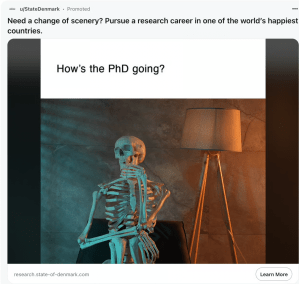
This week I got an ad on Reddit suggesting that thoughtful skeletons should consider moving to Denmark to finish their PhDs or advance their research careers. If I got the ad, their demographic targeting selection is a bit broader than I would have expected — after all, I’m not undead or a doctoral student or looking to move overseas.

Ad for emigration to Denmark, featuring a skeleton in a thoughtful pose with the caption "How's the PhD going?"

But if they’re pitching this to Reddit users in places like Boston, I’ll bet they’re going to find more than a few takers.

There’s a lot of scientific talent around here. And it’s highly mobile — more even than your typical professional talent pool might be. Every semester, there’s a new cohort of highly-trained experts finishing a stint and weighing their next options. Maybe they finished undergrad and want to begin grad school. Maybe they’ve just finished a PhD or postdoc. Maybe their grant funding is coming to a close. People move around a lot here.

Until now, one of the major risks the Boston region faced was that all this talent would decide to go elsewhere in the US just because it’s so expensive to live around here. Many people stay, of course, because they love this place specifically. But a lot of people are here because the jobs are here, the research is here, the grants are here. Because Harvard and MIT and all the smaller shoals of universities and spinoffs and startups are here, and the opportunities that they represent.

But now, at all levels of our regional eds and meds economy, that advantage is evaporating. Hospitals are laying off chaplains and counselors and technicians. Universities are staring down lists of impossible and unethical demands. Administrators whose entire careers have been devoted to caution bordering on timidity now find that there are no safe choices, that storm clouds are gathering, that they are profoundly unprepared for the nor’easter of shit that’s coming ashore.

It’s a virtual certainty that going to work in Denmark’s thriving biomedical industry was a possible but unlikely plan for a lot of Bostonians a year or two ago. And it’s equally likely that a lot more people are browsing apartment listings in Copenhagen than even a month ago.

After World War II, how long did it take the US to attract a critical margin of Europe’s scientific talent? And how long did that expertise support American primacy in science, finance, industry, and strength of arms? The Danes are not alone in making a bid for that talent now. French, German, Dutch, Belgian, and pan-European institutions are recruiting. And so is the Chinese government.

Related: America is Watching the Rise of a Dual State: “For most people, the courts will continue to operate as usual—until they don’t.”

Two Unrelated Headlines

Ars Technica: Experts suspect that the Trump tariffs were calculated using a chatbot.

Der Spiegel: A teenager’s fatal love affair with an AI chatbot.

Texas Banned Abortion. Then Sepsis Rates Soared.

Inside ICE Air: Flight Attendants on Deportation Planes Say Disaster Is “Only a Matter of Time”

Meanwhile, In Some Untidy Spot

A teacher at my local high school is running a fundraiser to pay the rent for students who lost a parent to ICE.

Joy

The indignity!

Just lounging.

The what now?

IRL pixels.

Functional Threshold Power

Today’s song is Gimme Sympathy, by Metric. It’s a bop, of course, but it also supports my ongoing claim that while rock has lost its preeminence in the popular music pantheon, it remains relevant as a source of inspiration. In this case, Gimme Sympathy is a response to Gimme Shelter, but also to the rivalry between the Rolling Stones and the Beatles:

After all of this is gone
Who’d you rather be,
The Beatles or The Rolling Stones?
Oh seriously, you’re gonna make mistakes, you’re young.
Come on, baby, play me something, like “Here Comes The Sun”

So it’s an optimism thing, more or less. We could use it.

(Also: interpolation and sampling of rock songs seems less popular than interpolation and sampling of R&B and soul. Is that just the style, or do R&B samples just work better for today’s hot hits? Sure, you can point to Lil Nas X riffing on In Bloom for his song Panini, which even gave Nirvana their highest-charting single decades after the band broke up, but that’s kind of a rare exception, isn’t it?)

Stray Thoughts On Bikes

Some of these may be entirely obvious to everyone else but I find them interesting:

  • Prowess in weightlifting is measured in kilos. Prowess in running is measured in miles per hour or minutes per mile. Prowess in cycling is measured in watts per kilogram, and in particular the measurement of functional threshold power (FTP), which is roughly the highest wattage you can produce over a sustained period of time.
  • When driving a car, you pick a speed and try to stick to it by changing the gearing and amount of power you expend. When riding a bike, it’s better to choose a sustainable power output, and change speed and gearing to maintain it.
  • The derisive name for a cyclist you do not like is “Fred.” Fred spends money like a pro but rides and (most importantly) dresses like an amateur. I can’t remember the equivalent term for a motorcyclist you dislike, but I think it might be “dentist.”
  • “Cycling” refers to competitive road (and sometimes gravel) riding in the same way that “weightlifting” refers specifically to Olympic weightlifting. That is, it’s a distinction that matters almost exclusively to insiders, and knowing or making the distinction is part of what makes you an insider.
  • The French origins of cycling as a sport persist in terms like gilet (vest) and bidon (water bottle).

Fear

Matt Yglesias was always the divisive hot take guy, sometimes trenchant, sometimes wildly wrong, generally clever, but not all that helpful. But let’s take a look back at this article from 2015 and sort of collectively say “oh shit, he might have been right about that one.”

And some more recent commentary:

  • The Atlantic: “What its advocates want is not a restoration of explicit Jim Crow segregation—that would shatter the illusion that their own achievements are based in a color-blind meritocracy. They want an arrangement that perpetuates racial inequality indefinitely while retaining some plausible deniability, a rigged system that maintains a mirage of equal opportunity while maintaining an unofficial racial hierarchy. Like elections in authoritarian countries where the autocrat is always reelected in a landslide, they want a system in which they never risk losing but can still pretend they won fairly.
  • Foreign Affairs: “U.S. democracy will likely break down during the second Trump administration, in the sense that it will cease to meet standard criteria for liberal democracy: full adult suffrage, free and fair elections, and broad protection of civil liberties… What lies ahead is not fascist or single-party dictatorship but competitive authoritarianism—a system in which parties compete in elections but the incumbent’s abuse of power tilts the playing field against the opposition.”

But come back to optimism for a moment. Because we’ve been here before, and we’ve won. Nazis marched in Boston this week, and they kept their masks on, because they know that if they showed their actual faces they’d be ruined, because they know they’re wrong.

We can still recover from this. We can take action, big or small, and move back toward the sort of world where healthcare isn’t over-politicized, where people control their own bodies, where we fund and achieve and celebrate amazing scientific breakthroughs.

Joy

[Ominous music intensifies]

For the past few years, the Super Bowl been a weird exercise in melancholy for me, largely because it’s a reminder of one of the last nights I spent with my father, in 2021. The whole family all gathered around him in his bed with an iPad while he tried to straddle the line between pain and opioid-induced unconsciousness. As my brother says, crying at the Super Bowl may be an unusual way to mourn, but it’s not a bad one.

But it’s not just a moment of reflection for me because it’s close to the anniversary of his death. It’s also because football still remains America’s game, but I don’t follow it closely, so watching it feels like being a foreigner looking in at the diminished mainstream of our culture, eroded as it is by hyper-segmentation and factionalism.

(In 2017, I went to a Super Bowl party with a friend who brought her new roommate, Dora, badly jet-lagged and less than 48 hours into living in America. We assured Dora that she didn’t need to follow the game, because this was just an excuse to eat some snacks. But it was the legendary Pats/Falcons overtime game, and at some point I looked over at her trying to parse six very loud conversations and an unfamiliar game in what I think was her third or fourth best language, and felt amazed that it was even possible to comprehend. I try to imagine what it felt like sometimes. It’s probably good for us to imagine being in a situation like that from time to time, even if we don’t experience it directly ourselves).

Anyway, this year, like in 2017, like in 2021, the Super Bowl felt just weird as hell. Above all else, above even Samuel L. Jackson making explicit the subtext of a profoundly political halftime show, was the paranoia. I cannot stop thinking about how many ads were built from a base of twisted conspiracy: Tom Brady is a robot, celebrities are aliens, football exists solely to sell us unhealthy food, the pharmaceutical industry is trying to keep us sick and poor on purpose (so get an online doctor to prescribe you these off-brand compounded weight loss injections, which have bypassed normal safety reviews).

Yes, I know, everything is driven by a conspiracy theory these days. And I know that some of those conspiracies are real, slipping in alongside arrant nonsense both silly and dangerous. But it feels more than a little tasteless to joke about the paranoia to sell batteries or frying pans or off-brand injectables.

I mean, we all went back and read The Paranoid Style in American Politics during the first Trump administration, didn’t we? (If not, go read it again. It’s not long.)

…. or is that just me being paranoid?

Daily Doomscroll

Joy