Paul Fussell on Class: A Rather Dated Field Guide

Paul Fussell’s 1983 book Class: A Guide through the American Class System was well-reviewed in its time, and remains influential. It also has plenty of critics. David Brooks, likewise a strong prose stylist prone to grand pronouncements, accurately described it as “insufferably snobby.” In the grand tradition of H. L. Mencken, the book is filled with bons mots, literary allusions, and anecdotes, seasoned with occasionally brilliant insights.

Have you ever seen that New Yorker cartoon where a father tells his son “if you can’t say something nice, say something clever but devastating?” Fussell must have been raised on that ethos to grow up and write this kind of book.

It’s got value, but to access it you have to excuse the way the author can’t seem to help but denigrate everything he sees, and his particularly vicious distaste for the middle class. It’s as though he’s made it a deliberate challenge to read his book without turning around to call him a pretentious dickhead. His attitude is infectious, and I found myself growing more cruel and disdainful as I wrote this review.

You also have to discount the era, not just of the book, but of the man. I expected a book from the 80s to show its age, but Fussell was born in 1924, and his worldview seems firmly postwar, quite different from what I recognize of my own 1980s upbringing. It’s a world of men and their wives rather than of individuals, of clearly-defined suits and uniforms rather than our rather more malleable dress codes.

To the extent that the book acts as a time-traveler’s guide to the way people believed they ought to act, it is inevitably dated. It’s only natural that just a handful of the specific class markers Fussell points out have retained the meanings he assigns them, like particular styles of lawn care or religious expression. Others are gone entirely, like pocket protectors and slide rules. Even the emphasis he places on spelling and pronouncing things correctly seems quaint today. Now that it’s easy to look up, it’s no longer a signal of good breeding to be able to pronounce words like salutary, genre, Ruscha, or Proust. Other markers are still around, but carry new meanings: ballcaps, denim, and clothes with words on them no longer carry strong class connotations at all — it’s down to the specific style of those things now.

But it’s not just out of date. Fussell also seems to confuse things he dislikes with things that are markers of class. His chapter on “prole drift” is almost unreadable, filled with outraged descriptions of the popularity of popular fiction, magazine covers that use the dirty trick of having visual appeal, the insufficient deference of clerks in stores where he must wait in line, and ads for things he doesn’t want appearing in his reading material.

Does he describe any of these things as signs that class markers are changing even as class remains? Of course not. He describes them as the death-knell of things that are good and wise and correct. Spend fifteen minutes in any bookstore and you’ll recognize him: he’s the old white guy outraged that he must place a special order for a title that’s not currently in stock, holding up the line as he harangues the cashier about how the greeting card rack is taking up space that should be reserved for philosophy.

It’s an even greater failure that Fussell describes social standing as operating along a single axis, without any discussion of code-switching or intersectionality. It’s no excuse that the term “intersectionality” wouldn’t be invented for another six years: he certainly would have read Baldwin, Mailer, and Freidan, but he draws no insights from any of them. Instead, he writes of “the prole and his wife” as though the man were the person with the class, and his wife a mere accessory.

Or consider this claim, from his brief chapter on social mobility:

Ambitious male homosexuals, at least in fantasy, aspire to rise, and from humble origins to ascend to the ownership of antique businesses, art galleries, and hair salons. The object is to end by frequenting the Great. They learn to affect elegant telephone voices and gravitate instinctively toward “style” and the grand. Lesbians, on the contrary, like to sink, dropping from middle-class status to become taxi drivers, police officers, and construction workers. The ultimate male-homosexual social dream is to sit at an elegant dinner table, complete with flowers and doilies and finger bowls, surrounded by rich, successful, superbly suited and gowned, witty, and cleverly immoral people. The ultimate lesbian social dream is to pack it in at some matey lunch counter with the heftier proles, wearing work clothes and doing a lot of shouting and kidding.

Even for the 1980s, that’s a ridiculous set of stereotypes masquerading as analysis, and it undermines every other assertion he makes. After reading that nonsense, can the reader trust his similarly broad claims about bowling leagues, country clubs, regional accents, newspapers, mail-order shopping, or the Sun Belt?

That’s especially important when it comes to assertions I can’t evaluate from my own experience. For example, he says that shopping in supermarkets is a middle-class activity. Perhaps he’s right that 20th century upper class types found supermarkets vulgar, but if so, it’s news to me. Similarly, he has quite a lot of opinions about indigestion and constipation being middle-class ailments. For some reason he even applies scare quotes to the words “antacid” and “laxative.” Is it because he regards those terms as euphemisms, a linguistic folly he attributes to the middle class with its fear of vulgarity and desire to be seen as more sophisticated than it is? Or does he think that only the middle class suffers from digestive trouble? I sincerely can’t tell, and I find his derisive style too tedious to spend any more time interpreting it.

I do understand what he means when he uses the same punctuation around the word “college:” he means any sort of school he doesn’t respect. He spends a great deal of time discussing the class connotations of American higher education, which is to say, he devotes an entire chapter to insulting lesser colleges and the people who attend them.

Yes, he’s right that as high school and college degrees became more common, they became less prestigious. Yes, he’s right that more college access could never raise the class status of everyone who got a degree. He might even be right that as it’s become more necessary and more common to have a degree, the intellectual rigor of the traditional university curriculum has declined. But he could make that point without being a colossal asshole. He could certainly do without a lengthy digression — I hesitate to call it a joke — about how the word university is higher-class simply because it is longer than the word college.

It makes sense that he’d feel the section about higher education so deeply, though: he taught at Penn and must therefore have been continually terrified that his peers wouldn’t respect him as much as someone who taught at one of the real Ivies. Perhaps the perfect portrait of Fussell’s own class position is that he derides The New Yorker as irredeemably middle class, accusing it of mealy-mouthed fear of controversy… and that The New Yorker later featured selections from his wife’s memoir discussing the unsurprising collapse of their marriage.

At any rate, I’m sure he’s right about quite a few things. For example, he’s right that expensive and useless are the province of the rich. But we’ve known about that, and had an analytical framework for it, since at least the era of Thorstein Veblen.

And he’s right that wealth and class intersect and interact but are not the same, and that this difference is critical to understanding both. When he talks about the failures of new money to buy class, I look over at my newsfeed and see James Franco failing to become a respected fine artist, or a glib claim about the sort of person who drives a vintage Ferrari as opposed to an equally expensive new Lamborghini. The useless and expensive thing is for the rich, but the style of it shows us the seam between classes.

His claim that class anxiety falls most acutely on people who fear falling to a lower class seems self-evident, and does a great job explaining all the recent think pieces about Subaru socialists and elite overproduction. It certainly explains why I’m even reading the book: I’m four years into a “temporary” gig with uncertain hours, watching AI nudge my skills toward irrelevance, wondering what I really got out of that extension-school master’s degree. Yep, that’s class anxiety all right! And how dreadfully middle-class of me to try to understand it with a self-consciously highbrow reading list, beginning with this very book.

Other insights seem broadly accurate, but riddled with exceptions if you look too closely. For example, he claims that sports are higher-class when they are more expensive, more time-consuming, and less violent. His key examples, golf on the high end and boxing at the low end, fit neatly into that framework. His claims about football make sense today, and make even more sense when you recall that in his day high-end box seats were new and football was more akin to NASCAR than the all-encompassing socioeconomic juggernaut it is today.

On the other hand, basketball is nonviolent yet affordable, popular with low-income city youth and Supreme Court justices alike. He cannot categorize it, so he does not mention it. Soccer wasn’t on his radar, but he’d have had a hell of a time squaring English football hooligans with the pay-to-play phenomenon of elite American youth teams.

Or consider bicycles, my own personal interest. His framework does a good job of explaining how Lycra-clad hobby cyclists, as avatars of useless and expensive upper-class activities, help to create the perception that a $70,000 pickup truck is the transportation of regular working people while a $700 bicycle is for elitists. But that’s far too simple, as is all of Fussell’s analysis. For example, it ignores the fact that coal-rolling pickups are a symbol not just of class, but of masculinity. He doesn’t seem to have had the imagination to approach consumer class signals from that direction at all.

Nor has he identified much of a practical application for any of these sweeping generalizations and occasional insights. Has he noted how government policies and funding are shaped by our beliefs about the class connotations of various activities? Of course he hasn’t: his whole schtick begins with the claim that anything practical is a mark of low class, just like those nerds with their pocket protectors and personal computers.

His sole attempt at any kind of usefulness is the last chapter, in which claims that Americans can escape the trap of class by becoming “category X,” self-directed and often self-employed intellectuals. Category X is, needless to say, where Fussell places himself, above and apart from the contest of class in America. It is also, as anyone who’s ever filed a 1099 can tell you, absolute horseshit.

Despite Fussell’s personal, stylistic, and analytical failings, Class remains a notable, rare, and influential attempt to understand how class divisions function in America. Perhaps a different author will provide me with a more practical guide to navigating those divisions, or communicating with people of different backgrounds, or literally anything other than a vague suggestion tobecome an intellectual in a futile effort to escape categorization.

Level Up: Book Reviews

Over the past couple months I’ve read two very long fantasy/sci-fi series: Matt Dinniman’s Dungeon Crawler Carl, and Tao Wong’s Thousand Li. Both are video-game/RPG-inspired, both are thousands of pages long, and both were first self-published online.

Their roots in self-publishing and fanfic are obvious. In both cases there’s a single heroic man, a Regular Guy (seriously, like a default character build in a video game that the player hasn’t bothered to customize) who gets swept up into a complex magical adventure. Carl is a Coast Guard veteran and reluctant cat dad who must save the world from alien invasion; Wu Ying is a peasant who gets recruited into the legendary magic societies of Chinese fairy tales. As they gain experience, they gain skill and power, develop insight, learn about themselves and others, and do great deeds. It’s not an especially complicated narrative, but it’s quite enjoyable, full of humor and adventure. Both authors also get noticeably better at writing as they go along. The protagonists and secondary characters develop, grow, take shape and depth. Themes emerge. Interesting themes.

I haven’t read any of Wong’s newer pieces, but Dinniman’s newest novel, Operation Bounce House, shows his progress nicely. As in the Carl series, his protagonist is just a Regular Guy trying to defend his home. But I got the distinct impression that Carl’s backstory was added late in the game, while Bounce House is a more fully developed work from the very beginning. The secondary characters have full personalities from the beginning as well, and even some of the antagonists have a bit of depth to them, real concerns and regrets. In his newer book, the big ideas about xenophobia, capitalism, the nature of humanity, and gamer culture really have room to grow and thrive.

Still, they all pale compared to V. E. Schwab’s Bury our Bones in the Midnight Soil, a masterful work of fantasy shot through with love and loss and hunger. Schwab weaves together the story of several women over the course of 500 years, making each a protagonist and antagonist in turn. Maria escapes the strictures of 16th century Spain by becoming a vampire and eating her husband; Charlotte escapes the strictures of 19th century England by becoming a vampire and eating her suitor; 21st century college student Alice winds up caught in their centuries-long folie a deux and becomes a vampire against her will, struggling to make sense of what it means to live and fight and survive when time wears away everything that makes you human, when you know that eventually all that will be left of you is hunger. It’s an entirely different level of artwork, and it shows off just how great genre fiction can be.

Bad News (Fascism)

Secret police detain journalist for opinions.

Secret police are using cars without plates, or obscured plates, or the wrong plates.

Secret police abducting citizens.

This story about the missing teenager abducted by the secret police reminds me of nothing so much as the scene in Terry Gilliam’s Brazil where the bereaved widow screams “WHAT HAVE YOU DONE WITH HIS BODY,” and there’s no answer, because of course there isn’t. The secret police disappeared, tortured, and murdered the wrong guy, and he’s not coming back. I’m not alone in making this comparison.

Undercover with the American far right.

Who is Russell Vought and why does it matter? (He’s a Christian nationalist, and he’s trying to destroy the secular state)

The EEOC is now a white grievance machine, which is just dandy.

Bad News (Other)

They’re finally digging up that mass grave from the mother-and-baby home in Tuam, Ireland. I can’t tell why this story has had such a hold on me for so long. There are plenty of horrors closer to home.

Peak 18-year-old presents a problem for college towns.

Joy

Cat and pool table.

Various dogs navigating various stairs (often badly).

PUPPY.

Archival film of a Scottish man in the 1970s going to visit a friend across the moors by bicycle. There are hidden whisky caches along the way.

Consider the college application essay

The college application personal statement is an odd genre, formulated not as an art or a trade but as an academic and administrative test. It begins with a generously flexible choice of prompts, but the other requirements are as strict and procrustean as a sonnet: it must be no more than 650 words, but not much less either. It must illustrate something important about the author, and who they’ll become — something not already shown in their report cards, portfolios, club memberships, sports trophies, reference letters, or supplemental statements. The intended audience will spend perhaps three minutes reading it, and their opinion will heavily influence where the author lives for the next four years. No pressure.

I don’t think it’s an especially good way to determine who gets to go to which college, but I like the way it requires introspection, self examination, revision, and meditation. Those aren’t things that tend to come naturally to most of us, especially at 17 or 18, and they’re not often required in schoolwork. But even when it’s uncomfortable, it’s healthy and useful to take a hard look at ourselves and our goals, to make them concise and explicit.

That’s my pitch to students, anyway. And I decided that if I was going to say things like that, I’d have to to write one for myself. As I expected, I found it hard going myself. I often advise students to write a draft, then set it aside for a few days and come back to it, and see how it looks with fresh eyes. I had the luxury of writing the first paragraph, setting it aside for months, coming back to it, deleting the entire thing, and starting over. I did that several times. I didn’t have a deadline, after all. But I knew it was going to be useful to write, so I kept coming back to it.

I chose the prompt “Some students have a background, identity, interest, or talent that is so meaningful they believe their application would be incomplete without it. If this sounds like you, then please share your story.” These are my 644 words:

The first time I called myself a writer, I was 21 and trying to impress an undergraduate at Wellesley. It didn’t work, and I didn’t say it again for years. I’d say I worked as a technical writer, but never claimed to be a writer with no qualifying adjective — not when my name went on the cover of a reference book, not when my web copy drove millions of page views, not when I ran direct mail campaigns for a billion-dollar student loan portfolio, not when I self-published my own poetry. Calling myself a writer felt like putting on my grandfather’s suit coat and pretending to be a businessman. I knew it was impostor syndrome, but I didn’t feel I’d earned the title. It felt uncomfortable, and I found myself trying to break it in like the pair of hot pink Dr. Martens I bought with my first paycheck as a freelance editor. 

By comparison, I began to describe myself as an activist after a mere decade. That title didn’t begin with a childhood dream and dogged determination, but with coincidence and spite. I’d attended a single community meeting about a daycare center on my street and been perplexed by the sea of opposition. A rival daycare didn’t want to share the local playground; a neighbor worried about traffic; the retailer next door didn’t want to share parking. When I said “a daytime business sounds like a good thing for the neighborhood,” a sea of gray heads turned to me and stared. I hated it. I signed up for newsletters and mailing lists and joined a local political group, and when I moved one city over a few years later, joined a nascent sister group. 

Naturally, I took on the role of writer there. I didn’t say “I’m a writer,” but I wrote: web copy, blog posts, explanations like “what is zoning” and “what is affordable housing,” editorials, and, of course, a newsletter. I’d joke that our unincorporated nonprofit was just a mailing list with opinions, but when we crossed a thousand subscribers I had to force myself to stop. In a city of 85,000, that readership made us a major political force, and false modesty would undermine our work, hold us back from exercising the influence we had so carefully built. Even then, I only admitted that I was an activist and nonprofit leader because it hurt the cause to pretend otherwise. 

There are precious few times in our lives when we say something and it becomes true simply because we’ve acknowledged it. It’s a kind of magic: we say the words, and in saying them, they take concrete reality. College-bound Americans cast the spell in personal statements, when a student says “I am an aspiring marine biologist” and suddenly is. Job-seekers do it with resumes: I am a chef, a marketer, an HR specialist, a project manager. The magic is there in every 12-step meeting where someone speaks the words “I’m an alcoholic” and reaffirms their place in recovery, and at every wedding where an oath transforms two individuals into a couple. I even found it at my father’s bedside in the last days of his life, writing his obituary with him, looking back at his life and deciding which parts of it were a legacy. 

Of course, it takes a long time to prepare that spell, to shape and build an identity, but the declaration makes it feel instant, as though by opening a shell we’re simultaneously creating the egg that pours out. I worked for years before I felt confident enough to say it, and then when I said it, the truth felt sudden, an instant becoming. Simply putting it in words made it real, as though I hadn’t been preparing for it my whole life: Aaron S. Weber is a writer, editor, and activist living in Somerville, Massachusetts. 

Heresy

In my 9th grade European history class, a classmate of mine had a genuinely difficult time understanding the concept of heresy. “If you follow Christ, you’re a Christian, aren’t you?” he said. “How could they say those other people weren’t Christian?” He simply could not comprehend that the basic ideas of his Sunday school lessons had ever been in question. To him, a thing like that couldn’t even be controversial, much less something people literally died for. It’s just obviously true by definition: Christ, Christ-ian, what more do you need to know?

The answer, of course, is that the Pope and the Inquisition got to define Christianity, and if you disagreed, they would burn you at the stake.

At the time, I thought he was an idiot, but he’d run into something pretty profound there: it’s really hard to discuss things when you don’t agree on the basic premise or definition of the issue in question. Worse, these kinds of ideas are so basic, so fundamental, that it’s hard to even recognize them as assumptions. Of course a Christian is a follower of Christ. What else would it be?

Well, ask the starovery. Or Emo Philips.

I thought about him recently when reading Thomas Zimmer’s recent piece on the nature of America, where he explores Trumpism not as an aberration but as a recurrence of a long-simmering conflict. Is America an idea about unity and freedom and equality, imperfectly executed, bending slowly toward justice? Is it a nation defined by the white Protestant men who founded it, with tentative privileges granted to minority groups only to the extent that they don’t disrupt the natural order? Everyone in that fight says they’re defending truth, justice, and the American way. And not only are they disagreeing about what those things mean, they can’t even comprehend how someone else would disagree.

I thought about him again when I saw a Facebook exchange between a guy who was appalled by ICE disappearances and torture, and a friend of his who said he shouldn’t get so upset about those perfectly normal legal arrests. “It’s not like anyone’s actually being fed to alligators,” he said. “That’s just a harmless joke.” One of them could not understand how anyone could be so cruel, and the other could not understand why anyone would be upset.

Or think about the way some leftists regard America as fundamentally harmful, and have a hard time comprehending that someone like me might actually like it. If I say “America has not always lived up to its ideals, but it can and will do better: look at our progress on labor and human rights and the environment,” they will say “America has always lived up to its ideals: look at slavery and CIA-backed coups and ICE raids.”

Meanwhile, all of us reasonable right-thinking liberals are baffled that a teacher in Idaho had to take down a classroom sign reading “Everyone is Welcome Here.” How, we ask, could a sign like that be forbidden? Who doesn’t want to welcome students in a classroom?

Well, that depends on what we mean by “everyone” and what we mean by “welcome,” doesn’t it? Because, let’s be honest, it doesn’t mean that literally everyone is welcome. It means “We don’t bully LGBT+ students here.” It means “Don’t be racist in this classroom.” Bullies and racists see “everyone is welcome” and read “YOU are not welcome,” and they hate it, and then of course they must ban it.

Point is, the people who now dominate the Republican party recognize that their definitions of words like “American” and “Christian” and “Everyone” and “Welcome” are under threat from people who want to include gays and minorities, but not bigots and fascists. They see that their understanding of the entire world is under attack.

Point is, there are a lot of people whose reality is so completely alien to us that it’s hard to recognize the conceptual country they live in. It’s not just strange, but upsetting that they cannot see same world we do. These basic concepts are foundational, and like a building’s foundation, we often take them for granted until we look at them from a different angle and see how tilted they are.

Nobody likes that feeling. It’s part of why this fight is so bitter and intractable.

News

A few days ago I made a list of things that were worrying and upsetting me.

This is a different list.

Joy

It’s like Gloversville out here

Today’s ominous article is by Gabrielle Drolet, who tells us How to Make a Living as a Writer. It’s quite simple, really: lots and lots of tiny projects and strung together into something that pays the rent. Drolet’s gigs include a few cartoons, a bit of choose-your-own-adventure erotica, and a reliable standby of daily morning horse-racing news for a reputation management service monitoring (and trying to downplay) scandal in the horseflesh trade. It’s not at all glamorous, this sort of commercial writing — more a trade than a craft or art. But it’s how a writer pays the bills, the same way a visual artist might do layout or logos or signs. And as devalued as it is, it’s getting worse. As automation nibbles at the edges, writing-as-a-trade becomes easier to automate and harder to respect. Or get paid for.

Coincidentally, my 40 hours a week at what I call the medical paperwork factory became 20 this month. They didn’t replace me with AI, or cut my hours because of the coming Republican war on Medicaid. This is just the regular precarity of the writing life: we finished a project, so now I’m down to half time.

Drolet surely knows this even better than I do, but that regular precarity is getting more precarious. For example, before my hours were cut, I had already seen several projects canceled because certain states no longer recommend vaccination to the poor. Meanwhile, as automation advances, more of that small pool of work will be done by The Machine and less by a human. What human work there is might not add up to a whole job. And what are the odds that a company will need me in particular, with 25 years of experience and a wage demand to match?

Couldn’t you just make ChatGPT do it?

Mystery

Robert Jackson Bennett’s fantasy/mystery A Drop of Corruption is a fun book from several angles. It’s a well-plotted mystery, of course. It’s a fantasy in a complex world of alchemy, of course. It’s a parable about neurodivergence and courage and ability. But it’s also a novel about the virtues of working in an imperfect system. The empire that our protagonists work for is not exactly well-loved by its neighbors, and for good reason. It’s crooked, it’s cruel, it’s unfair, and it’s also full of people working to make it better than it is, to make it worth keeping. To make it worthy of the love of patriots.

In the afterword, the author makes explicit where he’s coming from: he’s been thinking a lot about the danger of dictators, about the dangers of hoping for a quick fix or a single autocrat who can make the right decisions. About how the American empire he lives in is far, far, far from perfect, and yet holds the promise of being, shall we say, a more perfect union than it currently is. He puts that promise, that hope, in the hands of underpaid but dedicated civil servants, and puts them at the heart of his novel. It’s really quite well done.

Further

Joy

I’m Trying

Today’s song is Trying by Bully, which has a sort of a fin de siècle riot-grrl aesthetic. You can almost feel the band tapping through their iPhones looking for the right filter to mimic a badly calibrated Super 8 camera, trying to figure out which vibes of the past to throw into the pastiche, which ones to discard.

Also about trying and also with 1990s vibes, a Slate piece that epitomizes the genre I have come to think of as “Gen-X career disillusionment personal essay.” Obviously this is a generalization so broad as to be nearly meaningless, but these pieces all do seem to follow a pattern, and represent a specific strain of thought and style from people who are roughly my age. The authors are mostly (but not entirely) white men, and they’ve all obviously read Denis Johnson and Douglas Coupland at a formative age. The pieces generally run to a few thousand words: too long for print, too long for 21st century attention spans, perfect for what the authors probably feel was the best era of internet writing.

A typical example is heavy on cynical participation in corporate life. It’s almost always got some vague reference to bad behavior and low places that somehow still manages to provide too much embarrassing information. In this case we find it in the first paragraph: “…in the Johnson County, Iowa, jail, where I spent July 4 and 5 some years ago for reasons I’d rather not go into…”

In the past five or ten years, the Gen-X personal essay has also added a mandatory acknowledgement that its cynicism is passé. It pauses to note that nobody says “sellout” anymore, to remind contemporary readers that the author’s quaint career-related ambivalence and inner turmoil are coming from the era of the payphone and the rented VHS tape.

Critically, such an essay builds up to a conclusion that is well-styled, evocative, and, if you think about it, somewhere between obvious and pointless. Oh, the author has definitely done a great deal of introspection, and I’m sure there’s some personal growth in the writing of this essay, or in the therapy that made the introspection possible, but at the end of it, has the reader gained any insights? Is the reader any richer after what is, in essence, a short description of the sales and persuasion business in three of its least prestigious forms: jailhouse raconteur, telemarketer, and panhandler?

Gosh, are you telling me that sales is a dirty business? That people doing white collar jobs aren’t actually any better than people doing blue-collar work? That seamy and depressing soul-sucking labor and dead-end jobs can happen at any point on the economic spectrum? A truly novel insight. Arthur Miller couldn’t have done better with a smile and a shoeshine and a dead dream.

The narrator of all of these essays is almost always an example of elite overproduction, or at least someone with a degree working a job that they feel is beneath their dignity. It helps if they’re self-aware enough to realize that they’re being both pretentious and classist to look down upon their job rather than just find it irritating. Was the first of these groundbreaking, or was it already a cliche when it was printed?

And yet, as much as I mock them, these sorts of essays hit me right in the gut, because how do you persuade yourself to care enough about something to do it well, without caring so much that you tear yourself apart when things go wrong, or when you have to admit that it’s not, in the grand scheme of things, very important?

To really fall right into it: sometimes this genre feels especially relevant to my work life right now, and it makes me feel uncomfortable. Yes, we all know that being an adult in the working world is occasionally alienating. It’s a job. I get up every day and do it. It’s fine. I don’t want to discount the fact that it’s actually a good job, and many parts of it are also important, and helpful, and worthy. I’m proud to have written a flyer about addiction treatment that can be read and understood by someone who is too ashamed to even pick it up. I’m proud to have been able to explain antiretroviral HIV medications in a way that’s legible to people with only marginal English skills. That’s pretty good work. And I work with kind and thoughtful and collaborative people.

But some of my days could easily be the fodder for any number of these depressing cliches about corporate life. For example, I’ve been working on a project to change a corporate tagline from “funded in part” to “brought to you” in the footers of approximately 2,000 health insurance documents. It’s frustrating, and tedious, and it’s a reminder that I’m just a cog in a giant machine. Especially haunting this month are the constant reminders that the particular machine I’m working for is so widely reviled that a lot of folks were pretty happy to see one of its leaders gunned down in the street. (Following the murder, the headline insurers limit coverage of prosthetic limbs, questioning their necessity is a little too on the nose, you know?)

But as I said, cynicism about one’s career is mostly an outdated and embarrassing cliché at this point. So what if I work for an industry everyone hates? It’s a job. It’s fine.

Nailed It

Did I get that formula right? Let’s play that song back and run the checklist:

  • Contains one or two very specific details that don’t quite make up for how vague the rest is.
  • Acknowledges that nobody’s really too good for any job; still oozes pretentious disdain for this particular job in question.
  • Notes that generalizations are inaccurate; still makes broad generalizations.
  • Admits that it’s coming from an outdated worldview; does nothing to actually change said view.
  • Throws in something heavy or shocking at the close to distract from the fact that the entire piece can be summarized as “having a job can be a grind sometimes.”

Yep.

News

Good news: BBC roundup of some climate & nature breakthroughs in the past year.

Bad news: Guardian profile of Curtis “Mencius Moldbug” Yarvin, a neoreactionary influencer whose ideas form most of the intellectual framework (such as it is) of contemporary fascism.

Joy

New favorite subreddit: /r/meow_IRL, featuring cats with expressions that match how you feel when you don’t exactly feel your best. It’s got some great ones.

Whatever the hell this dog is doing.

Negativity in the Time of Poptimism

I’ve been mulling over the rise of respect for pop and popular genres for some time now. Citation needed, but roll with me here: romance fiction always had plenty of readership, but now dedicated romance bookstores are popping up, sales are booming even more than they used to, and the genre has respect it didn’t have before. Critics used to deride pop music and bands used to hate the idea of selling out, but now a “just let people enjoy things” sort of vibe is dominant in most media sectors.

Instead of the grim-dark themes of prestige cable TV like The Sopranos and The Wire we’ve got well-made, well-written family-friendly entertainment like Abbott Elementary, shows that treat the 22-minute situation comedy as a legitimate format and produce things that are, frankly, nice. And of course there’s reality TV, once the domain of mean judges crushing dreams and today the domain of Bakeoff. Even the profanity-filled Netflix rap contest Rhythm & Flow features judges Latto, DJ Khaled, and Ludacris reassuring the losing contestants they’ve got what it takes, and to keep working on their craft.

Feel-good feels good.

But there are exceptions, and worthy ones. One I ran into recently is from Christopher Buehlman, a horror novelist who dipped his toe into the fun side of the pool with The Blacktongue Thief, a frankly hilarious tale that could have been nothing but cliche (a mage, a knight, and a rogue walk into a tavern, seeking adventure…) and managed to be brilliant. The title character has a sense of humor that reminds you why they call a rogue “roguish,” and once I finished that book I went and read some of Buehlman’s other books.

They were not funny, although there were moments of laughter in the one about the necromancer with a drinking problem. And for a follow-up to Thief, Buehlman narrates the tale of the knight in his latest book, The Daughters’ War. This one is a sort of return to form for him: she’s grave where the thief was funny. In fact, she’s deadpan even when all the other soldiers are laughing or joking or whoring.

Buehlman manages to write the narrator as someone who speaks excellent English, but whose first language is not English; she’s betrayed only by a handful of uniquely slanted phrases, like “it is not for laughing.” But the phrasing doesn’t detract from the tale she tells, of a kingdom that’s lost its knights to invaders, then its farmers, and will now send its daughters off to be mowed down in war as well. He manages to bring us a fully realized narrator who has loved and lost, and lost badly. As someone traumatized, haunted by what she’s seen and done. Someone who will do whatever it takes to do the right thing.

It isn’t funny. It will not get called “rollicking” like the prior book did. But it’s brilliant, too.

And Also

There’s room for cruelty and disdain in literary criticism as well. I do not miss the days of the guilty-pleasure hatchet jobs from the likes of Dale Peck. But there’s still room for a burn in today’s literary environment, like this well-deserved, scathing review of the latest from Jordan Peterson:

The last time I reviewed a book by Jordan Peterson, a cleverly edited excerpt of my negative opinion (I described it as “bonkers”) appeared on the cover of the paperback edition, giving readers the misleading impression that I had endorsed it. So this time I shall have to be clear. The new book is unreadable. Repetitive, rambling, hectoring and mad, We Who Wrestle with God repels the reader’s attention at the level of the page, the paragraph and the sentence. Sometimes even at the level of the word.

Or perhaps this one:

The aesthetics of intellectualism, unaccompanied by the rigors of actual thinking, are on display on every page of “We Who Wrestle With God.” … At the level of the sentence, “We Who Wrestle With God” is probably the most unendurable book I have ever suffered through. But its unreadability is the point: Density passes for sophistication, and verbosity conceals vapidity.

Aaaah, that’s the stuff.

And Elsewhere

Utah is an epicenter for crooked adoption agencies. Truly bleak.

Brief introduction to the new right, a sort of glossary of the different factions of horrible people gloating about their ascendant power in the next four years.

52 Things I Learned in 2024.

Privilege and perspective

I haven’t yet succumbed to fear and loathing, and I’m not going to talk much about, you know, the events of earlier this month. Other people are more informed on the topic and have more actionable messages than I do. And I don’t intend to turn this blog/newsletter into a running commentary on all the bullshit that’s about to come out of Washington. But this week’s song is You Were Right, by Built to Spill.

I like the way it more or less lists out a series of rock cliches — you were right when you said all we are is dust in the wind, you were right when you said we’re running against the wind, you were right when you said it’s a hard rain gonna fall… and then really runs it down with the chorus of you were wrong when you said everything’s gonna be all right.

Will things eventually be all right? Well, giving up now certainly isn’t going to help, that’s for sure. And folks like me will probably be fine, which means we’ve got the opportunity to use that power and privilege to help folks who need it more than us.

So let’s not give up. Not yet.

On Travel

I had the incredible opportunity to spend all of October in Europe, and in addition to enjoying it and relaxing and having some incredible food, I had some complicated emotions about it. About the level of conspicuous consumption involved in a lengthy vacation, about Instagramming my travels, about telling people I met what I was up to, about choosing museums and exhibits and neighborhoods and afternoons window-shopping. I’ve written and deleted six different versions of this post, but really, if you have a minute or three, go read the post Taste Games, from Dynomight.

Something about how people talk about travel has long made me uneasy. After all, travel is expensive. No one in my circles would dream of going to a party and showing off their new Rolex. But somehow, travel is this unusual form of conspicuous consumption that isn’t subject to conspicuous consumption taboos. Why?

Basically, travel, and shopping, and the display of cultural and economic capital involved in a luxurious vacation, makes me hyper-aware of things that I don’t normally have to think about. And it feels like work.

Obviously this says more about me than about the nature of society or of taste.

Can’t you just relax on vacation, Aaron? No, of course not, because it feels like I’ve lit a rocket fueled by enormous amounts of compressed time and money, and it is disorienting to watch that fuel burn, and I feel a neurotic need to understand why I react like that.

Recommended Reading

Today’s job market: “I applied to 2,483 roles using AI.”

China cracks down on metaphors, puns, and homophones.

City on Fire: a history of NYC arson attacks during the civil war.

Totally what I’ve been saying all along, definitely agree with this, obviously.

Bad news about the climate, again.

Having navigated traffic recently in both Berlin and Rome, I feel keenly that anarchic flexibility is both a benefit and a curse. A visitor to India has a similar conclusion: “Life in India is a series of bilateral negotiations.”

Joy

Film-Shaped Object

As befits my age and station, I’ve spent the past few weeks in a rabbit-hole of road cycling. I haven’t yet got all the kit to go full MAMIL (Middle-Aged Man in Lycra), but I’m on my way to mastering the jargon. I’m learning about the merits of carbon and aluminum frames, Shimano and SRAM groupsets, and different styles of stems and dropouts. I have spent hours shopping for the right clothes and considering the merits of various app subscriptions.

And critically, I’ve learned the snob’s term for low quality products: bike-shaped object, a thing with wheels and a seat that isn’t truly fit for riding.

The term draws the distinction between good and bad products, of course, but most importantly, it draws the distinction between the speaker as an expert and the masses who don’t know any better. Someone who talks about a “bike-shaped object” is also saying this guy (it’s usually a guy) knows what he’s talking about.

Every subculture and area of expertise seems to have a term like this, an insult that establishes the speaker’s insider knowledge and status. Wine connoisseurs reject plonk or, if they’re especially distinguished, disparage the international style (too sweet, don’t you know). Weed connoisseurs won’t bother smoking schwag or boof or mids, and car and motorcycle lovers obviously have endless disparaging ways to refer to rival marques and styles (except perhaps Mustang fans, who don’t know any better, bless their hearts).

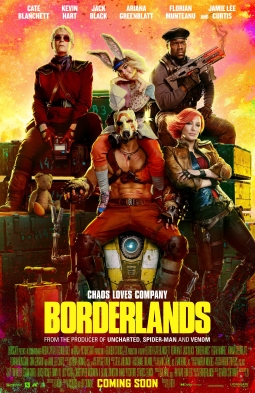
Bike-shaped object resonates with me because the formulation really works for so many other domains. For example, even though I’m not a film expert by any means, I recently encountered something I immediately recognized as a film-shaped object: Borderlands, horror director Eli Roth’s PG-rated adaptation of the ultraviolent video game.

Just like a bike-shaped object, Borderlands has all the pieces of a film but somehow fails to work as one. It’s got actors, including Cate Blanchett, Gina Gershon, and Jamie Lee Curtis. It’s got a hero’s journey, a cast of characters each with their own flaws and strengths, some character development, a bit of pathos, and of course some comic relief courtesy of Kevin Hart and Jack Black. It’s got special effects and a marketing budget and an established intellectual property tie-in.

And it’s unrelentingly, irredeemably terrible. We kept watching simply to see how much lower it could go. Perhaps it will be a cautionary tale for film school students, or a cult classic. But it is, undoubtedly, a film-shaped object rather than a real film. There’s only one reason to avoid calling it that: it’s so obviously bad that even non-experts like me can tell it’s a disaster. And if you can’t use your disdain to be exclusive and special, what’s even the point?

Outrage

I am yet again glad we stopped paying for the New York Times, as their pursuit of false equivalence leads them to try to compare “housing policies.” On the one hand, you see, is the Democratic party policy of housing construction and homeownership. They contrast that with the totally legitimate Republican party “housing policy” of militarized deportations of people with brown skin.

(Oh, sure, just undocumented immigrants, right? No note of how as many as one percent of all people in ICE custody are actually citizens? Gosh, who would ever have thought that an anti-voting policy that makes it harder to get citizenship documents might also harm citizens?)

Joy

Blame it on the dog.

There is no way you could get me to do this with a tiger, no matter how friendly.

Dead internet: Bots all the way down

A few years ago, I got a short freelance gig writing copy for an internet services company. My assignment was to write explanations of the company’s services that met the needs of two audiences. The first audience, of course, was the people who might buy the company’s services. The more important one, however, was search crawlers that would rank this company’s pages higher or lower than competing providers of identical services. My company’s unique selling proposition, in other words, was its search engine optimization, courtesy of yours truly. I think they paid me something like fifty bucks a page. I may have been the last American to do that job before it was offshored, but I’m sure that’s no longer the province of human workers. At least, not directly: whatever machine churning out replacement garbage was almost certainly trained by ingesting what I wrote, along with everything everyone else wrote everywhere.

Including, of course, AI-generated garbage. What happens when AI models train on the slop generated by other AI models? What happens when AI-generated copy is written to tickle the algorithms of AI-generated readers who then summarize it back to their human overlords?

We’re already seeing the impacts. For example, if you’re in any way attuned to pop culture, you’ll have heard a few weeks ago that someone did a spectacularly bad job in the Olympic breakdancing competition.

Perhaps, like me, you tried to look up the video of the dance to see what the big deal was. When I did, I found dozens of videos featuring the same still photo of the dancer, each with slightly different AI-generated voices repeating slightly different AI-generated summaries of public reactions to the event.

None of them provided any insight, or novelty, and none of them showed me the actual dance in question. The story was ubiquitous but also simultaneously illegible. I knew the outline and there was no depth available. It was just AI-generated slop pitched to the algorithm in the hopes of being at the top of the list, garnering a click, and getting someone to watch just enough seconds of garbage to trigger a fractional ad payout.

Meanwhile, Amazon is full of AI-written books, including mushroom foraging guides that suggest poisonous mushrooms are safe to eat, while Spotify is failing to address AI fakes overtaking actual human musicians. (Yes, we all knew it would start with synthwave and smooth jazz, but it’s sliding into real music as well).

It’s bots all the way down.

News

It’s 2024 and Drought is Optional: Cheap solar power could bring us to cheap mass desalination. One key factor: the waste brine is rich in valuable minerals.

Infiltrating the Far Right: Is this good or bad news? I’m honestly not sure. It’s interesting, anyway.

Police Are Killing More Americans than Ever: The Economist covers American policing, which remains unreformed and unrepentant.

Why I Left the Network: Pro Publica covers the misery of being a therapist subject to in-network payment programs. TLDR: One way insurance companies reduce spending on mental health treatment is making it hard to access, and one way they make it hard to access is making it hard to provide, so providers drop out.

Right on Red: Republicans in Congress are blocking traffic safety initiatives in Washington DC. Why? It’s not just that DC trends liberal and Republicans reflexively oppose its initiatives. It’s because street safety improvements often present minor inconveniences for people in cars, and Republicans in Congress regard the convenience of suburban commuters as more important than the lives of actual district residents.

Quick summaries of books endorsed by JD Vance: Dawn’s Early Light, by Heritage Foundation president Kevin Roberts, and Unhumans, by the truly vile Jack Posobiec. The upshot is he’s endorsing truly extreme proponents of right-wing political violence. (And yes, I am linking to a Times piece by Michelle Goldberg. When even the NYT Hot Take Machine thinks you’re out of bounds, you’re way out of bounds).

Joy

Double catch