Gay Marriage Legalized; Gay Divorce to Follow

Voters of Somerville! State Representative Ciampa, who voted to outlaw gay marriage, now has a challenger, Carl Sciortino. Sciortino seems to have the right ideas about housing too. I guess, at least, Ciampa is sticking to his guns… because despite what the right says about “anti-democratic judicial activism,” voting against gay marriage is voting yourself out of office in Davis Square.

Speaking of which, the Globe had a good article which I can’t seem to find online (they have a terrible website…) about the phrase “the traditional meaning of marriage” and how it’s a good example of the etymylogical fallacy. That particular error is made when one argues that the historical definition of a word necessarily has some sort of bearing on its current or future definition. That is, in my grandmother’s day, “cool” meant chilly, but that’s got no bearing on arguments about hipness or jazz. The article also notes that “wedlock,” the most common pre-Norman Anglo-Saxon word for marriage, actually means “contract proceedings” and could well be applied to any particular contract, such as land, feudal tribute, or car leasing.

On the editoral page, of course, Jeff Jacoby commits all the logical mistakes outlined above. My favorite part, however, is where Jacoby complains that the arguments of the anti-marriage right have been portrayed as bigoted.

I know it hurts to be insulted that way, Jeff, but that’s called “accurate reporting.” Nobody wants to hear it, especially not in a headline, but you really are a bigoted and ignorant bastard. I’m sure that the former Rev. Shanley could appreciate the pain of being vilified by the right-thinking world at large, but that doesn’t make it any less fair or just to portray you as a bigot than it was to portray Shanley as a sexual predator.

I wonder if Jacoby has been assigned to make flawed arguments so the Globe can claim it makes some token effort to appease its presumably crucial rich-bigot audience (the poor bigot, of course, reads the Herald), or if he actually believes what he says. Either way, I pity him. He and Nick Petreley make me think I could succeed as a journalist if only I slept with the right people– although I shudder to think of the people I’d have to sleep with. I mean, Jacoby. Ewww.

As Seen On…

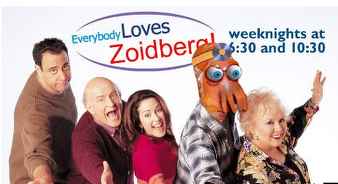
Everybody Loves Zoidberg WOULD be a really good show. I love Zoidberg anyway.

I’ve seen a few episodes of MTV’s MADE recently, and I think that, of the makeover reality shows, it’s really the best. It’s a simple concept: high school kid has some dream of personal accomplishment, and MTV shows up and helps them achieve it in 10 weeks. It’s always something difficult, and out of character, and good. A very femme young woman who wants to learn to skateboard because she’s tired of being so deliberately useless. A chorus nerd who wants to join the hip-hop dance team. An out-of-shape whiner who wants to run a triathalon.

These kids are not passively being “made over” by MTV. Instead, they’re becoming self-made, re-creating themselves in a quintessentially American narrative of self-invention, performative identity, and achievement.

Did I already say this? I can’t remember. I saw an episode in Germany and that’s when I began thinking of how the music videos on EuroMTV are local, but the shows are all bratty US kids, and how Made was especially US-centric. On the other hand, every child dreams of achievement and change. That’s what it is to grow to adulthood, really. The self-invention thing may be a very American twist, but everybody dreams of becoming somebody else.

The fight is so bitter because the stakes are so small

Every time I have to read a Nick Petreley article, I approach it with a sense of trepidation: will it have a reasoned opinion, or will it be full of bile? Well, this week it’s bile.

I wasn’t able to come up with a response, mostly because half of the article is an extended ad hominem attack on the GNOME developers, particularly Havoc and the UI team. Michael Hall, however, has a much more reasoned review in the most recent Server Watch: Enterprise Unix Roundup article. In the past, he’s provided a similarly nuanced, logical approach to the interminable desktop wars and other flammable software subjects.

I’m afraid I don’t have much else to say on the subject, aside from, well… illogical ad-hominem attacks on people who’ve never done anything bad to me and whom I have never met, and whose software is in fact a perfectly lovely alternative to what I happen to prefer. As they say in academia, the fight is so bitter because the stakes are so small.

Personal Essay: Difficult Movies, Hard Thinking, And Donnie Darko

Not too long ago, I loved difficult movies in the same way that I loved difficult novels. Not because they were obscure or hard to understand, but because they grappled with issues I thought were important: the nature of reality, love, death, pain, freedom. If it didn’t require at least a little effort on the part of the viewer or reader to engage, I didn’t think it was worth anyone’s time, and especially not my time. I mocked people who thought that movies should be popcorn fare, full of explosions and happy endings, who wanted mere entertainment. Film, I insisted, could and should be an art form. Anything less was trash, and people who enjoyed it uncritically were philistines.

More recently I’ve been avoiding movies altogether. I won’t watch the bad ones, but I won’t watch the good ones either. And not just movies: I’ve avoided novels, even full-length nonfiction, and read more magazines and blogs, especially those about abstractions, humor, economics, or design. I still disdain escapist novels and movies, but I’ve been avoiding the intellectual and emotional effort required to engage in a more serious work of art as well. After I saw “Lost in Translation” I felt hollowed out inside; although the movie was excellent, I don’t often have the emotional energy to engage with something difficult in the way that I used to.

Then, Sunday night, I finally saw Donnie Darko, and it was exactly the sort of movie I’d been avoiding: a dark and confusing portrayal of a young man slipping into paranoid delusions. The protagonist, Donnie, has no truly coherent world, only these shards of experience that he can’t quite put together. The adults around him have assembled their world-views, and stick to them: the unsympathetic teacher with her psychobabble, the father with his conservative politics… None of those world-views are entirely accurate, and Donnie’s presence often unsettles others, who are suddenly aware of the flaws in their own conceptions of themselves and their worlds.

But of course, having a consistent and comprehensible reality is a key part of being an adult. You build yourself a coherent, self-reinforcing ideology and world-view and you live in it like a shell. The sun rises every day. My political party is the better one. My nation is great, despite its flaws. I love my family. My work matters. I am not a soulless automaton.

Donnie has none of that, but he tries to build one– the problem being that he’s got to analyze every bit of reality and weigh its meaning. When two pieces fit together, it’s a sign, not a coincidence. If someone mentions that “cellar door” is a beautiful phrase, then something important will happen near a cellar door. I’ve felt that way, although not to the psychotic hallucinatory extent Donnie does: There’s a meaning in this, there’s poetry in this, there’s something here that needs to be examined. The examined life is quite tiring. Learning means, in many ways, learning what is not worth examining, and then passing it by. The poet, the artist, the philosopher, and the paranoid schizophrenic have in common that they refuse to ignore certain things, and instead find great meaning in them. It’s hard work, though.

When I was in high school, I took classes where I read Shakespeare, Aristotle, Unamuno, Garcia Marquez, and Tolstoy, and spent my days in this fog of analysis. We had a visitor one day, a former star pupil, who had graduated from college and was working in a law firm, and who said he just didn’t do much of the deep thinking and reading we were doing in our class: it was just too hard, and offered too little reward. I thought he was a fool, but I’m doing the same thing now.

That is, I’ve built myself a shell and kept out confusion and poetry because it’s too hard to deal with. I’ve been trying not to think, because it’s easier that way. And not just a little easier– look at what happens to Donnie.

As I got out of high school and really began to understand what it was to live in my head, and how I could grow up to be a functional human being instead of just stumbling around with my emotional entrails in my hands, I said to myself and to anyone who would listen: “I never want to go back to that. I never want to do that again. I will not do it.” So, I built my shell. I detached myself from experience as much as possible.

I mean, sure, nobody actually wants to feel bad. Neque porro quisquam est qui dolorem ipsum quia dolor sit amet, consectetur, adipisci velit, as the ancients said. But at what point does pain avoidance become cowardice?

It did, I think, at some point along the line. And now, here I am. Self-satisfied, twenty-seven, making fun of people with squalling, chubby brats at the next table, trying to dress like the boss. I imagine that for most people, there’s an exterior shell and there’s someone else inside. And I guess that I’ve got someone in here, somewhere, as well. But I’ve put so much into that shell, I’ve tried to become it. I’ve committed intellectual, artistic, emotional suicide. I’ve taken the easy way out.

We are the hollow men,
We are the stuffed men,
Leaning together
Headpiece filled with straw.

Oh, Oh, I Know Who We Can Blame!

Unfogged explains Limbaugh’s reasoning in blaming civil liberties and homosexuals for torture of prisoners in Iraq:

This is the elaborated Bad Apples defense– you know why they did it, those bad apples? They did it because they were allowed to look at porn. And you know what else? It’s because Clinton gayed up the military. Homoerotic. Maybe just for fun– or maybe other reasons. We know who to blame for that, don’t we? Goddamned right we know who to blame.

I can’t seem to work “It’s my party I can cry if I want to” into this

The folks over at the libertarian political rag Reason are fond of running little lists of government mistakes and overreaches, in the hope that they can illustrate their truths by example, and maybe elect some more small-government folks. Or something like that. Anyway, here are two absurd government overreaches promulgated mostly by the right.

In Britain, anyone under sixteen is now forbidden to do much of anything involving contact with others. Kissing, fondling, probably even close dancing, are technically against a new law, which is deliberately going to go unenforced. Great. Also they’ve finally gotten around to outlawing necrophilia, which I imagine was not specifically named in the past– you’d presumably be charged with some other corpse-treatment crime. OK, so it’s a silly law, but I imagine it’ll get sorted out.

More importantly, in the US, the FDA has written religious law into state policy by refusing to allow emergency contraceptives (a.k.a. “the morning-after pill,” sold under the brand name “Plan B”) to be sold over the counter, despite its medical board recommending exactly that.

What does this mean? It means that a council of doctors has determined that the drug is safe and useful, and that it should be available to people who want it, but that the FDA has bowed to political pressure from the religious right and will refuse it. Smaller government indeed.


Hullabaloo
links to a Salon article in which Joe Conason interviews Joseph Wilson (who exposed the “Yellow Cake” lie and whose wife was subsequently outed as a CIA agent, endangering her life and whatever missions she may have been on)… the gist of the article is that Wilson grew up Republican in a Republican family, and this administration is not the Republican party he grew up with.

Conason: What’s the difference in the GOP from when you were growing up?

Wilson: If you’re fiscally responsible, this is not your party. If you believe in a moderate foreign policy characterized by alliances, free trade and the ability to operate in an international environment, this is not your party. If you believe in limited federal government, this is not your party. If you believe that the government should stay out of your bedroom, this is very definitely not your party. In fact, I would argue that unless you believe in the American imperium, imposed on the world by force, or unless you believe in the literal interpretation of the Book of Revelations, this is not your party.

I imagine Reason will be backing LaRouche this year?

Sterile Gloves Have Never Been So Creepy

You’ve seen this picture by now, but note the comment halfway down the page by someone calling himself Graydon:

The grinning fellow with the thumbs up is wearing nitrile gloves.

Those are used for much the same set of purposes as latex gloves, only they’re physically much sturdier, and less likely to cause skin sensitivities in the wearer with prolonged use.

So they’re used in surgical applications to avoid the risk of sterility punctures from surgical instruments, or for a number of kinds of solvent based materials handling.

That fellow is wearing the lined, long-wearing kind; the cotton liners are flipped down over much of the glove cuff. He’s wearing them with the same degree of disregard wood finishers who wear them all day, most days, do, and with absolutely no regard for their sterility.

Anybody who wants to argue for it all being passive — for values of “passive” as would shame the devil to utter — psychological coercion is advised to think very carefully about those gloves.

Reminds me of a sad song from my childhood

Cribbed from /. but still good

Two rather good articles cribbed from Slashdot: Simson Garfinkel on robot gender, and the NYT on the living-ness of virtual pets.

Of course, when you talk about whether they’re alive, it’s a short hop to souls. Does Rover have a soul? Does Asimo or TiVo? And when someone says “what sort of relationship is it appropriate to have with an automaton?” I think immediately of the episode of Futurama where Fry dates a robot, and the rest of the crew shows him a social hygeine film explaining why dating robots is bad. Also Nat and Rony’s paper on robots and, you know, that thing people do.