Everything is Interpolated (remix feat. Shaboozey & J-Kwon)

Music

Today’s song is “A Bar Song (Tipsy)” by Shaboozey, which seems to be perfectly of its moment, for a couple of reasons aside from the fact that it’s yet another track about how binge drinking is hilarious. First, it includes an interpolation of J-Kwon’s 2004 ode to underage drinking, Tipsy. That song, in turn, samples Queen and The D.O.C, and, well, you get the idea, The Vibes are Endlessly Remixable. Second, it’s a country song by a Black artist. The moment for Black country has been building since 2018’s Old Town Road hit #19 on the country charts before being disqualified for being too, well, you know. Today, though, Shaboozey is the first Black male artist to hit #1 on the Hot Country charts. Because the prior Hot Country #1 was Beyonce’s “Texas Hold ‘Em,” this is also the first time the #1 country spot has been held by two Black artists consecutively.

Reading

Today’s book is The Saint of Bright Doors, a novel that, despite winning the 2023 Nebula, doesn’t fit neatly into any one genre. Sure, there are supernatural elements — demons described as “invisible laws and powers.” These demons are literal invisible monsters, but also the unspoken forces that bind the oppressed and protect the powerful — the inconsistent enforcement of laws; the never-ending classifications and reclassifications of class and race and caste; the unspoken and occasionally impossible expectations parents have for their children. It’s about a boy with supernatural powers, but it’s also about the Sri Lankan civil war, Theravada Buddhism, colonialism, and the formation of our consensus reality. The protagonist has been raised by his mother as an assassin to bring down his estranged father, a spiritual leader known as The Perfect and Kind. When he abandons this destiny to live on his own, he joins a support group for cast-off near-prophets, and is sucked into subversive politics and becomes a spy infiltrating a thaumaturgical research group. When riots and plague break out in the city, he’s forced once again to confront, and possibly avoid, all of his possible murderous destinies. It’s one of the very few “genre” books I’ve recommended to my mother, and it’s brilliant enough that when I finished reading it, I immediately started over and read it again.

Elsewhere

The Food that Makes You Gay: Jaya Saxena explores the intersection of homophobia and sexism and food, starting with Fox News personalities alleging that eating ice cream or soup makes a man effeminate.

The Uninsurable World: The Financial Times explores the ways the insurance industry can’t quite keep up with climate change.

The Shamans and the Chieftan: Alito, the rule of law, irrational political action and identity.

Why doesn’t Oklahoma City have a network of cooling centers for heat waves?

Hamilton Nolan covers the Texas Republican Platform.

Anil Dash: The purpose of a system is what it does.

Ruby Tandoh in the New Yorker: The Maillard Over-Reaction: Have we reached peak browning?

The Baffler takes on The Insulin Empire.

Joy

This very pretentious dog.

This dog wants to check his email for a sec.

Dog observing from inside a tent.

Imagine that you’re wrong

Last month, the New Yorker published a piece by Leslie Jamison about gaslighting, that phenomenon where an abuser manages to convince their victim they’re just imagining things. The term is ubiquitous online, to the point of diluting its meaning, but it’s still useful. It’s especially relevant now that we all suspect we’re being deceived constantly — whether it’s news media, or AI, or spam, or identity theft, or fraud, or literally any interaction whatsoever. And of course it’s a form of abuse that works directly against the key human instincts of trusting and respecting others, and considering that we might be wrong. To live in a society, we must make ourselves vulnerable to being misled, to being abused. How can we consider that we might be wrong, without letting someone else convince us that we’re wrong? How do we know what parts of reality are real, what are made up, what are merely distortions of our perception?

I’ve read two novels recently that grapple with that question in completely different ways. The first is Matt Ward’s 2006 Blindsight, a hard sci-fi tale which goes deep into the sort of truly weird philosophical questions that bedevil undergraduates late at night.

“Imagine that you’re Siri Keaton,” narrator Siri Keaton asks us. Imagine that due to neurosurgery and abuse in childhood, you have no endogenous emotions, and have had to simulate appropriate human behavior your whole life. That, alongside a ton of cybernetic augmentations, has made you an excellent analyst of human and AI behavior. It’s also destroyed all your relationships, because you can’t stop thinking of things like “love” and “sincerity” as evolutionary strategies. You, a few other heavily-augmented humans, and an AI captain are assigned to explore an alien presence in the Kuiper belt.

The aliens seem to be able to speak, but the linguist on board concludes they’re not capable of understanding; they’re a sort of Chinese room that receives and sends signals without any comprehension. Talking to them is like holding a conversation with ChatGPT: it’s confident, it sounds like meaning, but it’s meaningless.

The aliens are accompanied by ridiculously high levels of radiation and magnetic interference, which distort human perceptions. In their presence, crew members cycle through an entire Oliver Sacks book of neurological symptoms: one crew member becomes briefly convinced they’re dead; another feels the presence of God, and so on. That’s where the blindsight of the title comes in — a character is temporarily convinced they’ve gone blind, but can still guess where things are, because they’ve lost conscious awareness of their perfectly functional eyeballs and optic nerves.

After capturing a few of them, the humans determine that the aliens don’t have any sort of consciousness at all. They’re a fantastically advanced interstellar presence, but don’t waste any of their evolutionary capacity on thinking. It’s not at all like the AI captain, because our AI is conscious, isn’t it? And we are conscious as well. Of course. We’re not zombies. We have feelings and self-awareness. Sort of. Most of us, most of the time. Aren’t we?

Eventually, hostilities break out, and everyone except the narrator dies. He’s trapped in stasis in an escape pod, awakened periodically for maintenance, years from Earth, which is dying anyway. Consciousness, in other words, is an evolutionary dead end, as is humanity itself. There is no moral to the story.

Some Desperate Glory, by Emily Tesh, is much more hopeful, although still incredibly disturbing. Instead of imagining that you’re a functional sociopath, Tesh asks you to imagine that you’re one of the last humans to survive a war against an impossibly powerful alien alliance that destroyed the earth. You’ve been raised since birth to be the best cadet in your cohort, a true patriot ready to fight for humanity from a small outpost in a neglected star system. You know better than to waste recreation time on games, and you always push the squad to do their best. You revere your older brother and the outpost leader, and won’t make the mistakes of your sister, who betrayed the station and went to live as a collaborator with the aliens who control the rest of the galaxy. You’re going to be an ace pilot and a hero.

You are assigned to be a broodmare, to pump out children. Your only value to the outpost is your uterus. Your squad has always hated you because you’re such an asshole to them. Your brother is suicidal and you never noticed because you imagined he’d be happy with his high test scores. Your sister defected because the station commander groomed and raped her, and he’s got similar plans for you. The war is long over, and most humans now live perfectly well on a new planet, in alliance with the aliens. The heroic destiny you had imagined would actually be a futile attempt at genocide. You launch a long-shot effort to fix everything, and trillions die.

Tesh uses simulations and alternate universes to give the protagonist second and third chances: if Earth had been saved, she’d be a cadet in the triumphant human fleet, happy and well-nourished. But she’d still be under the command of the same abusive man, now an admiral, preparing to take control of incomprehensible power for his own ends. If Earth had still been destroyed, but she identified the abuse she’s experienced sooner, she could overthrow the commander and reunite the outpost denizens with to the rest of humanity. There’s an almost disappointing deus ex machina right at the end that saves the protagonist from having to make good on a noble sacrifice for the good of the galaxy, but overall it’s a beautifully told tale about the importance of found family and empathy, and about abuses of power.

Elsewhere

Whale on toast: Sure, we remember that we saved the whales. But did you know what whale oil was actually used for in the late 20th century? Probably not.

Staircases rule everything around me: An explanation for why American residential architecture looks the way it does, and a way to improve it with a tweak to the building code.

Joy

When I have nothing to say, my lips are sealed

Earlier this month, Hamilton Nolan came out with a truly excellent analysis of the phenomenon of overpaid, under-talented columnists. Alongside a review of my older posts, it confirmed my belief that I shouldn’t write this newsletter unless I had something I needed to say. (Hence, of course, the subject line of this message, which you surely don’t need to have explained to you.)

As he describes it, “Most columnists are mediocre. This is not their fault. Almost no one on earth is capable of having two good ideas per week. (I say this as someone who writes at least twice a week.)”

But why, he wonders, would a venue such as the New York Times have so many mediocre columnists? A Times column is, after all, probably one of the best jobs in writing, so even if most columnists are not very good, the Times could find truly excellent ones. But they do not.

I want to quote him at length here, because what he’s saying is insightful, and sharp, and hilarious:

The existence of these uninspired and uninspiring people occupying the very best jobs in their industry is evidence of the limits of the ideals that liberal society purports to value. Sure, the institutions of journalism name truth and enlightenment and justice and equality as their goals, but the unspoken qualification, “within the pool of people who went to, at least, Brown,” is every bit as important as the more noble part that is spoken louder. There is no reason for there to be even one shitty New York Times columnist. They can hire anybody they want. Anybody. The existence of shitty New York Times columnists, therefore, is an unimportant thing that reveals some important things about the myths of meritocracy. The most self-assured liberal institutions are in some ways more profoundly corrupt than some of the more raffish institutions that they look down on. I mean, the NFL is one of sickest symbols of America’s barely subdued imperial impulses, but you don’t see a guy playing nose tackle on the New York Giants because he was the owner’s kid’s college roommate at Yale. Can the New York Times say the same?

Short-form

Long-form

I’ve been reading sci-fi and fantasy by Ann Leckie, and both her sci-fi (starting with 2014 Hugo winner Ancillary Justice) and fantasy (2019’s The Raven Tower) take enormous structural risks that pay off beautifully.

Ancillary Justice features a narrator who isn’t quite human, and may or may not count as a person, or as a civilized person. The plot — interstellar machinations, political wrangling, epic quest for revenge — manages to dance along merrily as it makes us think about the nature of gender, of self, of humanity, of how a society perpetuates and defines itself, of what happens when it that definition needs to change.

The Raven Tower alternates chapters narrated in the first and second person. It’s not immediately obvious that it’s the same narrator in both cases, nor that this narrator is, in fact, a pagan god embodied in a boulder stuck in a castle subbasement. Until the very end it’s not clear that all the human characters are, in essence, pawns in its plans. How is this a setup for a good story? I don’t know, but it works.

Cute

Dog spots its dog-walker out of context.

Gang of illegally small kittens.

Good Enough to Do Bad Work

404 Media recently did a report on the use of AI-generated images as food illustrations on DoorDash and other food delivery services. InstaCart has also been making algorithmically suggested recipe suggestions with uncanny illustrations. The restaurants most likely to use fake pictures of fake food seem to be ghost kitchens — restaurants that exist only as a brand on a delivery site, operating out of the back of a different restaurant. There are more than a few in my city, like “Send Noods,” a delivery-only joint run from the kitchen of a Korean sushi place. (It sends noodles. Get it?)

Their judgement:

This is all incredibly depressing. A local pizzeria can’t get by unless it makes sandwiches for ghost kitchen brands, the people who make a living taking photographs of food are being displaced by AI tools, and gigantic food delivery apps are still making money by taking a cut from restaurants and screwing over gig delivery drivers.

It’s not good, it’s not accurate, but it’s good enough to be a vague illustration, good enough for a glance if you don’t look closely, if you’re not counting on the product you buy to match the picture on the menu. And who is? We all know food photography is fake anyway. This is just faker and cheaper, just like shitty fast fashion gets you an outfit that’s half as good for a third of the price, and it works OK as long as you don’t think too hard about the pollution, the exploitative labor practices, the millions of coal-fired GPUs churning away to produce the gray goo that passes for “content” these days.

More Bad News

In Oklahoma, where anti-trans and anti-gay rhetoric and laws have been among the most aggressively poisonous, a 10th grader named Nex Benedict has died. One day they were fine. The next day, they were beaten into unconsciousness for not dressing the right way. The day after that, they were dead. Everyone’s in full coverup mode. Coverage from Slate and The Cut has some disagreement about details, but both sources agree that the full story won’t be known for some time, if ever. What does it mean? What kinds of behavior are allowed and tolerated and encouraged at every level to produce a situation where a fifteen year old is dead after a fight in a high school bathroom? Just another pointless death that folks like Chaya Raichik claim they didn’t intend to inspire.

Meanwhile:

Good News/Bad Opinions

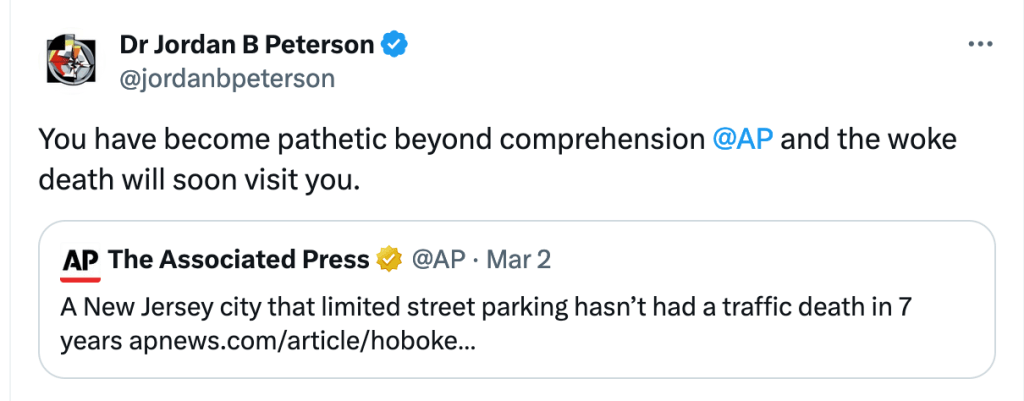
In Hoboken, New Jersey, adjustments to traffic enforcement and parking have resulted in a remarkable record: no traffic deaths on city-controlled streets in seven years. The major changes were narrowing intersections to slow traffic, and “daylighting,” or preventing cars from parking right next to a corner, which improves visibility. Noted conservative intellectual Jordan Peterson responded to AP News coverage of this milestone on Twitter with outrage:

Two Excellent Pieces of Film Criticism

An exploration of Dune Part Two, and the ways in which it both subverts and supports the Chosen Hero narrative, which it gives the rather unfortunate but not entirely inaccurate nickname magic dick theory:

In Dune, though? It’s all a con. There is no benevolent higher power.

The connection between patrilineal inheritance, male heterosexuality, and just governance is not a fact of nature; it’s a convenient fiction. The prophecy that makes the Fremen accept Paul as the savior figure… was planted in Fremen culture generations ago… It’s a plainly imperialist fiction designed to exploit an indigenous population, and it works.

A very good meditation on the 1989 film Do The Right Thing, art criticism, and the kinds of violence that make us feel safe:

I think the reaction to Do the Right Thing revealed that the burning of a white-owned pizzeria and a fight over inclusion represented violence that scared white audiences, while a persistent police presence in a Black neighborhood that might at any moment turn into the murder of a resident of that neighborhood did not represent violence that made white people feel scared. It might have even been the sort of violence that made many white people feel safe. In fact, most of the talk by mostly white pundits and audiences didn’t even seem to acknowledge the act of policing on Black neighborhoods to be violence at all.

Like I said, sometimes when people talk about art, the art starts talking about them.

Joy

The old-school comic strip Nancy has been running since the 1930s, but has had something of a resurgence since the latest artist, Olivia Jaimes, took the helm in 2018. Two recent gems: one about the transcendence of art, and pondering the eternal question “is that all there is?

Also:

Until Tomorrow

Today’s song is Ta Fardah, by PAINT, a Farsi-language tale of falling in love with the airport security agent by LA-based Pedrum Siadatian.

PAINT is just one of a perhaps-surprising number of bands revisiting the surf/garage/psychedelia vibe these days, with what may or may be greater depth than the first time around. I’m especially fond of Habibi, which mixes Farsi influences with punk and 1960s girl groups to produce catchy jams that veer from covering a fun night of dancing (I Got the Moves) to upsetting and unfulfillng sex (Siin). Another great pick is La Luz, which has a more lush and less punky sound but still carries the banner for what you might call woman-group rather than girl-group garage rock. Highly recommended.

Bad news

Big Ideas

The Ink: Future Shock. Progress is good, but how do we help people adapt to it?

Consider that we have completely changed the meaning of being a man and what you can do and not do as a man in the last 20, 30, 40 years. Thank god. But let’s be honest: We have done a better job of dismantling some of the old stories and practices and structures of masculinity that needed dismantling than we have of teaching men new ways to be men. The result is a vacuum, and certain podcast charlatans are very deft at getting in there and pied-piping men into new misogynistic visions to fill the void.

Dynomight: Taste Games. Yeah, I’ll drink Budweiser or a local craft beer but not Heineken because, wait, am I just falling into the Pierre Bourdieu trap again? Yes, we have YET MORE ruminations on Bourdieu, conspicuous consumption, beer, status, taste, travel, high-end sneakers, and the Correct Way to Pour Wine:

Something about how people talk about travel has long made me uneasy. After all, travel is expensive. No one in my circles would dream of going to a party and showing off their new Rolex. But somehow, travel is this unusual form of conspicuous consumption that isn’t subject to conspicuous consumption taboos. Why? … A deeper conspiracy theory is that Travel is popular because it allows people who aren’t socially permitted to play Fancy Cars a way to do that while pretending that they’re only playing a normal, respectable game of Glass Beads.

Joy

Song and Dance

Today’s song is Some Sunsick Day by Morgan Delt. It’s sort of an abstract nihilistic fantasy with psychedelic guitar vibes.

After the blast levels our town
We can relax and watch it come down

To go with the song, check out this Financial Times story about an emerging global gender divide in politics (alternate link for the paywalled). The upshot: on average, young men are dramatically more conservative than young women, while in prior generations there were roughly as many conservative men as conservative women. The FT has plenty of charts showing, for example, that British men under 30 are almost as opposed to immigration as their fathers, while British women the same age are more welcoming to immigrants than their mothers. Or that nearly half of young German men voted for the far-right AfD party, while only 16% of young women did.

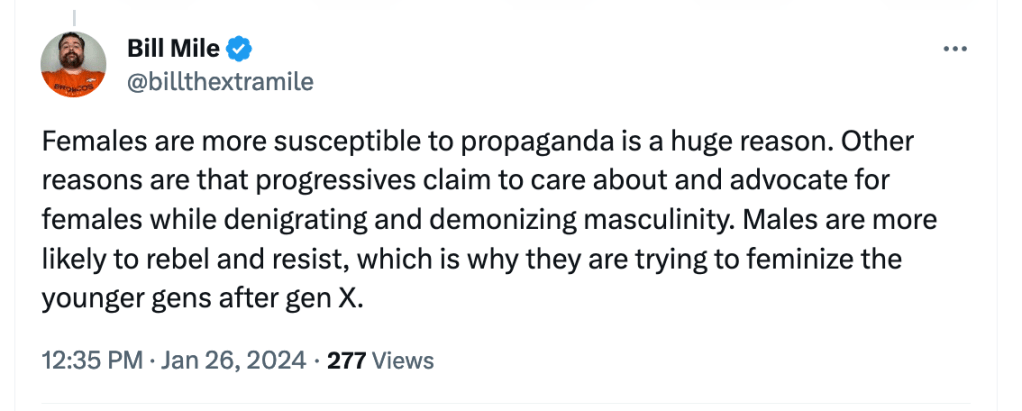
As though to underscore the point, this was the top reply to the journalist posting about his article on Twitter:

As with so much else in pop culture and trends these days, Korea appears to be in the vanguard; a major issue in the 2022 elections there was whether to dismantle the Ministry of Gender Equality and Family. Writing in The Dial, Yung In Chae & Spencer Lee-Lenfield explain the moment and its terminology:

In Korean, the term for “single” or “unmarried” is mihon. Hon means “marriage”; the prefix mi- means “not yet.” Put together, the word implies that marriage is a natural stage in any given person’s life. Over the last eight years, feminists in Korea have increasingly pushed back against this idea. One result has been the emergence of a new term: bihon, or “not married:” a single life by choice and forever.

The Atlantic went in depth on the same issue last March (no-paywall link here), emphasizing the fear and fury of the separatist “4B” movement that rejects dating, sex, children, and marriage with men:

One woman, a 4B adherent, said she jokes with her friends that the solution to South Korea’s problems is for the whole country to simply disappear. Thanos, the villain in The Avengers who eliminates half the Earth’s population with a snap of his fingers, didn’t do anything wrong, she told me. Meera Choi, the doctoral student researching gender inequality and fertility, told me she’s heard other Korean feminists make the exact same joke about Thanos. Underneath the joke, I sensed a hopelessness that bordered on nihilism.

After we start over again
We’ll start to feel safe in our skin
Maybe we’ll be wrinkled and grey

Further Reading

In Defector, The Future Of E-Commerce Is A Product Whose Name Is A Boilerplate AI-Generated Apology: an exploration of the enshittification of e-commerce, AI, lazy content generation, and more.

In Scope of Work, Tallow to Margarine, a remarkably interesting discussion of industrial fat science.

In Newsweek, I Miscarried in Texas. My Doctors Put Abortion Law First, a first-person account of the pointless torture that Texas puts women through.

Joy

She Was a Shark Smile in a Yellow Van

Today’s song is Shark Smile, by Big Thief, a tale as old as time: falling in love with the wrong person and dying in a tragic car crash.

She was a shark smile in a yellow van
She came around and I stole a glance in my youth

But who wouldn’t ride on a moonlit line?
Had her in my eye, 85 down the road of a dead end gleam

Which is a great time to remind you once again that American car deaths are rising, especially people struck by taller SUVs, which are encouraged by our ludicrously out of date CAFE standards. And muscle cars, which have too much power. And our road design standards which emphasize speed over safety. And driver behavior is worse since March 2020, just as cars continue to get bigger and deadlier and faster.

Also killing a lot of us: booze.

Policy

Georgia didn’t expand Medicaid coverage during the Obama era, but they recently implemented a new program called Georgia Pathways to Coverage, which allows more people to qualify for Medicaid. It may surprise you just how stingy the regular benefits are: to qualify for standard Medicaid in Georgia, you must be a child, severely disabled, or pregnant.

The new, more generous Pathways program allows working adults below the poverty line – that’s just over $14,000 per year for a single person — sign up for insurance. “Working” must be at least 80 hours a month, and they generously count education, training, and community service as work. Applicants must submit documentation of their work every month or risk disenrollment.

Last year, I helped with a small portion of the implementation, mostly making sure that instructions were legible at a sixth-grade reading level. At the time I thought it was corrosively bad, clearly designed to allow politicians to issue a press release saying they were helping people without having to pay for any actual care.

Rollout has gone, predictably, very badly.

Meanwhile, in Texas, abortion bans are, predictably, killing people. And the state is, predictably, tormenting those who survive.

Reading

Joy

Housekeeping

Later this month I will migrate this newsletter to a new platform and automatically import your subscription to that new platform. If you don’t want to get any more emails, let me know (or just click the unsubscribe link). I have been migrating old content off this platform and onto SecretlyIronic.com, since I only posted stubs and links to the newsletter for a few years, and I feel like it’d be a shame to lose it all, even if half of it is linkrot and anger. There’s some real bons mots in there!

Terrestrial Radio and the End of TinyLetter

Tinyletter will be shutting down at the end of February, meaning I need to either find a new platform or just go back to blogging here. I’ve been going through all 285 posts I’ve written so far, moving the full content to this site, and it’s a pain but it’s also neat to look back and reflect.

Back to your regularly unscheduled programming: I have Some Thoughts about terrestrial radio.

First, of course, we have to say “terrestrial radio” now, of course, to distinguish it from satellite and streaming services, the same way we have to say “acoustic guitar” and “postal mail” and “acoustic bicycle.” It’s almost charmingly obsolete. Who still listens to terrestrial radio? Well, “people who can’t figure out how to work Bluetooth in their cars” turns out to be a pretty big audience.

And with the persistence of terrestrial radio, we must of course have the persistence of the radio edit. Sure, we’ve come a long way since the FBI investigated whether the lyrics to Louie, Louie were obscene, but the radio edit – the one without the swears – persists. However, it makes almost no sense, because merely taking the swear words out of a song doesn’t truly render it “safe for kids.” For example, the radio version of Lil’ Nas X’s Montero changes “cocaine” to “champagne” in one place, but the line “shoot my shot on your face while I’m riding” is a little harder to finesse. The result is “put a smile on your face while (mumble mumble).” Either way, it’s a song about celebrating your identity by getting absolutely railed.

It’s inconsistent, too. Radio versions of the Akon fuck jam “Dangerous” bleep out even metaphorical swearwords like “snake” and “kitty,” but Ariana Grande’s song 34+35 (the sum is 69, get it?) leaves in phrases like “give me those babies” and “hold it open like a door for you,” as well as an entire verse celebrating the cleanliness of the singer’s butthole. Does this discrepancy have anything to do with race or gender, or is it just the result of different editors having different standards? Who’s even going to check?

Similarly:

  • Cardi B hated having to do the radio edit for Bongos because seriously, how does the phrase “eat these peaches and plums” make it any less obvious about what’s getting eaten?
  • Farruko’s stylophone-heavy club banger Pepas was inescapable on Spanish-language FM radio last summer. The clean version drops “fumando y jodiendo” from the intro and squelches the actual word “pastillas” but leaves the slang for pills (pepas) in place both in the song and in the title. The whole song is about doing molly and there’s no way to make it family-friendly, and yet here we are, singing a song about taking (….) in the club and being sure to drink plenty of water for your hangover tomorrow.
  •  “WAP,” the ode to vaginal moisture by Cardi B & Megan Thee Stallion, may one of the filthiest songs to ever reach #1 on the Billboard charts. It may also the #1 song with the least play on terrestrial radio, because both radio edits are absolutely awful. One eliminates all the filth, which is to say it has lyrics about how “my (….) make that (….) game weak.” The other replaces the title phrase with “wet and gushy,” which somehow manages to be even dirtier.
  • The original radio edit for Notorious BIG’s 1994 “Juicy” elides the n-word, of course. However, after the 2001 World Trade Center attacks they had to cut out a metaphor involving the 1994 World Trade Center bombing (“time to get paid, blow up like the World Trade”). Since the artist was dead by then, the producers just cut out the vocals for the whole verse, leaving a bar or so of inexplicably unadorned bass line.
  • Spanish-language stations might censor it, but English-language ones don’t know what to do with the Pitbull x Lil’ Jon collab “Culo.” They just… leave it all hanging out there. CULO!


Elsewhere

Joy

Erasure

It’s hard to figure out which disaster to look at — the climate-change-driven storms, the rampage shootings, the hate crimes, the war crimes, the online meltdowns of people allergic to nuance. No, I’m not linking to any of those things.

The recent Polish elections, in which young people drove a surge of turnout and pushed back a severe right-wing trend in government, give me reason for optimism. But while the right was in power, things were pretty grim, and a single electoral victory doesn’t mean permanent success. For years, national and local governments in Poland have been championing an anti-LGBT ideology — see this profile from 2020 of a woman living in what was deemed an “LGBT-free zone.”  It’s not just something that shows up in human-interest stories, either: a recent working paper identified a surge in all-cause deaths, suicide deaths, and suicide attempts among LGBT people in Poland during the anti-gay crusades.

And there’s no reason to think it couldn’t happen here. Hate crimes of all kinds are way up, and rising percentages of Americans support political violence. There is a coherent, consistent movement to erase anything that isn’t exactly perfectly straight and white. Yeah, sure, it’s hilarious that Alabama libraries just banned a children’s book because the author’s last name was “Gay.” But take a look at the incredible reporting from Judd Legum’s Popular Information: Scholastic has just added a quick and easy checkbox for schools running book fairs: should we include any diversity? Basically, if you’re a school librarian and you want to avoid any hassle, you can just pick the “all white, all straight” selection. Bio of John Lewis? Bio of Harvey Milk? Story about two penguins raising a chick? Too controversial, skip ’em all.

Legum has been a key source of information on the book-ban situation in Florida, the vanguard of the “anti-woke” movement. He was the first to report that Manatee County school librarians had been ordered to purge all books with any gay characters. Local news picked up the story, although two Hearst-owned TV stations claimed it was fake, then, when confronted with evidence, put the whole thing into the memory hole. In other words, not only is there a movement to erase and normalize queerness, there is also a concerted effort to make you think it’s not happening.

The New York Times, as usual, fumbled the ball earlier this month with their profile of two families “moving out of state because of political polarization.” On the one hand, a family leaving Iowa because their child’s medical care is now a crime. On the other, a family leaving Oregon because they didn’t like looking at homeless people and were angry about freeway tolls. Because sure, pal, there’s gotta be exactly two sides to every story, and they’re equally valid.

Better: The New Yorker’s profile of a family of American domestic refugees fleeing anti-LGBT policies.

Other Reading

New Yorker: Evan Osnos China’s Age of Malaise
Philadelphia Inquirer: Will Bunch on the right’s “Red Caesar” plan for a US dictatorship
Chicago Magazine: Profile of a woman getting $500 a month in a UBI pilot program

Bad Cop No Donut

Joy

Hot Masculine Summer

Maybe it’s the climate change, maybe it’s all the hot air surrounding our latest “crisis of masculinity” right now — the Times, the Post, the New Yorker, the Atlantic, the Economist, Politico, all have various lengthy discussions of it, and have been doing it for most of this decade so far. As much ink as they’ve wasted on it, it seems to be ramping up even more now. Men are falling behind, or at least, not doing as well as they used to, and right-wing grifters like alleged rapist and human trafficker Andrew Tate and alleged intellectual powerhouse Jordan Peterson are popping up everywhere to show men back to the glory days of strength and vigor and power.

One of the hottest of these macho scam artists right now is actually someone I met at a party maybe 20 years ago. He was fond of drunkenly challenging people to play chess without a board, something he claimed he could do because he was smart enough to remember where all the pieces were without seeing them, without the pieces even existing. Today he’s a neo-fascist philosopher with a PhD who goes by the pseudonym “Bronze Age Pervert.” He still thinks playing chess is a great test of intellect but now there’s a whole homoerotic BDSM fitness thing to go with it, real Hugo Boss for the SS vibes. It’s cheap and tacky but apparently young men just eat that shit up.

Meanwhile, other right-wing grifters are melting down over the popularity of the Barbie movie. Some of this is just an attempt to garner more hate-clicks as the Twitter ecosystem dies out.

But some of it does appear to be a genuine obsession with performing masculinity in exactly the right way. They don’t appreciate the irony of their performance being, basically, drag. They think it’s innate. Tell a dude in a lifted pickup that his $75,000 expression of masculinity isn’t all that different from a pair of high heels, and he very well might get so angry he tries to crush you with it.

None of it seems new to me, though. I mean, men have been worrying whether other men are pussies for longer than I can remember. Teddy Roosevelt’s football reforms, for example, were driven by a concern that young men needed to play violent sports to be truly manly. It probably goes back at least as far as Socrates being executed for corrupting the youth of Athens, if not further.

I sometimes recall the way my peers taught me about what it means to be a man one summer. You see, as a child, I loved bright colors. When middle school hit and it was time to go to sleepaway summer camp, I picked out a bright purple sleeping bag. I packed my favorite neon pink shirt, because neon was rad in the late 80s and early 90s. I also had a very close friend who stayed at that camp for half the time I did, and I hugged him goodbye when he left.

I got called a faggot for it, of course, for that and for everything else about the way I was — I cried at sad movies; my taekwondo lessons had never actually taught me how to fight; I talked about things I’d learned from books; I brought sci-fi novels on hikes. I don’t remember who said what exactly, but I remember it culminated in a shoving match on a narrow trail several days into a camping trip.  We’d been rock-climbing. There was a cliff.

I don’t think I even told the counselors. Tattling only made it worse, and besides, it was normal. Just typical teen boys bickering, the typical way young men learn not to be pretty or thoughtful or affectionate.

This might be a broad generalization, but it seems to me that anyone who worries about the definition or nature or behavior of masculinity, or doing it correctly, is a colossal piece of shit willing to destroy other people rather than face his own insecurity. I don’t care if you’re a sincere seeker, a pseudo-intellectual, or an edgelord fascist: once you start trying to argue about whether this kind of joyful, fluid, self-expression “counts” as “manly” you’re taking a step down the path that leads to O’Shae Sibley getting stabbed to death in a parking lot for the way he dances.

Further Reading

Joy