Related: people feel unsafe and push for police crackdowns not because of crime specifically but because of visible poverty. We could address many of these highly visible, highly upsetting problems by providing more housing, but because we regard them as criminal we do the American thing and just add guns to the mix, to predictably terrible results.
Republicans will almost certainly push for a nationwide ban next, which makes you wonder how much more polarized things can get. Ron Brownstein, writing in the Atlantic, sees two historical parallels. The more recent is Jim Crow, when the states of the old confederacy took a “defensive” approach to their anti-rights agenda, enforcing segregation in-state but not trying to codify it nationwide. The other is the “offensive” runup to the Civil War, when the states of what would become the confederacy tried to spread slavery nationwide. Brownstein is careful to note he isn’t saying we’re doomed to an actual all-out war, but offense seems inevitable. As state-level voting rights violations, a hard-right Supreme Court, and the regressive nature of the US Senate itself lead an extremist minority to national power, we’re going to see a good deal of offense and escalation.
But, of course, the Court has also insured that “getting a clear statement from Congress” to address our deepest problems is essentially impossible. The decision in Citizens United v. F.E.C., in 2010, empowered corporations to game our political system at will. That explains, in part, why Congress has not passed a real climate bill in decades. The efforts that Democratic Administrations have made to try and control greenhouse gasses have mostly used provisions of the Clean Air Act because it is the last serious law of its kind that ever came to a President’s desk (Nixon’s, in this case).
The Imperfectionist on how to give yourself a break about a challenge that seems difficult but is in fact impossible:
Here’s a surprisingly useful question to ask yourself next time you’re stumped by a problem, daunted by a challenge, or stuck in a creative rut: “What if this situation is even worse than I thought?” … Imposter syndrome? Worse than you think – because you think the issue is that you don’t yet have the qualifications to hold your own among your colleagues, when in fact the truth is that everyone is winging it, all the time, and that if you’re ever going to make your unique contribution to the world, you’re going to have to do it in a state of unreadiness.
Ali Griswold on abortion care as a corporate perk (and the hypocrisy of companies offering it):
It should go without saying that turning access to basic life-saving women’s health care into a corporate perk to attract and retain talent is the sort of perverse and dystopian outcome you’d only encounter in a country like the U.S. In addition to making people more dependent on their employers, it’s also a band-aid available to a tiny percentage of the working population and a potential privacy nightmare.
In public services, as in so much of life, you get what you pay for, which drives the gaping inequality among cities. Decades into a process of fiscal decline, a local government will have no more loans to take, taxes to raise, services to privatize, or assets worth selling. As the city reduces or eliminates staff, local government seems less competent and more irritating. Infrastructure and public space decays. “It’s death by a thousand cuts,” says Reverend Joan Ross of Detroit, referring to the city’s collapse in services. “It takes you a long time to bleed to death. But you do.”
Peter Hessler is one of my favorite writers on just about any subject, and this month he has a story about how he lost his job teaching English in China. Nobody is exactly sure what the real rules are, and everyone denies having said anything when contacted by fact-checkers, but Hessler clearly became slightly too controversial for administrative comfort after one of his comments on a student’s essay was misquoted and went viral on Weibo.
What fascinated me was how the students navigated the Kafkaesque political landscape of nebulous rules with inconsistent enforcement. They all had to use illegal VPNs to do better research for term papers. They all know the cruelty and capriciousness with which success can be granted or taken away, no matter how hard they work. But the system, cruel and capricious and corrupt as it is, still seems too immense to change, and grants them enough rewards that it seems worthwhile. So, they live with it, even though most aren’t strongly nationalistic and don’t believe the propaganda. The idiom that keeps coming up is that one should not yinyefeishi, or give up eating for fear of choking. As long as living standards continue to rise generation to generation, the failures of the current system are acceptable, and radical change isn’t necessary or desirable to most people.
The article doesn’t guess at what might happen if the system fails to deliver, if a gerontocracy refuses to relinquish its hold on power, if standards of living and life expectancy start to drop for the next generation. Perhaps the US will find out before China.
On phalloplasty: “It is easy to stand up for some vague and glittery right to gender self-determination; fighting for the penis is like rooting for the Yankees.”
New music from Africa, “immensely popular on the unofficial mp3/cellphone network from Abidjan to Bamako to Algiers, [with] limited or no commercial release.”
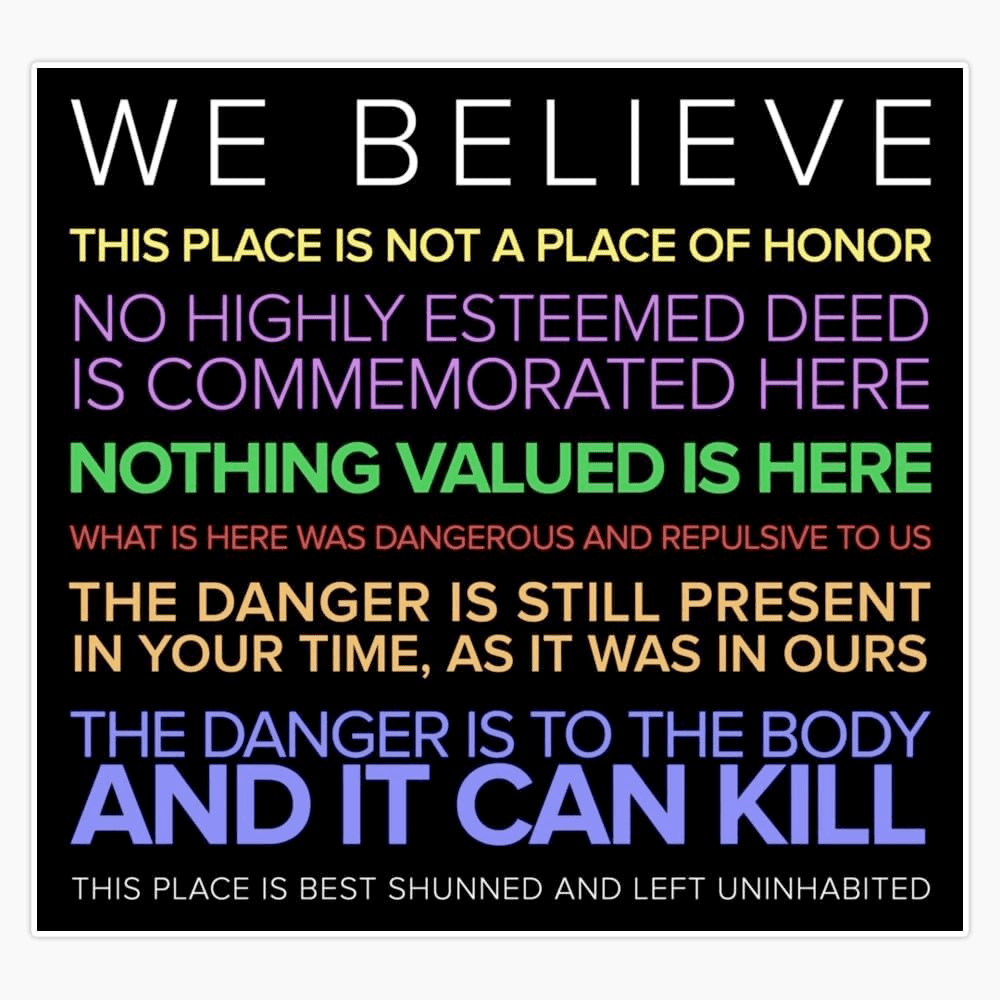
In the 1980s, researchers and semioticians began to try to imagine a way to label nuclear waste that would be legible for the thousands of years it would be dangerous. By the 1990s they had come up with a series of symbols, increasingly complex messages, and easy to translate phrases that could be used to at least make an attempt to communicate a danger to a far-future archaeologist.
One key segment begins like this:
“This place is not a place of honor. No highly esteemed deed is commemorated here. Nothing valued is here. What is here was dangerous and repulsive to us.“
So, good luck to future archaeologists trying to sort out which of our warnings are ironic and which are accompanied by dangerous levels of ionizing radiation. The texts we leave behind will probably make about as much sense as that ancient Sumerian “dog walks into a bar” tablet.
Can’t talk (there’s no signal inside) but I think I just found a place of honor! I bet all kinds of highly esteemed deeds are commemorated here — capsandnumbers (@Capsandnumbers) March 23, 2022
No Highly Esteemed Deeds
The Nation covers a class realignment focused on asset ownership rather than income or relation to the means of production, and specifically real estate asset ownership. One thing they note which I had not known is that homelessness as we know it today really only took off in the 1970s:
Although poor Americans have always resided in substandard housing, street homelessness only became a large-scale urban phenomenon in the late 1970s. A relatively early study of the homelessness crisis, Peter Rossi’s Down and Out in America, distinguishes between “old” homelessness and contemporary “literal homelessness” by noting that in the decades prior to the rise of mass homelessness, “the homeless by and large were familyless persons living in very inexpensive (and often inadequate) housing, mainly cubicle and SRO [single-room-occupancy] hotels.” By 1979, Rossi wrote, “It became more and more difficult to ignore the evidence that some people had no shelter and lived on the streets.”
Not A Place of Honor
This New Yorker article about the Margaritaville Retirement Communities is absolutely worth your time. The proponents note that it’s “like being in college,” in that there’s a lot of people like you (white, financially comfortable, apolitical) and you can get pretty much anywhere you need to go on foot or by golf cart. It actually does sound fun. But it also sounds like a nightmare?
Mainstream Democrats have responded by blaming the gays for being too strident and trying to pivot to the center, as though letting the Child Tax Credit expire and plunging millions of children back into poverty would be a good way to mollify Q-anon cultists who believe Democrats are all satanic child molesters.
Ever notice how a lot of new trucks & SUVs have those sort of weird upturned snouts and big, angry looking faces? That’s not a coincidence.
The upturned snouts are a regulatory trick to make them qualify as off-road or heavy-duty vehicles so they have lower fuel economy and safety requirements. It’s the same phenomenon as putting seats into the back of the Subaru Brat was designed to get around a tax on light trucks known, for complex reasons, as the Chicken Tax.
The angry face is mostly aesthetic, an appeal to buyers who want a truck to look tough. Both design trends result in higher bumpers, greater mass, and reduced forward visibility, and those in turn lead to excess deaths, just like the Subaru Brat killed or maimed more than a few of its fun-loving truck-bed passengers.
Whether you bought a Sierra… or a Ram or a Silverado or a Jeep Gladiator or any other megatruck or monster SUV, you’re making an announcement to the world. It’s not the announcement you think it is, though. It’s not about your wealth or your toughness or your masculinity. No, you’ve announced, very clearly, that you don’t care if you accidentally kill a stranger. You’re saying: “I’m totally cool with someone else dying because of a decision I made.”
That’s not theoretical. The NHTSA just released their 2020 stats, and despite decreased vehicle miles traveled (VMT) due to the pandemic, 38,824 people died in traffic, the most since ’07.
Of course, I also just responded to a recent survey about cycling by saying that the main reason I don’t ride my bike is that I have nowhere to go.
Back in the 70s and 80s, right-wingers used to say that environmentalists were like watermelons: Green on the outside, Red on the inside. With the arrival of undeniable climate change impacts, argues a new thinktank policy paper, we’re about to see some avocados: green on the outside, Brownshirt on the inside. It sounds kind of surprising until you recall that in the early 2000s the Sierra Club was nearly taken over by anti-immigrant groups who argued that America had limited resources and should reserve them for native-born whites.
I first heard the phrase “marketers ruin everything” from marketing guru Gary Vaynerchuk, who has since gone on to monetize his brand so hard he’s become just another toxic hustle bro with a podcast. But it’s not really a new insight. Marketing is, after all, how capital appropriates culture. 1940s ads were full of highbrow allusions to the classics because that was where the prestige was at the time. Clumsy appropriation of counterculture and subculture gave us everything from those appalling ads for St. Ides Malt Liquor to the simply embarrassing flop of OK Cola. Less clumsy appropriation slides in unnoticed until J. Balvin is recommending que hagas un beer run antes de la fiesta porque New Year’s Eve es Miller Time. (Balvin himself of course has his own, even more questionable appropriations to answer for).
The confrontational Twitter personas of Steak-Umms and Wendy’s were just the tip of the spear for the market’s advance on internet-meme culture (coincidentally, @Steak-Umm now has a new ad agency notable for letting you have conversations with Moon Pies via your Alexa. Visit Garbage Day for more dirt on that and other aspects of our social media nightmare). Moving beyond those out-of-character brand accounts, Shake Shack and DoorDash are collaborating on a limited-time Valentine’s Day dating app called Eat Cute. There will be prizes! There will be brand synergy! There will be collection of ENORMOUS amounts of personal data about connections, preferences, locations, and spending habits that can be used to maximize sales and also turned into its own monetized stream of ads and database sales to other precision marketers. (Of course, it’s not just dating, those prayer apps are also selling the data of the devout).
Anyway, as the Mekons say, just like prayer and art and personally identifying information, sex is just a commodity to be bought and sold like rock ‘n roll. (“And when I danced and saw you dance, I saw a world where the dead are worshiped – This world belongs to them now they can keep it!)
Mekons aside, today’s song is Australia, by The Shins. It’s a cheerful tune about dread, ennui, and giving up on your dreams, illustrated by a comedic heist in which a semi-competent crew steals decorative balloons from a car dealership.
Happy Friday!
Your nightmares only need a year or two to unfold
The LA railyard complaining about rampant thefts had previously fired significant portions of its security team. Same as previous screaming about retail theft, it mostly looks like a corporation trying to duck the expense of guarding private property.
A 2018 longread from The Baffler discusses paleoconservativism, David Duke, Pat Buchanan, and how the right-wing revolt of 1992 is still hanging over us today.
Click here, then click the headline “How Miami Became the Most Important City in America” to get around the Financial Times paywall and read a top contender for this year’s hotly contested “most scathing thing written about Florida” award.
So many of America’s problems can be attributed to our twin obsessions with cars and guns, but nothing underscores it quite as thoroughly as recent news about John Kuczwanski, a former chief of staff for a GOP state senator and Florida government official. Five years after being arrested for brandishing a handgun during a road rage incident outside of a Tallahassee Circle K, he got into another fight at the same intersection. This time, after ramming his BMW into a Prius, he pulled his gun and fired. He missed. The other driver, also armed, did not.
Of course America, and in particular the Florida GOP, will not learn from this. We build our environment for cars, and cut funding for transit because it’s for people of color, so we get too many cars. We forgive drivers for outrageous behavior and so cultivate road rage. And of course, we let just about anyone have a handgun even when they’ve demonstrated clearly that they should not. If not for the pathological policies Kuczwanski and his employers advocated and enacted, he might be alive today.
Recommended Reading/Listening
In Wired: A Grand Theory of Buying Stuff A telling anecdote about how we buy things, and buy things for our things, and suddenly we have too many things and we haven’t achieved what we originally set out to do. In the case of author’s anecdote, the extra things are a digital drum pad and all the accessories. “The upshot of all this is that I have absolutely no musical talent… I am not a musician. I am a systems administrator for my digital audio workstation. There will be no SoundCloud for me.” But dialing back the accessories, and listening more carefully, he begins to gain a greater appreciation for drummers and producers, and an understanding of how music is made and heard. Song pairing:Tonight I’m Gonna Give the Drummer Some, by Amy Rigby. (“He’s cute, if a middle-aged man can be described as cute…”)
On Substack: America’s Top Environmental Groups Have Lost the Plot on Climate Change Bloomberg’s Noah Smith brings in a guest to cover the reasons groups like the Sierra Club, Extinction Rebellion and the Sunrise Movement are opposing things like efforts to bring green electricity to cities and efficient mass transit. “Conservation is a conservative impulse, but right now, the climate threat calls for sweeping changes to our physical environment. Our best shot at mitigating the impact of climate change is to electrify every process in our economy as quickly as possible.” Song Pairing: A punk cover of Little Boxes, because the genre and the song were once critiques of conformity and are now wielded in opposition to everything new and different.
Good news everyone, the following post has been reviewed by Twitter operations and does not violate the terms of service, so we know that free speech and a robust discourse is alive and well in America:
Other bastions of free speech include Penn Law professor Amy Wax, the Robert Mundheim Professor of Law at the University of Pennsylvania Law School, back in the news again for doubling down on her ongoing advocacy for a whiter, more gentile America. The New Yorker profiled her back in 2019, after she was quoted saying that Black or Latino law students are always below average; she’s recently expanded to insult Asians as well.
Not to say that internet pile-ons are good, but there are some things that should be outside the bounds of polite society. I don’t think this is particularly controversial, but here we are.
At least we’ve started cracking down on prosecutorial misconduct. I mean, sure, it just took a murder, a viral video of said murder, and a national outcry to get justice, but that’s cool. We’ve got a total panopticon and lots of time on our hands, so we just have to watch endless murder videos and start letter writing campaigns every time we want justice for anything. Besides, everyone enjoys watching murder videos.
To understand the current fight over housing in Atlanta, you have to go back almost 100 years. Before 1929, Atlanta was divided into two residential zones: “R-1 white district” and “R-2 colored district.” After a U.S. Supreme Court ruling prohibited such explicit segregation, “R-1” became a “dwelling house” zone and “R-2” became an “apartment house” district. To this day, much of Atlanta is still organized this way, leading to a lack of affordable housing — and housing in general — as the city expands.
Meanwhile, in crime: A man stealing a couple hundred bucks worth of stuff from Walgreens gets widespread news coverage, and the thief lands in jail. But Walgreens itself recently admitted to stealing more than $4.5 million from its employees. Nobody will go to jail, although the company will be required to pay back some of the stolen money. (Also worth reading: Darrell Owens’ take on the Bay Area crimewave, which addresses whataboutism and root causes and economic precarity).
Actual good news: bike lanes draw angry comments and complaints, but once in place, they’re popular and successful at increasing safety and decreasing pollution.
This isn’t by accident. The political environment we inhabit has been systematically and relentlessly prepared for violence as an option, creating a base prepared for eventual bloodshed or overthrow by force, but also necessitating that meaningless and principle-less politicians like Gosar embrace ever-increasingly dangerous rhetoric as a means of gesturing to that radicalized base.
But it’s not confined to the right. These sorts of nasty jokes are plenty common on the left:
I would pay a reasonable amount of money to watch a 10-week series where 12 contestants take turns beating the living shit out of JD Vance in a tent while the original GBBO hosts announce how much time they have left and make quips, if netflix is listening. — Mass for Shut-ins (Podcast) (@edburmila) November 10, 2021
A trolley problem is usually just a thought experiment, but in this case it happens to be a remarkably robust analogy with regard to Manchin and the doomsday blanket situation. On one track we have the millions of people living and bound to be born in coastal areas who will find their homes and lives literally underwater in 20 years, plus the various social and political implications of displacing them at roughly the same moment we radically diminish nature’s capacity to support life. And on the other track we have Joe Manchin. The normal person who feels some obligation to the future and comes face-to-face with this seemingly total failure of our usual systems must ask him-/her-/themself: Would it help if I killed somebody?
The author immediately clarifies that this is a thought experiment, please don’t literally kill a senator. But it’s not a great rhetorical trend, and who knows how close it brings us to “will no one rid me of this turbulent priest” territory – especially given the remarkably strong power of of parasocial influencer relationships.
Extended Metaphors
I’ve been watching my motorsports and I’ve been reading my political theory, and I can’t stop noticing how success feeds on success, how each team or person or family wants to keep the best for themselves, how an external rule-making body has to step in to level the playing field or it’s a pointless experience for everyone. In MotoGP, there was a period when Michelin would make special tires the Saturday before each race and ship them overnight to their top sponsored riders, giving them a key advantage of tires tuned perfectly for their riding style and the day’s predicted track conditions. This was wildly expensive for Michelin and a major setback for everyone who didn’t get their special tires. It made the sport worse to participate in and worse to watch, and that’s why the sport changed the rules to put everyone on the same tires. Today, the field is somewhat more even, although competition + money continues to produce weird expensive advantages for some teams (don’t ask me how ride-height and launch control systems work, but apparently they were very expensive to develop, and lack of them was a key reason Suzuki had such a terrible season this year).
But wouldn’t you want the very best, if you could make it happen? If you knew the super-rich were buying university admission with seven-figure donations, wouldn’t you be tempted to spend hundreds of thousands bribing a coach? Or tens of thousands for actual sports and international volunteering and tutors and coaches? Maybe a bigger mortgage to move to a better-ranked school district? Or if you don’t have the money to buy your way into a good elementary school, what about enrolling your child in the better school district a relative lives in, even if you don’t live there?
(Illegal underground tutoring rings. Illicit math smugglers. A rough crowd, you know. Maybe the spice of the forbidden will make homework more appealing?)
Meanwhile
I had a much-delayed annual physical recently, and the NP asked me if I was in therapy. I said no, are there any therapists available? She laughed and said of course not, have you considered an app instead?