Good news everyone, the following post has been reviewed by Twitter operations and does not violate the terms of service, so we know that free speech and a robust discourse is alive and well in America:
Other bastions of free speech include Penn Law professor Amy Wax, the Robert Mundheim Professor of Law at the University of Pennsylvania Law School, back in the news again for doubling down on her ongoing advocacy for a whiter, more gentile America. The New Yorker profiled her back in 2019, after she was quoted saying that Black or Latino law students are always below average; she’s recently expanded to insult Asians as well.
Not to say that internet pile-ons are good, but there are some things that should be outside the bounds of polite society. I don’t think this is particularly controversial, but here we are.
At least we’ve started cracking down on prosecutorial misconduct. I mean, sure, it just took a murder, a viral video of said murder, and a national outcry to get justice, but that’s cool. We’ve got a total panopticon and lots of time on our hands, so we just have to watch endless murder videos and start letter writing campaigns every time we want justice for anything. Besides, everyone enjoys watching murder videos.
To understand the current fight over housing in Atlanta, you have to go back almost 100 years. Before 1929, Atlanta was divided into two residential zones: “R-1 white district” and “R-2 colored district.” After a U.S. Supreme Court ruling prohibited such explicit segregation, “R-1” became a “dwelling house” zone and “R-2” became an “apartment house” district. To this day, much of Atlanta is still organized this way, leading to a lack of affordable housing — and housing in general — as the city expands.
Meanwhile, in crime: A man stealing a couple hundred bucks worth of stuff from Walgreens gets widespread news coverage, and the thief lands in jail. But Walgreens itself recently admitted to stealing more than $4.5 million from its employees. Nobody will go to jail, although the company will be required to pay back some of the stolen money. (Also worth reading: Darrell Owens’ take on the Bay Area crimewave, which addresses whataboutism and root causes and economic precarity).
Actual good news: bike lanes draw angry comments and complaints, but once in place, they’re popular and successful at increasing safety and decreasing pollution.
This isn’t by accident. The political environment we inhabit has been systematically and relentlessly prepared for violence as an option, creating a base prepared for eventual bloodshed or overthrow by force, but also necessitating that meaningless and principle-less politicians like Gosar embrace ever-increasingly dangerous rhetoric as a means of gesturing to that radicalized base.
But it’s not confined to the right. These sorts of nasty jokes are plenty common on the left:
I would pay a reasonable amount of money to watch a 10-week series where 12 contestants take turns beating the living shit out of JD Vance in a tent while the original GBBO hosts announce how much time they have left and make quips, if netflix is listening. — Mass for Shut-ins (Podcast) (@edburmila) November 10, 2021
A trolley problem is usually just a thought experiment, but in this case it happens to be a remarkably robust analogy with regard to Manchin and the doomsday blanket situation. On one track we have the millions of people living and bound to be born in coastal areas who will find their homes and lives literally underwater in 20 years, plus the various social and political implications of displacing them at roughly the same moment we radically diminish nature’s capacity to support life. And on the other track we have Joe Manchin. The normal person who feels some obligation to the future and comes face-to-face with this seemingly total failure of our usual systems must ask him-/her-/themself: Would it help if I killed somebody?
The author immediately clarifies that this is a thought experiment, please don’t literally kill a senator. But it’s not a great rhetorical trend, and who knows how close it brings us to “will no one rid me of this turbulent priest” territory – especially given the remarkably strong power of of parasocial influencer relationships.
Extended Metaphors
I’ve been watching my motorsports and I’ve been reading my political theory, and I can’t stop noticing how success feeds on success, how each team or person or family wants to keep the best for themselves, how an external rule-making body has to step in to level the playing field or it’s a pointless experience for everyone. In MotoGP, there was a period when Michelin would make special tires the Saturday before each race and ship them overnight to their top sponsored riders, giving them a key advantage of tires tuned perfectly for their riding style and the day’s predicted track conditions. This was wildly expensive for Michelin and a major setback for everyone who didn’t get their special tires. It made the sport worse to participate in and worse to watch, and that’s why the sport changed the rules to put everyone on the same tires. Today, the field is somewhat more even, although competition + money continues to produce weird expensive advantages for some teams (don’t ask me how ride-height and launch control systems work, but apparently they were very expensive to develop, and lack of them was a key reason Suzuki had such a terrible season this year).
But wouldn’t you want the very best, if you could make it happen? If you knew the super-rich were buying university admission with seven-figure donations, wouldn’t you be tempted to spend hundreds of thousands bribing a coach? Or tens of thousands for actual sports and international volunteering and tutors and coaches? Maybe a bigger mortgage to move to a better-ranked school district? Or if you don’t have the money to buy your way into a good elementary school, what about enrolling your child in the better school district a relative lives in, even if you don’t live there?
(Illegal underground tutoring rings. Illicit math smugglers. A rough crowd, you know. Maybe the spice of the forbidden will make homework more appealing?)
Meanwhile
I had a much-delayed annual physical recently, and the NP asked me if I was in therapy. I said no, are there any therapists available? She laughed and said of course not, have you considered an app instead?
Evicted, by Matthew Desmond. Engaging, readable, and heartbreaking profile of families on the edge and the landlords who exploit them. I don’t usually cry at nonfiction.
High-Risers: Cabrini Green and the Fate of American Public Housing, by Ben Austen. Similarly engaging history of public housing in Chicago. Profiles people who lived there, people who administered the program, and the reasons it all fell apart. I’m only about halfway through this one.
Race for Profit, by Keeanga-Yamahtta Taylor. Scholarly analysis of the failures of housing policy post-redlining. Studiously, almost stolidly analytical and yet still leaves me simmering with rage. Also only about halfway done with this.
A Psalm for the Wild-Built, by Becky Chambers. A short, sweet novella about what it means to find purpose, and what it means to be a person.
Articles
The Squamish nation has reclaimed ten acres of downtown Vancouver that were stolen from them in the early 20th century. As a tribal nation they’re exempt from municipal zoning laws, which means they can build six thousand new homes in an incredible sort of indigenous-art-informed solarpunk style. Their official project site is here and it’s beautiful.
The Guardian on American households without plumbing: “…a studio apartment without a working bathroom in San Francisco’s Mission District… The sink spewed yellow colored water, and the toilet wasn’t properly connected to the building’s plumbing system… rent was $2,300 a month.”
Climate refugees in Chico, California: “About a quarter of Chico’s unsheltered residents lost their homes in the 2018 Camp Fire which burned the neighboring town of Paradise to the ground… Chico’s war on the unhoused may be providing a grim glimpse into an eco-authoritarian future, in which the poor victims of climate change-fueled disasters are treated like human refuse by those whose wealth has protected them, at least in the short term, from the worst impacts of planetary warming.”
This headline alone: “New Florida Surgeon General Appeared at Demon-Sperm COVID Conspiracy Summit With Future Capitol Rioter.”
When Dasani Left Home: An update to a 2013 profile of a homeless child from the New York Times Magazine. This story made me very uncomfortable and I’m not sure how to address that aside to sit with it for a while. It’s borderline poverty porn.
Charlie Warzel on “all this rage.”: “The main question occupying my mind is: Where does all that rage go? Eventually, the pandemic will subside. Health care workers will have a slight reprieve from this hell. But the immense grief and PTSD will stick around. I imagine the anger and resentment will, too. What happens then?”
Will Wilkinson on Beverley Hills: “An amazing case study in NIMBY entitlement that merits our close attention and withering scorn.”
Voudou Economics: How did 30,000 Haitians get to Texas? (Well, first they went to Brazil to build stadiums for the Olympics & World Cup…)
Has it been a whole month? It’s been a whole month.
Here are some good things to read:
From The Verge: An absolutely incredible account of New York City delivery workers uniting to defend themselves from theft and violence in the face of absolute indifference from police and city government.
From Substack: A letter from a photographer and military veteran who took portraits of other veterans on a retreat that used psychedelic therapy to treat PTSD.
From the New Yorker: The always-informative Atul Gawande on Costa Rica’s public health success. My econ 101 class taught me that GDP and lifespan are generally correlated, but the US and Costa Rica are the counter-examples. US lifespan is down despite all our wealth because we have such enormous inequality and such terrible public health systems. Costa Rican lifespan is up despite being a middle-income country because it has less inequality and excellent public health systems.
From Stereogum: Revisiting the 20th anniversary of Prefuse 73’s debut album Vocal Studies & Uprock Narratives. I picked up a copy at Other Music back when it came out (record stores were a thing, I’d never have found it without the clerk recommending it), and loved it. I’ve been listening to it all week on repeat and it’s still incredible.
Twitter
I have taken the medicine that was in the stables
and which you were probably saving for your horses
“Snowclones” are a templates for cliché, and therefore discouraged by, for example, official journalism style guides. I love them. My current favorite, “the existence of X implies the existence of Y,” has been spinning around as a series of Twitter jokes for quite some time now:
The existence of an oubliette implies the existence of a larger, scarier oobly.
The existence of biscuits and Triscuits implies the existence of the elusive moniscuit.
The existence of casual sex implies the existence of ranked competitive sex.
People who write paid newsletters or newsletters with a big audience take on an obligation to send them out regularly. Since I’ve only got a couple dozen folks and I’m not trying to make money on this, I have the luxury of making it sporadic. I don’t have anything specific today, but I’ve found a number of quite interesting pieces I thought you might like.
Long(ish) Reads
At the NY Times:The Subversive Joy of Lil Nas X’s Gay Pop Stardom. Read this even, or especially if you’re not a hip-hop/pop/R&B fan. He’s just twenty-two and he is killing it. Obviously when you see a young person thrust into stardom, you worry for them, but right now, in this shining moment, Lil Nas X is a ray of goddamn sunshine, especially for young gay Black people, and they could really use some goddamn sunshine. His new single, Industry Baby, is out now, and he’s using the platform to raise money for bail funds.
At GQ: Jason Sudeikis is Having a Hell of a Year. If you’ve seen and enjoyed Ted Lasso, then definitely read this. But even if you haven’t, it’s a really well-written piece. It profiles the actor, of course, but it also offers interesting thoughts about fame, the intersection of art and real life (both the protagonist and the actor have remarkably similar recent relationship trajectories), and more.
At Mainer: Proud Boys in Maine Meeting At Portland Dive Bar. Starts off as a completely normal “bartender refuses to serve Nazis” story, but it becomes a WILD ride. If you want a glimpse behind the regular story and a look at some very Maine characters, this is your tale.
These days, motorcycle racing is almost surprisingly safe, especially at the elite levels. Safer, certainly, than riding on the street, since there are no distracted drivers in SUVs. Super-tough leathers contain in-suit airbags and anti-whiplash devices, and the carefully designed tracks include generous runoff areas to allow downed riders to come to a stop safely. Last year in the 2020 Austrian Grand Prix, Spanish MotoGP rider Maverick Viñales found that his brakes had totally failed on the main straight, hopped off the back of the bike at 140 mph, then just walked away annoyed.
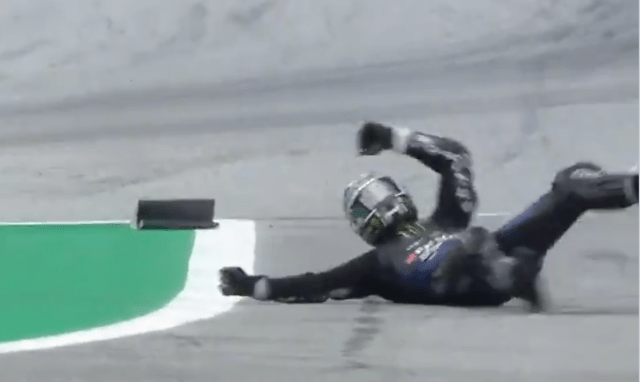
Another factor in improved rider safety is that designers have aimed to create safer crashes. You see, there are two main ways to wipe out on a motorcycle: low-side and high-side. In a low-side crash, a rider leans too far into a turn, the front wheel slides out, and the rider winds up on the ground beside the bike. When that happens, rider and bike slide straight away from the curve into one of those carefully designed runoff areas, removing themselves from traffic with just a few bruises. In a high-side crash, the rear tire comes loose, usually under power, and then regains traction with a different vector, twisting the bike and throwing the rider into the air. That’s obviously a heavier impact, but it’s also less likely to fall away from the racing line. Bikes in the early 1990s were notoriously prone to high-sides — a documentary about that era is called “The Unrideables” — but today, electronic traction control and advanced tire chemistry make those crashes relatively rare.
And of course, when injuries do happen, emergency medical care is far better than it was even ten years ago. MotoGP rider Jorge Martín had a horrific incident in Portugal just a few weeks ago, was rushed into surgery, and is expected to return to racing, possibly as soon as this season.
Still, there is the ever-present risk of death.
On May 29th, in a practice session for the Grand Prix d’Italia at Mugello, Swiss rider Jason Dupasquier fell in an apparent high-side crash, landed on the racing line and was immediately struck by the rider behind him. He died the next morning. He was nineteen, and had been competing in the Moto3 class, the rough equivalent of double-A minor league baseball – a professional athlete at the beginning of his career.
I’ve been worrying about this all week because I pay for a MotoGP VideoPass subscription, which means I’m a small part of the torrent of cash that sustains the sport that killed him. And it was always going to kill someone. The funds that pay for safer tires and tracks and emergency on-demand helicopter travel to top-tier hospitals also pay to put those kids in a pack, jostling for the best aerodynamic position, testing their skills, and sometimes losing badly.
And I don’t know how to square that. I quit watching the NFL because I was sick of how crooked and dangerous football was, but I never had a NFL League Pass subscription or even a cable bill that paid for it. If it was on TV I’d watch it, but at some point I no longer enjoyed it because I was watching people destroy themselves for my entertainment.
But here I am paying good money to watch a sport that’s, on balance, probably worse than football, because it’s not just dangerous for the competitors, but is a petroleum-driven climate nightmare (the all-electric MotoE class notwithstanding). And there’s the fact that new track being built in Indonesia also comes with a generous helping of alleged human rights violations. And the sponsors are pretty shady too, even without the once-omnipresent cigarette companies and their totally-not-a-tobacco-company subsidiaries.
If you’re running a team backed by Saudi Aramco and Mohammed Bin Salman, it’s probably time to take a good look at your soul. And if I’m paying ten bucks a race to watch it, then it’s probably time to take a good look at mine.
This March marked the 30th anniversary of the Rodney King beating, an early incident of citizen video capture of police brutality. It does not seem that thirty years of reform, protests, civilian oversight, blue-ribbon commissions, or consent decrees have changed a goddamn thing. Instead, we’ve got cops flying a cop flag over the American flag because they’re loyal to the badge over citizenry.
The Cincinnati police pulled down the American flag at the justice center and replaced it with the thin blue line. Infuriating. Picture from a friend. pic.twitter.com/1bM0ovH0T6
Clearly, if we are to have laws we need some form of law enforcement. But whatever policing is in the United States, it is not law enforcement. It resembles more the standing army that the framers of the constitution warned against, the Redcoats holding their line just before the Boston Massacre.
Some members of the founding generation expressed fears that a standing army would pose a threat to liberty. Police forces as we know them did not exist. Of course, slave patrols policed Blacks in the South. Courts have made us accept a lot in the name of law enforcement. https://t.co/zlMuUMazZ0
Surely, not every cop is implicated in this system? Perhaps we should listen to what they say when they think nobody else is listening. For example, a recent data leak from a right-wing crowdfunding site tell us that numerous donations in support of right-wing vigilante shooter Kyle Rittenhouse came from police officers, including an internal affairs executive in Norfolk, VA who sent the following note with his donation: “You’ve done nothing wrong. Every rank and file police officer supports you. Don’t be discouraged by actions of the political class of law enforcement leadership.”
When someone tells you who they are, believe them. How do you reform an institution that killed someone in this country almost every single daylast year? How do you reform a system that produces multiple separate stories about elderly women brutalized by police while picking flowers?
The media always focuses on when police kill. But there are plenty of days when we don’t. For example in 2020 there were 18 days when police officers didn’t kill anyone at all.
Los Angeles Police Department Parody (@LAPDParody) April 12, 2021
This is not just about training. This isn’t about a few bad apples. It is that law enforcement, with its long history, from knights in armor chopping down serfs and disrupting peasant rebellions, to armored police units in the heartland of America rolling through streets in tanks with 21st century technology meant to suppress the people, has a fundamental problem: the belief that these forces are intended to make war with their own people in order to protect property, wealth, and power.
The problem is the very concept of the thin blue line.
So, by all means, yes, support law enforcement. But end American policing.
We’re experiencing high call volume for people applying for Funeral Assistance. We’ve contracted support to provide us with 5,000 agents to help with the huge volume of calls. There’s no deadline to apply at this time. https://t.co/pIFqSEpRAehttps://t.co/YgM3JVSzTq