Is it actually worse?

Declinism is a generalized tendency to believe that things are getting worse over time.

For example, in July 2023, The Atlantic published a short piece about how America’s obsession with long hours is destroying churchgoing, which frays interpersonal ties, which disrupts communities, which, give-a-mouse-a-cookie style, will probably destroy America or something. But we’ve heard that song before (remember Bowling Alone?) We’ve been hearing it since 1929 at least. We’ve been hearing that Boston isn’t what it used to be since Ben Franklin complained that the taverns were better before independence. We’ve been hearing that Kids These Days Are Lazy since ancient Greeks lamented youth were just writing things down instead of memorizing the great epics. But of course, while churchgoing is on the downswing, other forms of involvement are up. We’re not bowling in formal leagues anymore, but Strava users know each other well enough.

But as much as that pessimism was misplaced last time, we always worry. We ask ourselves, well, are things getting worse this time? Are we working too much? Is the latest social media or structural change or trend fraying our communities?

The latest buzzwords in my feeds are polyworking and overemployment, and although the you must work very hard all the time doing as many things as possible theme isn’t new, it’s certainly showing its face in a new style.

Some people, of course, love the whole thing, laughing all the way to the dual-income-one-person bank. There are anecdotes of clever software engineers pulling in two or even three six-figure salaries at once. And why shouldn’t they? Your bosses pay you as little as possible for the most work they can squeeze out of you. Why shouldn’t you work as little as possible for the most money you can squeeze out of them?

When the Teamsters do it, it’s a punchline, but that punchline is basically just clever PR by Pinkertons and their ilk. “Labor unions = lazy workers” is one of the most successful, most malevolent memes in America, even more than auto companies inventing the concept of jaywalking to reserve public streets for their customers rather than the general public.

Substacker Kyle Fitzpatrick sketches out the trend as he sees it today:

In the 2000s, when I first started working, you could just have one job and survive. In the 2010s, you could have one job and a fun, goal-related little something on the side that you hoped became the thing. Now? You have a job and a side-hustle but also another job and none of those ladder into your goals so you still have to keep doing them all despite none of them really being fulfilling. Did I mention you’re doing this while freelance, without set health care or other corporate amenities like holidays?

Anyone in this position knows this isn’t anything new, just that the noise… is getting louder.

The concern here is that creative workers in particular find themselves needing to both do their jobs and spend a great deal of time and energy becoming, essentially, professional influencers selling themselves. It’s not merely enough to be good at something, in other words, you also have to be good at marketing yourself for it.

And to a certain extent I feel that thrum of anxiety myself. I’ve got my main freelance assignment (no benefits, no PTO, but flexible) plus my two or three side hustles, plus my volunteering and my unpaid writing. All of that is both work and a sort of meta-work: marketing and managing my reputation for being good at this sort of intellectual work. And there’s an awful lot of it. An overwhelming amount of it, sometimes.

On the other hand, it’s worth remembering that mandatory polywork may be a new trend for white-collar workers like Kyle and me, but it isn’t at all new for others. And more importantly, being good at something, whether that’s being a village blacksmith or a leading subject matter expert, has always been subtly different from being known to be good at it, and successful people have always had to be both. It’s always been necessary be both good and known to be good, to be both just and seen to be just.

I catch myself doom-mongering about this a lot, I’m afraid, and have to force myself to take a step back. I have to remember I’ve got it way easier than most people in America today, that most people in America today have it way easier than the rest of the world, and that the rest of the world has it way easier than they did fifty or a hundred years ago. I don’t risk being maimed by my job, I don’t get forced to do unpaid overtime, I don’t even commute. I’ve been unemployed and under-employed, and the situation I’m in is far, far better. Hell, it’s far better than certain full-employee I’m-a-real-boy jobs I’ve had. I chose this. I continue to choose it.

I wouldn’t necessarily advocate that everyone choose this multiple-hustles life, and making it mandatory for everyone would be truly horrific. But it’s working for me, for now. I know I’ve got it pretty good, is what I’m saying.

Or at least, it could always get worse.

Joy

Film-Shaped Object

As befits my age and station, I’ve spent the past few weeks in a rabbit-hole of road cycling. I haven’t yet got all the kit to go full MAMIL (Middle-Aged Man in Lycra), but I’m on my way to mastering the jargon. I’m learning about the merits of carbon and aluminum frames, Shimano and SRAM groupsets, and different styles of stems and dropouts. I have spent hours shopping for the right clothes and considering the merits of various app subscriptions.

And critically, I’ve learned the snob’s term for low quality products: bike-shaped object, a thing with wheels and a seat that isn’t truly fit for riding.

The term draws the distinction between good and bad products, of course, but most importantly, it draws the distinction between the speaker as an expert and the masses who don’t know any better. Someone who talks about a “bike-shaped object” is also saying this guy (it’s usually a guy) knows what he’s talking about.

Every subculture and area of expertise seems to have a term like this, an insult that establishes the speaker’s insider knowledge and status. Wine connoisseurs reject plonk or, if they’re especially distinguished, disparage the international style (too sweet, don’t you know). Weed connoisseurs won’t bother smoking schwag or boof or mids, and car and motorcycle lovers obviously have endless disparaging ways to refer to rival marques and styles (except perhaps Mustang fans, who don’t know any better, bless their hearts).

Bike-shaped object resonates with me because the formulation really works for so many other domains. For example, even though I’m not a film expert by any means, I recently encountered something I immediately recognized as a film-shaped object: Borderlands, horror director Eli Roth’s PG-rated adaptation of the ultraviolent video game.

Just like a bike-shaped object, Borderlands has all the pieces of a film but somehow fails to work as one. It’s got actors, including Cate Blanchett, Gina Gershon, and Jamie Lee Curtis. It’s got a hero’s journey, a cast of characters each with their own flaws and strengths, some character development, a bit of pathos, and of course some comic relief courtesy of Kevin Hart and Jack Black. It’s got special effects and a marketing budget and an established intellectual property tie-in.

And it’s unrelentingly, irredeemably terrible. We kept watching simply to see how much lower it could go. Perhaps it will be a cautionary tale for film school students, or a cult classic. But it is, undoubtedly, a film-shaped object rather than a real film. There’s only one reason to avoid calling it that: it’s so obviously bad that even non-experts like me can tell it’s a disaster. And if you can’t use your disdain to be exclusive and special, what’s even the point?

Outrage

I am yet again glad we stopped paying for the New York Times, as their pursuit of false equivalence leads them to try to compare “housing policies.” On the one hand, you see, is the Democratic party policy of housing construction and homeownership. They contrast that with the totally legitimate Republican party “housing policy” of militarized deportations of people with brown skin.

(Oh, sure, just undocumented immigrants, right? No note of how as many as one percent of all people in ICE custody are actually citizens? Gosh, who would ever have thought that an anti-voting policy that makes it harder to get citizenship documents might also harm citizens?)

Joy

Blame it on the dog.

There is no way you could get me to do this with a tiger, no matter how friendly.

Good Enough to Do Bad Work

404 Media recently did a report on the use of AI-generated images as food illustrations on DoorDash and other food delivery services. InstaCart has also been making algorithmically suggested recipe suggestions with uncanny illustrations. The restaurants most likely to use fake pictures of fake food seem to be ghost kitchens — restaurants that exist only as a brand on a delivery site, operating out of the back of a different restaurant. There are more than a few in my city, like “Send Noods,” a delivery-only joint run from the kitchen of a Korean sushi place. (It sends noodles. Get it?)

Their judgement:

This is all incredibly depressing. A local pizzeria can’t get by unless it makes sandwiches for ghost kitchen brands, the people who make a living taking photographs of food are being displaced by AI tools, and gigantic food delivery apps are still making money by taking a cut from restaurants and screwing over gig delivery drivers.

It’s not good, it’s not accurate, but it’s good enough to be a vague illustration, good enough for a glance if you don’t look closely, if you’re not counting on the product you buy to match the picture on the menu. And who is? We all know food photography is fake anyway. This is just faker and cheaper, just like shitty fast fashion gets you an outfit that’s half as good for a third of the price, and it works OK as long as you don’t think too hard about the pollution, the exploitative labor practices, the millions of coal-fired GPUs churning away to produce the gray goo that passes for “content” these days.

More Bad News

In Oklahoma, where anti-trans and anti-gay rhetoric and laws have been among the most aggressively poisonous, a 10th grader named Nex Benedict has died. One day they were fine. The next day, they were beaten into unconsciousness for not dressing the right way. The day after that, they were dead. Everyone’s in full coverup mode. Coverage from Slate and The Cut has some disagreement about details, but both sources agree that the full story won’t be known for some time, if ever. What does it mean? What kinds of behavior are allowed and tolerated and encouraged at every level to produce a situation where a fifteen year old is dead after a fight in a high school bathroom? Just another pointless death that folks like Chaya Raichik claim they didn’t intend to inspire.

Meanwhile:

Good News/Bad Opinions

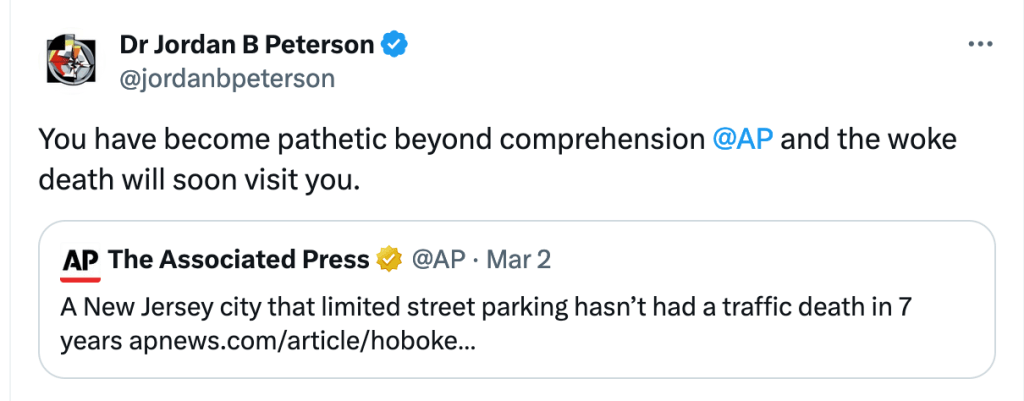
In Hoboken, New Jersey, adjustments to traffic enforcement and parking have resulted in a remarkable record: no traffic deaths on city-controlled streets in seven years. The major changes were narrowing intersections to slow traffic, and “daylighting,” or preventing cars from parking right next to a corner, which improves visibility. Noted conservative intellectual Jordan Peterson responded to AP News coverage of this milestone on Twitter with outrage:

Two Excellent Pieces of Film Criticism

An exploration of Dune Part Two, and the ways in which it both subverts and supports the Chosen Hero narrative, which it gives the rather unfortunate but not entirely inaccurate nickname magic dick theory:

In Dune, though? It’s all a con. There is no benevolent higher power.

The connection between patrilineal inheritance, male heterosexuality, and just governance is not a fact of nature; it’s a convenient fiction. The prophecy that makes the Fremen accept Paul as the savior figure… was planted in Fremen culture generations ago… It’s a plainly imperialist fiction designed to exploit an indigenous population, and it works.

A very good meditation on the 1989 film Do The Right Thing, art criticism, and the kinds of violence that make us feel safe:

I think the reaction to Do the Right Thing revealed that the burning of a white-owned pizzeria and a fight over inclusion represented violence that scared white audiences, while a persistent police presence in a Black neighborhood that might at any moment turn into the murder of a resident of that neighborhood did not represent violence that made white people feel scared. It might have even been the sort of violence that made many white people feel safe. In fact, most of the talk by mostly white pundits and audiences didn’t even seem to acknowledge the act of policing on Black neighborhoods to be violence at all.

Like I said, sometimes when people talk about art, the art starts talking about them.

Joy

The old-school comic strip Nancy has been running since the 1930s, but has had something of a resurgence since the latest artist, Olivia Jaimes, took the helm in 2018. Two recent gems: one about the transcendence of art, and pondering the eternal question “is that all there is?”

Also:

Until Tomorrow

Today’s song is Ta Fardah, by PAINT, a Farsi-language tale of falling in love with the airport security agent by LA-based Pedrum Siadatian.

PAINT is just one of a perhaps-surprising number of bands revisiting the surf/garage/psychedelia vibe these days, with what may or may be greater depth than the first time around. I’m especially fond of Habibi, which mixes Farsi influences with punk and 1960s girl groups to produce catchy jams that veer from covering a fun night of dancing (I Got the Moves) to upsetting and unfulfillng sex (Siin). Another great pick is La Luz, which has a more lush and less punky sound but still carries the banner for what you might call woman-group rather than girl-group garage rock. Highly recommended.

Bad news

Big Ideas

The Ink: Future Shock. Progress is good, but how do we help people adapt to it?

Consider that we have completely changed the meaning of being a man and what you can do and not do as a man in the last 20, 30, 40 years. Thank god. But let’s be honest: We have done a better job of dismantling some of the old stories and practices and structures of masculinity that needed dismantling than we have of teaching men new ways to be men. The result is a vacuum, and certain podcast charlatans are very deft at getting in there and pied-piping men into new misogynistic visions to fill the void.

Dynomight: Taste Games. Yeah, I’ll drink Budweiser or a local craft beer but not Heineken because, wait, am I just falling into the Pierre Bourdieu trap again? Yes, we have YET MORE ruminations on Bourdieu, conspicuous consumption, beer, status, taste, travel, high-end sneakers, and the Correct Way to Pour Wine:

Something about how people talk about travel has long made me uneasy. After all, travel is expensive. No one in my circles would dream of going to a party and showing off their new Rolex. But somehow, travel is this unusual form of conspicuous consumption that isn’t subject to conspicuous consumption taboos. Why? … A deeper conspiracy theory is that Travel is popular because it allows people who aren’t socially permitted to play Fancy Cars a way to do that while pretending that they’re only playing a normal, respectable game of Glass Beads.

Joy

About suffering they were never wrong

We’re in the midst of a constitutional crisis. A manifestly unqualifed, poorly-vetted, corrupt justice is about to be installed on the Supreme Court. The foxes are trying to hedge their bets from inside the henhouse.

Even in ultra-liberal Massachusetts, 35% of Republican voters cast ballots for a man credited with triggering a yearslong wave of anti-gay violence in Uganda. In a shocking echo of Hungarian fascism, Texas has ordered school districts to stop funding education for migrant children. Government cruelty to immigrant citizens is now extending to Vietnamese-Americans. The government officials marketing this sort of cruelty have a longstanding process of making money from it even when the policy is overturned.

Anyhow, in a corner, some untidy spot, where the dogs go on with their doggy life… the economy has somewhere to get to and sails calmly on. We still have to work.

Good economic news!
A while ago Alexandra Ocasio-Cortez was criticized for saying “unemployment is low because everyone has two jobs.” The fact-checkers said, well, actually “everyone” is an exaggeration, and the number of multiple-job-holders isn’t that significant. Her correct and important point – that the unemployment numbers don’t reflect the very serious problems of wage stagnation and overall misery – was (of course) ignored in a rush to pile on to her slight inaccuracy. (For some reason this level of scrutiny isn’t applied to certain male officials with white or orange skin).

I’m one of the people the fact-checkers say is statistically insignificant: When I took my third job, I rose to about 30 hours a week, so the state cut off my unemployment benefits and now counts me as one of the gainfully employed. I’m good economic news! I’m also getting a great lesson in precarity: I don’t know from week to week how much I will bring home, much less my annual earnings, although I’m pretty certain they’ll be substantially lower than last year. If my household were actually on the brink, as so many American households are, it would be really, really bad.

This week, I got another job. I’m not yet at the level of Kevin Gates, boasting “GET IT GET FLY I GOT SIX JOBS I DON’T GET TIRED” but for those of you keeping track at home, I’ve got four jobs now: Essay coach, two consulting gigs, and now poll worker.
kevin-gates
Like all the others, being a poll worker is seasonal, temporary, and contingent. In this case, it’s roughly minimum wage, and there are just a handful of available workdays each year: Primary election, early voting, and general election. The primary this past Tuesday was my first day on the job. It was hot and the chairs were uncomfortable and I have a newfound distaste for people who write in no-hope candidates as a protest, because I had to count them at the end of the night, but it was mostly a great experience and I made about $165. Good economic news!

This month one of my other jobs is ending. Sort of.

See, the organization has a policy to prevent exploitative perma-temp arrangements, so I can’t be a temp anymore. Instead, I’ll be a consultant. Of course, they also have policies to prevent exploitative miscategorization of employees as consultants. A consultant has multiple customers and advertises for multiple customers, so I needed to update my LinkedIn to reflect that. Merely looking for a full-time job and doing some freelance work doesn’t make me overtly consultative enough. Moreover, a consultant doesn’t have a dedicated desk and doesn’t use dedicated company resources. So I have to take my name and the photo of my wife out of the shared cubicle (five people, four desks). Consulting!

Mistakes were made on all sides
A plainclothes cop left his unmarked vehicle running while picking up a to-go order at a pizzeria. Two teens jumped in for a joyride and were unsurprisingly caught. And beaten. And cuffed. And then beaten some more. Also attacked by dogs.

And then the recording of the interrogation was released:

Welcome to White Town motherfuckers…. I’m not hampered by the fucking truth ’cause I don’t give a fuck! People like you belong in jail. I’ll charge you with whatever — I’ll stick a fucking kilo of coke in your pocket and put you away for 15 years.

The officer in question was given a 60-day paid suspension.

(Note that the “Rin Tin Tin Myth” makes police dogs seem noble and friendly. Arrests with dogs are brutal.)

(Must be nice to have a union. I would be fired immediately from any of my several jobs for doing any of the things that cop did, starting with leaving a company vehicle unattended with the keys in the ignition).

Cultivating joy
Don’t look behind you, there’s a bird trying to keep up. (I can’t remember if I posted this before but it’s still funny to me).
A short story read by a former student of mine. Another story of hers will be in The Best American Short Stories of 2018, edited by Roxane Gay.
Some birds teach each other how to do stuff.

Trouble With a Capital T

We got trouble with a capital T that… yeah. The Washington Post reports that “the Trump administration is accusing hundreds, and possibly thousands, of Hispanics along the border of using fraudulent birth certificates since they were babies, and it is undertaking a widespread crackdown.”

See, once it turned out that Obama had a birth certificate, nobody could trust birth certificates anymore. Because obviously Obama wasn’t American. You know, you have to be American to be a citizen. I can’t exactly define what that means, but I know it when I see it.

I mean, you better not have a Bank of America bank account if you’re not One Of Us.

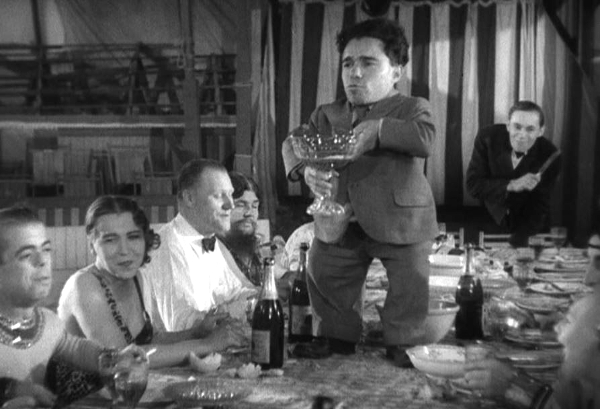
And yes, I am specifically referring to the horrifically exploitative pre-code film Freaks:

freaks-movie-still
Like looking in a mirror
In Hungary, there’s a tax on doing anything nice for immigrants.

There’s a new sexism scandal at a Tokyo medical school.

Chinese parents are furious as their expensive school district admits kids from poor regions. Solution: A “poor door” so the children of migrants don’t wind up in the classrooms of property-owners.

Big ideas
Francis Fukuyama tries to explain why history stubbornly refuses to end. His original prediction has become, at this point, a punchline more than an idea.

For example, StrongTowns has a great article this week on what they’re calling the “irrelevance of thingies,” by which they mean that the Internet of Things type hype is largely just hype. They contend that cities actually matter even more than they used to:

It’s been more than two decades since Frances Cairncross published his book The Death of Distance that prophesied that the advance of computing and communication technologies would eliminate the importance of “being there” and erase the need to live in expensive, congested cities. (It goes down, along with Francis Fukuyama’s The End of History and Kevin Hassett’s Dow 36,000 as one of the demonstrably least accurate book titles of that decade.)

Cultivating joy
Cat is terrible dinner guest.
Cat is rude to marine life.
Swarm of very wrinkly little puppies.

Individual 1 For President

Someone must have set ’em up
Now they’ll be workin in the cold grey rock
Now they’ll be workin in the hot mill steam
Now they’ll be working in the concrete
In the sirens and the silences now
All the great set-up hearts
All at once start to beat…

individual-1-bumper-sticker
Dime con quién andas y te diré quién eres…

Legacy
Adam Serwer notes the very American precedents for the Trump kleptocracy… and also reports that these two paragraphs have inspired a great deal of hate mail:

Many commentators have described that kind of authoritarianism as foreign to the United States. But it isn’t. It has its inspiration and precursor in the racial kleptocracy of the Jim Crow South, in which states were essentially criminal enterprises that existed to expropriate black wealth, exploit black labor, disenfranchise black voters, and shield acts of racist terrorism and violence from prosecution.
Remnants of this society are still with us, from mass incarceration, to discrimination against black jurors, to stand-your-ground laws. But alongside it, America retains a system in which the wealthy remain largely immune to [punishment for] financial crimes. Weak laws and regulations make the prosecution of financial crimes difficult, and prosecutors are often loath to pursue individuals who might be able to fill their campaign coffers come election time. Whether the president is Barack Obama or Donald Trump, the rich can afford a different kind of justice than everyone else.

Big ideas
What is the fate of capitalism? Well, that depends on what you mean by “capitalism” doesn’t it?

Seattle fears becoming San Francisco, split between wealth and shitting in the streets.

Article suggestions from our friend Kevin: Slavery inspired Taylorism, the root of modern management theory; Do robots already rule the world?

Cultivating joy
Big cats carrying big kittens
Cats are liquid. Pro and con.

Pop Psychology

I’m taking business courses right now, which sometimes seems to mean memorizing a lot of pop-psychology mnemonics for different personality and management models and theories. One of the models of behavior we have learned is called “Influence Without Authority” and it begins with treating your opponents as potential allies. This seems hopelessly naive sometimes but I’ve tried to apply it to my daily life anyway.

For example, the Somerville Ward 3 Democrats mailing list lit up this week about a project to turn a former function hall into apartments. Neighbors were concerned about parking and about the addition of rental units, because they felt that renters don’t stick around and create a stable community. I managed to gently guide the discussion toward the far less controversial topics of immigration policy and classism by pointing out that if our town wants to be welcoming to immigrants and people with modest means, it need to begin by making it possible for them to find a moderately priced apartment. It kind of worked, in that it led to a non-furious internet disagreement. Which, I guess, is a small miracle in its own way.

Links
Injustice: That prison is literally made of poison. Obviously they told nearby citizens about the danger of drinking local water, but not the prisoners.

Note also that in a sad echo of the three-fifths compromise, prisoners are counted in the census as residents of their prisons, but not permitted to vote, distorting representation, voting power, and funding distributions.

Sarcasm: A modest proposal on what else we could replace with Amazon services.

Policy: A brief history of public housing in Vienna. In stark contrast with American public housing, it doesn’t suck.

Iatrogenic medicine: Sasha Frere-Jones on the harms of benzodiazepenes.

Win/Fail via Twitter
Yak fail.
Dog win.
Dog fail.
Chart fail.