These days, motorcycle racing is almost surprisingly safe, especially at the elite levels. Safer, certainly, than riding on the street, since there are no distracted drivers in SUVs. Super-tough leathers contain in-suit airbags and anti-whiplash devices, and the carefully designed tracks include generous runoff areas to allow downed riders to come to a stop safely. Last year in the 2020 Austrian Grand Prix, Spanish MotoGP rider Maverick Viñales found that his brakes had totally failed on the main straight, hopped off the back of the bike at 140 mph, then just walked away annoyed.
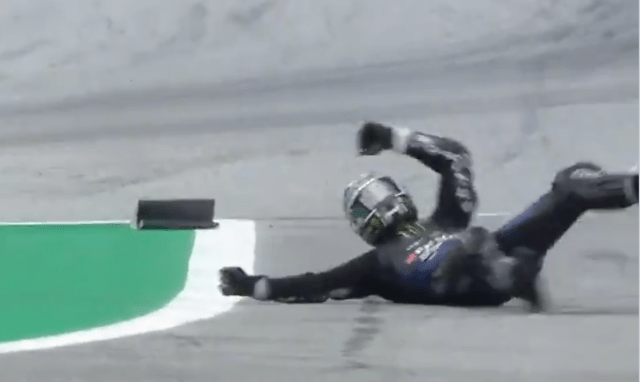
A race that came to a very abrupt end! 💥
Thankfully @mvkoficial12 was able to walk away from this scary get off unscathed! 🙌#AustrianGP 🏁 pic.twitter.com/NbU63tHZSv
MotoGP™🏁 (@MotoGP) August 23, 2020
Another factor in improved rider safety is that designers have aimed to create safer crashes. You see, there are two main ways to wipe out on a motorcycle: low-side and high-side. In a low-side crash, a rider leans too far into a turn, the front wheel slides out, and the rider winds up on the ground beside the bike. When that happens, rider and bike slide straight away from the curve into one of those carefully designed runoff areas, removing themselves from traffic with just a few bruises. In a high-side crash, the rear tire comes loose, usually under power, and then regains traction with a different vector, twisting the bike and throwing the rider into the air. That’s obviously a heavier impact, but it’s also less likely to fall away from the racing line. Bikes in the early 1990s were notoriously prone to high-sides — a documentary about that era is called “The Unrideables” — but today, electronic traction control and advanced tire chemistry make those crashes relatively rare.
And of course, when injuries do happen, emergency medical care is far better than it was even ten years ago. MotoGP rider Jorge Martín had a horrific incident in Portugal just a few weeks ago, was rushed into surgery, and is expected to return to racing, possibly as soon as this season.
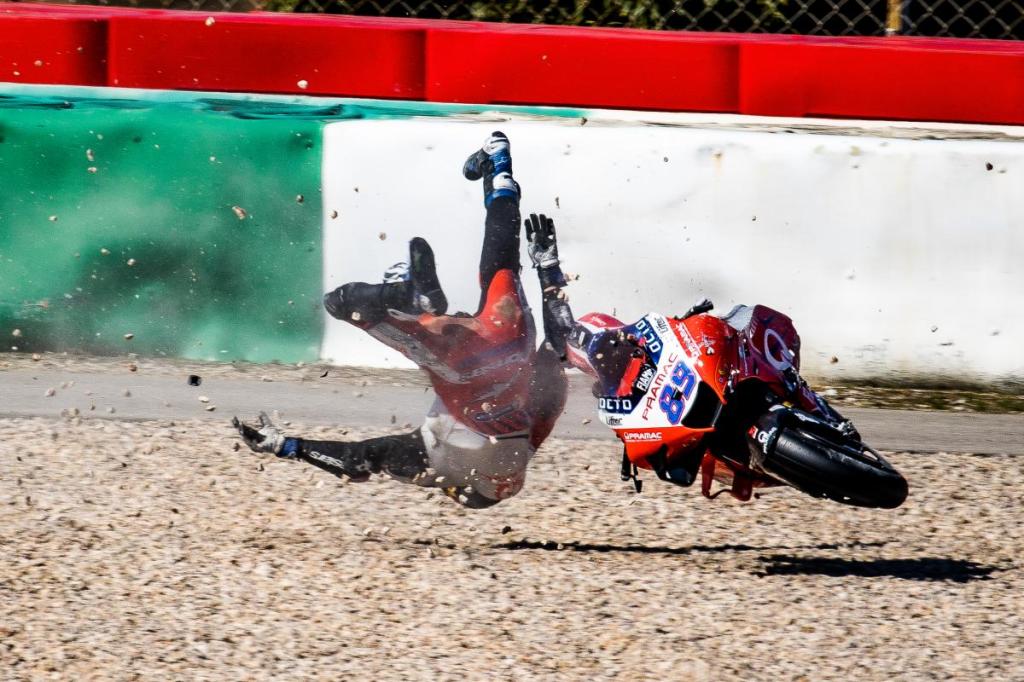
Still, there is the ever-present risk of death.
On May 29th, in a practice session for the Grand Prix d’Italia at Mugello, Swiss rider Jason Dupasquier fell in an apparent high-side crash, landed on the racing line and was immediately struck by the rider behind him. He died the next morning. He was nineteen, and had been competing in the Moto3 class, the rough equivalent of double-A minor league baseball – a professional athlete at the beginning of his career.
I’ve been worrying about this all week because I pay for a MotoGP VideoPass subscription, which means I’m a small part of the torrent of cash that sustains the sport that killed him. And it was always going to kill someone. The funds that pay for safer tires and tracks and emergency on-demand helicopter travel to top-tier hospitals also pay to put those kids in a pack, jostling for the best aerodynamic position, testing their skills, and sometimes losing badly.
And I don’t know how to square that. I quit watching the NFL because I was sick of how crooked and dangerous football was, but I never had a NFL League Pass subscription or even a cable bill that paid for it. If it was on TV I’d watch it, but at some point I no longer enjoyed it because I was watching people destroy themselves for my entertainment.
But here I am paying good money to watch a sport that’s, on balance, probably worse than football, because it’s not just dangerous for the competitors, but is a petroleum-driven climate nightmare (the all-electric MotoE class notwithstanding). And there’s the fact that new track being built in Indonesia also comes with a generous helping of alleged human rights violations. And the sponsors are pretty shady too, even without the once-omnipresent cigarette companies and their totally-not-a-tobacco-company subsidiaries.
If you’re running a team backed by Saudi Aramco and Mohammed Bin Salman, it’s probably time to take a good look at your soul. And if I’m paying ten bucks a race to watch it, then it’s probably time to take a good look at mine.



 Secretly Ironic