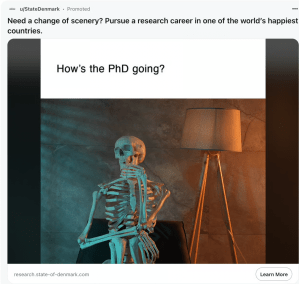
This week I got an ad on Reddit suggesting that thoughtful skeletons should consider moving to Denmark to finish their PhDs or advance their research careers. If I got the ad, their demographic targeting selection is a bit broader than I would have expected — after all, I’m not undead or a doctoral student or looking to move overseas.
But if they’re pitching this to Reddit users in places like Boston, I’ll bet they’re going to find more than a few takers.
There’s a lot of scientific talent around here. And it’s highly mobile — more even than your typical professional talent pool might be. Every semester, there’s a new cohort of highly-trained experts finishing a stint and weighing their next options. Maybe they finished undergrad and want to begin grad school. Maybe they’ve just finished a PhD or postdoc. Maybe their grant funding is coming to a close. People move around a lot here.
Until now, one of the major risks the Boston region faced was that all this talent would decide to go elsewhere in the US just because it’s so expensive to live around here. Many people stay, of course, because they love this place specifically. But a lot of people are here because the jobs are here, the research is here, the grants are here. Because Harvard and MIT and all the smaller shoals of universities and spinoffs and startups are here, and the opportunities that they represent.
But now, at all levels of our regional “eds and meds” economy, that advantage is evaporating. Hospitals are laying off chaplains and counselors and technicians. Universities are staring down lists of impossible and unethical demands. Administrators whose entire careers have been devoted to caution bordering on timidity now find that there are no safe choices, that storm clouds are gathering, that they are profoundly unprepared for the nor’easter of shit that’s coming ashore.
It’s a virtual certainty that going to work in Denmark’s thriving biomedical industry was a possible but unlikely plan for a lot of Bostonians a year or two ago. And it’s equally likely that a lot more people are browsing apartment listings in Copenhagen than even a month ago.
After World War II, how long did it take the US to attract a critical margin of Europe’s scientific talent? And how long did that expertise support American primacy in science, finance, industry, and strength of arms? The Danes are not alone in making a bid for that talent now. French, German, Dutch, Belgian, and pan-European institutions are recruiting. And so is the Chinese government.
Today’s song is Gimme Sympathy, by Metric. It’s a bop, of course, but it also supports my ongoing claim that while rock has lost its preeminence in the popular music pantheon, it remains relevant as a source of inspiration. In this case, Gimme Sympathy is a response to Gimme Shelter, but also to the rivalry between the Rolling Stones and the Beatles:
After all of this is gone Who’d you rather be, The Beatles or The Rolling Stones? Oh seriously, you’re gonna make mistakes, you’re young. Come on, baby, play me something, like “Here Comes The Sun”
So it’s an optimism thing, more or less. We could use it.
(Also: interpolation and sampling of rock songs seems less popular than interpolation and sampling of R&B and soul. Is that just the style, or do R&B samples just work better for today’s hot hits? Sure, you can point to Lil Nas X riffing on In Bloom for his song Panini, which even gave Nirvana their highest-charting single decades after the band broke up, but that’s kind of a rare exception, isn’t it?)
Stray Thoughts On Bikes
Some of these may be entirely obvious to everyone else but I find them interesting:
Prowess in weightlifting is measured in kilos. Prowess in running is measured in miles per hour or minutes per mile. Prowess in cycling is measured in watts per kilogram, and in particular the measurement of functional threshold power (FTP), which is roughly the highest wattage you can produce over a sustained period of time.
When driving a car, you pick a speed and try to stick to it by changing the gearing and amount of power you expend. When riding a bike, it’s better to choose a sustainable power output, and change speed and gearing to maintain it.
The derisive name for a cyclist you do not like is “Fred.” Fred spends money like a pro but rides and (most importantly) dresses like an amateur. I can’t remember the equivalent term for a motorcyclist you dislike, but I think it might be “dentist.”
“Cycling” refers to competitive road (and sometimes gravel) riding in the same way that “weightlifting” refers specifically to Olympic weightlifting. That is, it’s a distinction that matters almost exclusively to insiders, and knowing or making the distinction is part of what makes you an insider.
The French origins of cycling as a sport persist in terms like gilet (vest) and bidon (water bottle).
Fear
Matt Yglesias was always the divisive hot take guy, sometimes trenchant, sometimes wildly wrong, generally clever, but not all that helpful. But let’s take a look back at this article from 2015 and sort of collectively say “oh shit, he might have been right about that one.”
And some more recent commentary:
The Atlantic: “What its advocates want is not a restoration of explicit Jim Crow segregation—that would shatter the illusion that their own achievements are based in a color-blind meritocracy. They want an arrangement that perpetuates racial inequality indefinitely while retaining some plausible deniability, a rigged system that maintains a mirage of equal opportunity while maintaining an unofficial racial hierarchy. Like elections in authoritarian countries where the autocrat is always reelected in a landslide, they want a system in which they never risk losing but can still pretend they won fairly.
Foreign Affairs: “U.S. democracy will likely break down during the second Trump administration, in the sense that it will cease to meet standard criteria for liberal democracy: full adult suffrage, free and fair elections, and broad protection of civil liberties… What lies ahead is not fascist or single-party dictatorship but competitive authoritarianism—a system in which parties compete in elections but the incumbent’s abuse of power tilts the playing field against the opposition.”
But come back to optimism for a moment. Because we’ve been here before, and we’ve won. Nazis marched in Boston this week, and they kept their masks on, because they know that if they showed their actual faces they’d be ruined, because they know they’re wrong.
For the past few years, the Super Bowl been a weird exercise in melancholy for me, largely because it’s a reminder of one of the last nights I spent with my father, in 2021. The whole family all gathered around him in his bed with an iPad while he tried to straddle the line between pain and opioid-induced unconsciousness. As my brother says, crying at the Super Bowl may be an unusual way to mourn, but it’s not a bad one.
But it’s not just a moment of reflection for me because it’s close to the anniversary of his death. It’s also because football still remains America’s game, but I don’t follow it closely, so watching it feels like being a foreigner looking in at the diminished mainstream of our culture, eroded as it is by hyper-segmentation and factionalism.
(In 2017, I went to a Super Bowl party with a friend who brought her new roommate, Dora, badly jet-lagged and less than 48 hours into living in America. We assured Dora that she didn’t need to follow the game, because this was just an excuse to eat some snacks. But it was the legendary Pats/Falcons overtime game, and at some point I looked over at her trying to parse six very loud conversations and an unfamiliar game in what I think was her third or fourth best language, and felt amazed that it was even possible to comprehend. I try to imagine what it felt like sometimes. It’s probably good for us to imagine being in a situation like that from time to time, even if we don’t experience it directly ourselves).
Anyway, this year, like in 2017, like in 2021, the Super Bowl felt just weird as hell. Above all else, above even Samuel L. Jackson making explicit the subtext of a profoundly political halftime show, was the paranoia. I cannot stop thinking about how many ads were built from a base of twisted conspiracy: Tom Brady is a robot, celebrities are aliens, football exists solely to sell us unhealthy food, the pharmaceutical industry is trying to keep us sick and poor on purpose (so get an online doctor to prescribe you these off-brand compounded weight loss injections, which have bypassed normal safety reviews).
Yes, I know, everything is driven by a conspiracy theory these days. And I know that some of those conspiracies are real, slipping in alongside arrant nonsense both silly and dangerous. But it feels more than a little tasteless to joke about the paranoia to sell batteries or frying pans or off-brand injectables.
I mean, we all went back and read The Paranoid Style in American Politics during the first Trump administration, didn’t we? (If not, go read it again. It’s not long.)
Remember people claiming universities were basically leftist? Harvard clubs just hosted a white-nationalist conclave featuring Steve Bannon. Among the speakers was Penn Law professor Amy Wax, who argued that “it’s important to have a European majority” in America. (Wax has famously kept her professorship, despite years of overtly horrible behavior that began with claims that Black students aren’t equipped to study law, something that is now apparently grounds for an invitation to speak at Harvard).
Progressive governance failures have made America less mobile. That’s especially bad given that a lot of Americans will need to move from places that are hostile to their existence or rights, or from places increasingly prone to being on fire or underwater.
A weightlifter on RFK Jr.’s claims about health, exercise, and gender-affirming treatment. (TLDR: yes, he lifts, a little. Yes, exercise is good for you. Yes, he’s a hypocrite who takes hormones and vaccinated his kids even as he tells others they should avoid both. No, pointing all this out won’t change anything in any way that matters).
Today’s song is Trying by Bully, which has a sort of a fin de siècle riot-grrl aesthetic. You can almost feel the band tapping through their iPhones looking for the right filter to mimic a badly calibrated Super 8 camera, trying to figure out which vibes of the past to throw into the pastiche, which ones to discard.
Also about trying and also with 1990s vibes, a Slate piece that epitomizes the genre I have come to think of as “Gen-X career disillusionment personal essay.” Obviously this is a generalization so broad as to be nearly meaningless, but these pieces all do seem to follow a pattern, and represent a specific strain of thought and style from people who are roughly my age. The authors are mostly (but not entirely) white men, and they’ve all obviously read Denis Johnson and Douglas Coupland at a formative age. The pieces generally run to a few thousand words: too long for print, too long for 21st century attention spans, perfect for what the authors probably feel was the best era of internet writing.
A typical example is heavy on cynical participation in corporate life. It’s almost always got some vague reference to bad behavior and low places that somehow still manages to provide too much embarrassing information. In this case we find it in the first paragraph: “…in the Johnson County, Iowa, jail, where I spent July 4 and 5 some years ago for reasons I’d rather not go into…”
In the past five or ten years, the Gen-X personal essay has also added a mandatory acknowledgement that its cynicism is passé. It pauses to note that nobody says “sellout” anymore, to remind contemporary readers that the author’s quaint career-related ambivalence and inner turmoil are coming from the era of the payphone and the rented VHS tape.
Critically, such an essay builds up to a conclusion that is well-styled, evocative, and, if you think about it, somewhere between obvious and pointless. Oh, the author has definitely done a great deal of introspection, and I’m sure there’s some personal growth in the writing of this essay, or in the therapy that made the introspection possible, but at the end of it, has the reader gained any insights? Is the reader any richer after what is, in essence, a short description of the sales and persuasion business in three of its least prestigious forms: jailhouse raconteur, telemarketer, and panhandler?
Gosh, are you telling me that sales is a dirty business? That people doing white collar jobs aren’t actually any better than people doing blue-collar work? That seamy and depressing soul-sucking labor and dead-end jobs can happen at any point on the economic spectrum? A truly novel insight. Arthur Miller couldn’t have done better with a smile and a shoeshine and a dead dream.
The narrator of all of these essays is almost always an example of elite overproduction, or at least someone with a degree working a job that they feel is beneath their dignity. It helps if they’re self-aware enough to realize that they’re being both pretentious and classist to look down upon their job rather than just find it irritating. Was the first of these groundbreaking, or was it already a cliche when it was printed?
And yet, as much as I mock them, these sorts of essays hit me right in the gut, because how do you persuade yourself to care enough about something to do it well, without caring so much that you tear yourself apart when things go wrong, or when you have to admit that it’s not, in the grand scheme of things, very important?
To really fall right into it: sometimes this genre feels especially relevant to my work life right now, and it makes me feel uncomfortable. Yes, we all know that being an adult in the working world is occasionally alienating. It’s a job. I get up every day and do it. It’s fine. I don’t want to discount the fact that it’s actually a good job, and many parts of it are also important, and helpful, and worthy. I’m proud to have written a flyer about addiction treatment that can be read and understood by someone who is too ashamed to even pick it up. I’m proud to have been able to explain antiretroviral HIV medications in a way that’s legible to people with only marginal English skills. That’s pretty good work. And I work with kind and thoughtful and collaborative people.
But some of my days could easily be the fodder for any number of these depressing cliches about corporate life. For example, I’ve been working on a project to change a corporate tagline from “funded in part” to “brought to you” in the footers of approximately 2,000 health insurance documents. It’s frustrating, and tedious, and it’s a reminder that I’m just a cog in a giant machine. Especially haunting this month are the constant reminders that the particular machine I’m working for is so widely reviled that a lot of folks were pretty happy to see one of its leaders gunned down in the street. (Following the murder, the headline insurers limit coverage of prosthetic limbs, questioning their necessity is a little too on the nose, you know?)
But as I said, cynicism about one’s career is mostly an outdated and embarrassing cliché at this point. So what if I work for an industry everyone hates? It’s a job. It’s fine.
Nailed It
Did I get that formula right? Let’s play that song back and run the checklist:
Contains one or two very specific details that don’t quite make up for how vague the rest is.
Acknowledges that nobody’s really too good for any job; still oozes pretentious disdain for this particular job in question.
Notes that generalizations are inaccurate; still makes broad generalizations.
Admits that it’s coming from an outdated worldview; does nothing to actually change said view.
Throws in something heavy or shocking at the close to distract from the fact that the entire piece can be summarized as “having a job can be a grind sometimes.”
New favorite subreddit: /r/meow_IRL, featuring cats with expressions that match how you feel when you don’t exactly feel your best. It’s got some great ones.
I’ve been mulling over the rise of respect for pop and popular genres for some time now. Citation needed, but roll with me here: romance fiction always had plenty of readership, but now dedicated romance bookstores are popping up, sales are booming even more than they used to, and the genre has respect it didn’t have before. Critics used to deride pop music and bands used to hate the idea of selling out, but now a “just let people enjoy things” sort of vibe is dominant in most media sectors.
Instead of the grim-dark themes of prestige cable TV like The Sopranos and The Wire we’ve got well-made, well-written family-friendly entertainment like Abbott Elementary, shows that treat the 22-minute situation comedy as a legitimate format and produce things that are, frankly, nice. And of course there’s reality TV, once the domain of mean judges crushing dreams and today the domain of Bakeoff. Even the profanity-filled Netflix rap contest Rhythm & Flow features judges Latto, DJ Khaled, and Ludacris reassuring the losing contestants they’ve got what it takes, and to keep working on their craft.
Feel-good feels good.
But there are exceptions, and worthy ones. One I ran into recently is from Christopher Buehlman, a horror novelist who dipped his toe into the fun side of the pool with The Blacktongue Thief, a frankly hilarious tale that could have been nothing but cliche (a mage, a knight, and a rogue walk into a tavern, seeking adventure…) and managed to be brilliant. The title character has a sense of humor that reminds you why they call a rogue “roguish,” and once I finished that book I went and read some of Buehlman’s other books.
They were not funny, although there were moments of laughter in the one about the necromancer with a drinking problem. And for a follow-up to Thief, Buehlman narrates the tale of the knight in his latest book, The Daughters’ War. This one is a sort of return to form for him: she’s grave where the thief was funny. In fact, she’s deadpan even when all the other soldiers are laughing or joking or whoring.
Buehlman manages to write the narrator as someone who speaks excellent English, but whose first language is not English; she’s betrayed only by a handful of uniquely slanted phrases, like “it is not for laughing.” But the phrasing doesn’t detract from the tale she tells, of a kingdom that’s lost its knights to invaders, then its farmers, and will now send its daughters off to be mowed down in war as well. He manages to bring us a fully realized narrator who has loved and lost, and lost badly. As someone traumatized, haunted by what she’s seen and done. Someone who will do whatever it takes to do the right thing.
It isn’t funny. It will not get called “rollicking” like the prior book did. But it’s brilliant, too.
And Also
There’s room for cruelty and disdain in literary criticism as well. I do not miss the days of the guilty-pleasure hatchet jobs from the likes of Dale Peck. But there’s still room for a burn in today’s literary environment, like this well-deserved, scathing review of the latest from Jordan Peterson:
The last time I reviewed a book by Jordan Peterson, a cleverly edited excerpt of my negative opinion (I described it as “bonkers”) appeared on the cover of the paperback edition, giving readers the misleading impression that I had endorsed it. So this time I shall have to be clear. The new book is unreadable. Repetitive, rambling, hectoring and mad, We Who Wrestle with God repels the reader’s attention at the level of the page, the paragraph and the sentence. Sometimes even at the level of the word.
The aesthetics of intellectualism, unaccompanied by the rigors of actual thinking, are on display on every page of “We Who Wrestle With God.” … At the level of the sentence, “We Who Wrestle With God” is probably the most unendurable book I have ever suffered through. But its unreadability is the point: Density passes for sophistication, and verbosity conceals vapidity.
Brief introduction to the new right, a sort of glossary of the different factions of horrible people gloating about their ascendant power in the next four years.
Declinism is a generalized tendency to believe that things are getting worse over time.
For example, in July 2023, The Atlantic published a short piece about how America’s obsession with long hours is destroying churchgoing, which frays interpersonal ties, which disrupts communities, which, give-a-mouse-a-cookie style, will probably destroy America or something. But we’ve heard that song before (remember Bowling Alone?) We’ve been hearing it since 1929 at least. We’ve been hearing that Boston isn’t what it used to be since Ben Franklin complained that the taverns were better before independence. We’ve been hearing that Kids These Days Are Lazy since ancient Greeks lamented youth were just writing things down instead of memorizing the great epics. But of course, while churchgoing is on the downswing, other forms of involvement are up. We’re not bowling in formal leagues anymore, but Strava users know each other well enough.
But as much as that pessimism was misplaced last time, we always worry. We ask ourselves, well, are things getting worse this time? Are we working too much? Is the latest social media or structural change or trend fraying our communities?
The latest buzzwords in my feeds are polyworking and overemployment, and although the you must work very hard all the time doing as many things as possible theme isn’t new, it’s certainly showing its face in a new style.
Some people, of course, love the whole thing, laughing all the way to the dual-income-one-person bank. There are anecdotes of clever software engineers pulling in two or even three six-figure salaries at once. And why shouldn’t they? Your bosses pay you as little as possible for the most work they can squeeze out of you. Why shouldn’t you work as little as possible for the most money you can squeeze out of them?
When the Teamsters do it, it’s a punchline, but that punchline is basically just clever PR by Pinkertons and their ilk. “Labor unions = lazy workers” is one of the most successful, most malevolent memes in America, even more than auto companies inventing the concept of jaywalking to reserve public streets for their customers rather than the general public.
In the 2000s, when I first started working, you could just have one job and survive. In the 2010s, you could have one job and a fun, goal-related little something on the side that you hoped became the thing. Now? You have a job and a side-hustle but also another job and none of those ladder into your goals so you still have to keep doing them all despite none of them really being fulfilling. Did I mention you’re doing this while freelance, without set health care or other corporate amenities like holidays?
Anyone in this position knows this isn’t anything new, just that the noise… is getting louder.
The concern here is that creative workers in particular find themselves needing to both do their jobs and spend a great deal of time and energy becoming, essentially, professional influencers selling themselves. It’s not merely enough to be good at something, in other words, you also have to be good at marketing yourself for it.
And to a certain extent I feel that thrum of anxiety myself. I’ve got my main freelance assignment (no benefits, no PTO, but flexible) plus my two or three side hustles, plus my volunteering and my unpaid writing. All of that is both work and a sort of meta-work: marketing and managing my reputation for being good at this sort of intellectual work. And there’s an awful lot of it. An overwhelming amount of it, sometimes.
On the other hand, it’s worth remembering that mandatory polywork may be a new trend for white-collar workers like Kyle and me, but it isn’t at all new for others. And more importantly, being good at something, whether that’s being a village blacksmith or a leading subject matter expert, has always been subtly different from being known to be goodat it, and successful people have always had to be both. It’s always been necessary be both good and known to be good, to be both just and seen to be just.
I catch myself doom-mongering about this a lot, I’m afraid, and have to force myself to take a step back. I have to remember I’ve got it way easier than most people in America today, that most people in America today have it way easier than the rest of the world, and that the rest of the world has it way easier than they did fifty or a hundred years ago. I don’t risk being maimed by my job, I don’t get forced to do unpaid overtime, I don’t even commute. I’ve been unemployed and under-employed, and the situation I’m in is far, far better. Hell, it’s far better than certain full-employee I’m-a-real-boy jobs I’ve had. I chose this. I continue to choose it.
I wouldn’t necessarily advocate that everyone choose this multiple-hustles life, and making it mandatory for everyone would be truly horrific. But it’s working for me, for now. I know I’ve got it pretty good, is what I’m saying.
I haven’t yet succumbed to fear and loathing, and I’m not going to talk much about, you know, the events of earlier this month. Other people are more informed on the topic and have more actionable messages than I do. And I don’t intend to turn this blog/newsletter into a running commentary on all the bullshit that’s about to come out of Washington. But this week’s song is You Were Right, by Built to Spill.
I like the way it more or less lists out a series of rock cliches — you were right when you said all we are is dust in the wind, you were right when you said we’re running against the wind, you were right when you said it’s a hard rain gonna fall… and then really runs it down with the chorus of you were wrong when you said everything’s gonna be all right.
Will things eventually be all right? Well, giving up now certainly isn’t going to help, that’s for sure. And folks like me will probably be fine, which means we’ve got the opportunity to use that power and privilege to help folks who need it more than us.
So let’s not give up. Not yet.
On Travel
I had the incredible opportunity to spend all of October in Europe, and in addition to enjoying it and relaxing and having some incredible food, I had some complicated emotions about it. About the level of conspicuous consumption involved in a lengthy vacation, about Instagramming my travels, about telling people I met what I was up to, about choosing museums and exhibits and neighborhoods and afternoons window-shopping. I’ve written and deleted six different versions of this post, but really, if you have a minute or three, go read the postTaste Games, from Dynomight.
Something about how people talk about travel has long made me uneasy. After all, travel is expensive. No one in my circles would dream of going to a party and showing off their new Rolex. But somehow, travel is this unusual form of conspicuous consumption that isn’t subject to conspicuous consumption taboos. Why?
Basically, travel, and shopping, and the display of cultural and economic capital involved in a luxurious vacation, makes me hyper-aware of things that I don’t normally have to think about. And it feels like work.
Obviously this says more about me than about the nature of society or of taste.
Can’t you just relax on vacation, Aaron? No, of course not, because it feels like I’ve lit a rocket fueled by enormous amounts of compressed time and money, and it is disorienting to watch that fuel burn, and I feel a neurotic need to understand why I react like that.
Having navigated traffic recently in both Berlin and Rome, I feel keenly that anarchic flexibility is both a benefit and a curse. A visitor to India has a similar conclusion: “Life in India is a series of bilateral negotiations.”
As befits my age and station, I’ve spent the past few weeks in a rabbit-hole of road cycling. I haven’t yet got all the kit to go full MAMIL (Middle-Aged Man in Lycra), but I’m on my way to mastering the jargon. I’m learning about the merits of carbon and aluminum frames, Shimano and SRAM groupsets, and different styles of stems and dropouts. I have spent hours shopping for the right clothes and considering the merits of various app subscriptions.
And critically, I’ve learned the snob’s term for low quality products: bike-shaped object, a thing with wheels and a seat that isn’t truly fit for riding.
The term draws the distinction between good and bad products, of course, but most importantly, it draws the distinction between the speaker as an expert and the masses who don’t know any better. Someone who talks about a “bike-shaped object” is also saying this guy (it’s usually a guy) knows what he’s talking about.
Every subculture and area of expertise seems to have a term like this, an insult that establishes the speaker’s insider knowledge and status. Wine connoisseurs reject plonk or, if they’re especially distinguished, disparage the international style (too sweet, don’t you know). Weed connoisseurs won’t bother smoking schwag or boof or mids, and car and motorcycle lovers obviously have endless disparaging ways to refer to rival marques and styles (except perhaps Mustang fans, who don’t know any better, bless their hearts).
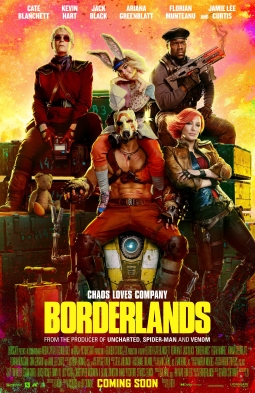
Bike-shaped object resonates with me because the formulation really works for so many other domains. For example, even though I’m not a film expert by any means, I recently encountered something I immediately recognized as a film-shaped object: Borderlands, horror director Eli Roth’s PG-rated adaptation of the ultraviolent video game.
Just like a bike-shaped object, Borderlands has all the pieces of a film but somehow fails to work as one. It’s got actors, including Cate Blanchett, Gina Gershon, and Jamie Lee Curtis. It’s got a hero’s journey, a cast of characters each with their own flaws and strengths, some character development, a bit of pathos, and of course some comic relief courtesy of Kevin Hart and Jack Black. It’s got special effects and a marketing budget and an established intellectual property tie-in.
And it’s unrelentingly, irredeemably terrible. We kept watching simply to see how much lower it could go. Perhaps it will be a cautionary tale for film school students, or a cult classic. But it is, undoubtedly, a film-shaped object rather than a real film. There’s only one reason to avoid calling it that: it’s so obviously bad that even non-experts like me can tell it’s a disaster. And if you can’t use your disdain to be exclusive and special, what’s even the point?
Outrage
I am yet again glad we stopped paying for the New York Times, as their pursuit of false equivalence leads them to try to compare “housing policies.” On the one hand, you see, is the Democratic party policy of housing construction and homeownership. They contrast that with the totally legitimate Republican party “housing policy” of militarized deportations of people with brown skin.
A few years ago, I got a short freelance gig writing copy for an internet services company. My assignment was to write explanations of the company’s services that met the needs of two audiences. The first audience, of course, was the people who might buy the company’s services. The more important one, however, was search crawlers that would rank this company’s pages higher or lower than competing providers of identical services. My company’s unique selling proposition, in other words, was its search engine optimization, courtesy of yours truly. I think they paid me something like fifty bucks a page. I may have been the last American to do that job before it was offshored, but I’m sure that’s no longer the province of human workers. At least, not directly: whatever machine churning out replacement garbage was almost certainly trained by ingesting what I wrote, along with everything everyone else wrote everywhere.
Including, of course, AI-generated garbage. What happens when AI models train on the slop generated by other AI models? What happens when AI-generated copy is written to tickle the algorithms of AI-generated readers who then summarize it back to their human overlords?
We’re already seeing the impacts. For example, if you’re in any way attuned to pop culture, you’ll have heard a few weeks ago that someone did a spectacularly bad job in the Olympic breakdancing competition.
Perhaps, like me, you tried to look up the video of the dance to see what the big deal was. When I did, I found dozens of videos featuring the same still photo of the dancer, each with slightly different AI-generated voices repeating slightly different AI-generated summaries of public reactions to the event.
None of them provided any insight, or novelty, and none of them showed me the actual dance in question. The story was ubiquitous but also simultaneously illegible. I knew the outline and there was no depth available. It was just AI-generated slop pitched to the algorithm in the hopes of being at the top of the list, garnering a click, and getting someone to watch just enough seconds of garbage to trigger a fractional ad payout.
It’s 2024 and Drought is Optional: Cheap solar power could bring us to cheap mass desalination. One key factor: the waste brine is rich in valuable minerals.
Why I Left the Network: Pro Publica covers the misery of being a therapist subject to in-network payment programs. TLDR: One way insurance companies reduce spending on mental health treatment is making it hard to access, and one way they make it hard to access is making it hard to provide, so providers drop out.
Right on Red: Republicans in Congress are blocking traffic safety initiatives in Washington DC. Why? It’s not just that DC trends liberal and Republicans reflexively oppose its initiatives. It’s because street safety improvements often present minor inconveniences for people in cars, and Republicans in Congress regard the convenience of suburban commuters as more important than the lives of actual district residents.
Quick summaries of books endorsed by JD Vance: Dawn’s Early Light, by Heritage Foundation president Kevin Roberts, and Unhumans, by the truly vile Jack Posobiec. The upshot is he’s endorsing truly extreme proponents of right-wing political violence. (And yes, I am linking to a Times piece by Michelle Goldberg. When even the NYT Hot Take Machine thinks you’re out of bounds, you’re way out of bounds).
Today’s song is “A Bar Song (Tipsy)” by Shaboozey, which seems to be perfectly of its moment, for a couple of reasons aside from the fact that it’s yet another track about how binge drinking is hilarious. First, it includes an interpolation of J-Kwon’s 2004 ode to underage drinking, Tipsy. That song, in turn, samples Queen and The D.O.C, and, well, you get the idea, The Vibes are Endlessly Remixable. Second, it’s a country song by a Black artist. The moment for Black country has been building since 2018’s Old Town Road hit #19 on the country charts before being disqualified for being too, well, you know. Today, though, Shaboozey is the first Black male artist to hit #1 on the Hot Country charts. Because the prior Hot Country #1 was Beyonce’s “Texas Hold ‘Em,” this is also the first time the #1 country spot has been held by two Black artists consecutively.
Reading
Today’s book is The Saint of Bright Doors, a novel that, despite winning the 2023 Nebula, doesn’t fit neatly into any one genre. Sure, there are supernatural elements — demons described as “invisible laws and powers.” These demons are literal invisible monsters, but also the unspoken forces that bind the oppressed and protect the powerful — the inconsistent enforcement of laws; the never-ending classifications and reclassifications of class and race and caste; the unspoken and occasionally impossible expectations parents have for their children. It’s about a boy with supernatural powers, but it’s also about the Sri Lankan civil war, Theravada Buddhism, colonialism, and the formation of our consensus reality. The protagonist has been raised by his mother as an assassin to bring down his estranged father, a spiritual leader known as The Perfect and Kind. When he abandons this destiny to live on his own, he joins a support group for cast-off near-prophets, and is sucked into subversive politics and becomes a spy infiltrating a thaumaturgical research group. When riots and plague break out in the city, he’s forced once again to confront, and possibly avoid, all of his possible murderous destinies. It’s one of the very few “genre” books I’ve recommended to my mother, and it’s brilliant enough that when I finished reading it, I immediately started over and read it again.
Elsewhere
The Food that Makes You Gay: Jaya Saxena explores the intersection of homophobia and sexism and food, starting with Fox News personalities alleging that eating ice cream or soup makes a man effeminate.
The Uninsurable World: The Financial Times explores the ways the insurance industry can’t quite keep up with climate change.


 Secretly Ironic