Hella Dope

Massachusetts legalized recreational cannabis use by ballot measure in 2016, and the state legislature spent two years delaying dispensary openings in order to put together careful regulations to stop weed from becoming … well, too popular. They had some reasonable concerns. When public health types look at alcohol legalization, they see the harms of prohibition replaced by the harms of an alcoholic beverage industry that slowly kills its best customers, leads to plenty of violence & destruction for others nearby, and uses its immense economic power to avoid regulation. There’s a whole genre of stories with the concept “imagine if we covered alcohol the way we cover other drugs,” and they provide a very useful insight into the harms of an underregulated market for abusable substances. Regulators looked at the nascent weed industry and feared that it would wind up building huge profits by generating problematic overusers.

So, they had a lengthy licensing process, plenty of security requirements, high taxes, and restrictions on advertising and promotional deals. The medical market, of course, was considered safe because it treated patients, not recreational smokers, and because access to it was supervised by doctors.

In some ways the regulators have succeeded, because today’s Massachusetts recreational pot customers are mostly tourists, occasional users, and people who haven’t smoked in years (if ever) and want to give it a try. In a rather more important way, that success is irrelevant, because everything they feared about the recreational market was already in place in the medical market.

Getting a medical card costs about $200 and can be done by phone. Mainstream doctors don’t prescribe cannabis, so it’s the realm of specialists who operate cannabis-only clinics, which means nobody is ever denied a card if they ask. Nor is the cost a barrier: medical sales are untaxed, which rapidly makes up the difference for anyone who smokes more than occasionally. Moreover, medical retailers are allowed to deploy a wide range of promotions, including paraphernalia giveaways, Instagram DJ sets, and huge discounts for new and returning customers (excuse me, patients). Many dispensaries offer a 50% discount on the first few hundred dollars worth of purchases, or 5% cash back, or discounts for larger purchases, or all of those. I saw one with coupons for $1 eighths (about a $50 discount) in randomly selected pre-rolled joints, making “buying medicine” into a sort of Charlie and the Chocolate Factory raffle. Imagine Pfizer giving away free Viagra with your Lipitor, or, more alarmingly, the origins of the opioid epidemic in unethical industry marketing.

Fortunately, cannabis is substantially less dangerous than alcohol and opioids. At least, as far as we know. One of the problems with prohibition, you see, is that it was so difficult to study cannabis for so long that we actually don’t know as much as we should about the effects of this very large and rapidly growing industry.

Just wait for the 4/20 holiday specials.

Trademark Madness

Every year around the NCAA basketball tournament, some nontrivial number of urologists do jokey promotions for vasectomies, because it’s a perfect excuse to say “I really should stay on the couch all day watching sports.” Some places include coupons for wings with every vasectomy, or encourage a group of friends to all get snipped together so they can all watch basketball all day. It’s now led to a lawsuit over the trademark “Vasectomy Mayhem” being too similar to March Madness.

Things That Are Bad

Amazon.
Pickup trucks. (See also: stroads and SUVs). (See also: bills to protect drivers who run over protesters).
Somehow, the California Environmental Quality Act.
Police in Minneapolis, London, Chicago, Boston, and Boston again.

Things That Are Good

Resurrecting a fabric lost to colonial depredations.

Twitter

People who think the U.S. is still this all-conquering dominant hegemon remind me of that guy in Mary Poppins who sings “It’s grand to be an Englishman in 1910”

Noah Smith 🐇 (@Noahpinion) March 14, 2021

Joy

Dog plus net equals derp.
Jewish space laser enamel pin, of course.
A fox napping on a skylight.
This komondor.
Cat “helping.”
Our vegetable love shall grow …. a husky?
A different dog with an alarmingly long nose. (Bonus: video of nose in action!)

Momentarily Take the Form of an Enormous Bird

The internet-age term Milkshake Duck refers to something delightful that is quickly revealed to be awful. It’s from a Twitter joke: “The whole internet loves Milkshake Duck, a lovely duck that drinks milkshakes! *5 seconds later* We regret to inform you the duck is racist.”

It has, of course, become a verb:  “One of the most bizarre storylines to come out of 2021 thus far has been the recursive milkshake ducking of the Reply All series on the Bon Appetit Test Kitchen.“

The latest milkshake duck to cross my path: non-fungible tokens. These are generated by a clever cryptographic system that allows you to create unique digital items that can be resold, like actual physical art. Digital artists now have a way to generate scarcity, which can help them actually get paid for their work. Lovely. Plus, it’s funny to buy the original of an infinitely reproducible GIF!

We regret to inform you that it uses so much electricity that limited edition GIFs are now a major source of carbon emissions globally.

Reader Input

A reader responds about shame:

But shame is a dangerous emotion; this very unpleasant emotion can easily be projected onto others. Twenty years ago, I would have said that Americans had the virtue of being ashamed of their racism. Trump freed lots of people of their shame—shame over their feelings of resentment, shame over being less successful than they thought they should have been, shame over their hateful feelings in general. He offered them targets on which to project the responsibility for their failures—the “libs,” immigrants, Blacks, feminists.  He gave them a way to redefine shamelessness as masculinity, bravery, honesty. “He tells it like it is” was code for shameless speech.  Shame is a useful social corrective, but it can backfire.”

Speaking of shamelessness, I managed to hold in an “I TOLD YOU SO” for all of fifteen seconds after reading that David Brooks had a second salary funded by Facebook and didn’t disclose it because the rules don’t apply to him. (Give him a break, his research assistant/wife is only 36, he needs two incomes to cover her student loans).

Speaking of shamelessness, everything about Madison Cawthorn.

Joy

Meet Tupelo the borzoi and her very long nose. I can’t get over how much I love/am alarmed by this dog and her nose. She is the embodiment of grace and elegance. She is very friendly. I want to pet her.

Kermit the Frog as David Byrne in concert.

A murmuration of starlings momentarily takes the shape of an enormous bird.

Shamefasted

I’ve been thinking about a post-WWI novel detailing the life of a 14th century Norwegian teenager, brazen criminality, contemporary class structure and the concept of shame. I don’t think I understand any of those things well at all. But they all keep bouncing around in my head. Bear with me. I got a point here. I think.

Let’s start with medieval Norway. The Kristin Lavransdatter novels of Sigrid Undset portray a family in 14th century Norway. When the titular protagonist disobeys her father, he laments that she is not “shamefasted.” I didn’t like much of the rest of the book, to be honest, but I’ve carried that word around for a while. It’s an odd and antique sort of word, and possibly an artifact of an awkward translation. But what a word: bound by shame. Being bound by shame probably strikes 21st century Americans as a bad thing, but clearly has been a virtue in other places and other times.

And then, just this week, I saw this tweet from a notable sociologist:

Shame, in particular, is a very middle class emotional landscape.

Tressie McMillan Cottom (@tressiemcphd) February 15, 2021

Dr. Cottom isn’t referring to the entire historical sweep of shame, of course. “Middle class” wouldn’t even make sense in 14th century Norway, while honor and shame were probably pretty critical to everyone there. She’s talking specifically about the variance in emotional responses across power differentials in the US right now. And in this place and time, it seems that the elite are just not properly shamefasted. Look at Ted Cruz not even bothering to pretend to help his constituents, or the entire public persona of Steve Mnuchin.

It’s like that classic line from The Wire: “Is you takin’ notes on a criminal fuckin’ conspiracy?” These people have been doing dirt so regularly that it seems normal. They have forgotten to be ashamed, or perhaps think their wealth and power insulate them from needing to even consider it.

Apparently there’s quite a bit of research on the topic, and new power dynamics create new feelings of shame or shamelessness pretty rapidly. Power corrupts, in other words, and it corrupts quickly.

Do we need to bring back some kind of external shame enforcer, like the ancient cobradores del frac that have seen a revival in 21st-century Spain? Like, should we arrange to have someone walk behind Senator Cruz ringing a bell and shouting SHAME SHAME SHAME everywhere he goes? (Anyone want to run a kickstarter to pay someone to do that? Is that even legal?)

I don’t know. I’m not a sociologist. Or a lawyer. But it’s on my mind.

(Incidentally, the lady ringing this particular bell here is Hannah Waddingham, who is just stellar in the warm and hilarious Ted Lasso.)

Content Curation

This NYT article about Garfield and remix culture (yes, Garfield) is quite excellent. Trust me.

This incredible Atlantic piece about deep-sea parasites is worth it for the marine biology alone, but it’s so much more. Trust me.

some ✨personal news ✨

I’m so excited to share that i have no idea what I’m doing with my life ❤️

Jenny (@jennyrdrguez) February 4, 2021

Joy

Voidcat.
Eggcat.
Absolute unit of a bunny.
Incredibly cool iced-up lighthouse.
Lightly vandalized fast-food signs = hilarious.
A very cold bison.
A very clever child misinterpreted some instructions.
A pie chart of what pie charts are called in different languages (in France, it’s a Camembert!)
A very glamorous penguin.
Kitten dressed up for lunar new year.

All Joy/No Doomscrolling

I subscribe to an awful lot of newsletters and RSS feeds and media streams. Probably too many. I scroll through them all and bookmark things for the newsletter or just to read later. And this week I was looking back at the saved items from the past month and so many of them just made me sad and angry, and I asked myself why I would inflict them on all fifty-nine subscribers to this newsletter.

So, here’s only the good stuff. No doomscrolling. Y’all already know about the cop that maced a nine-year-old. 2020 was a shit year and 2021 isn’t shaping up to be any better. Let’s focus on the better parts.

A Twitter thread of wholesome niche science-themed TikToks (the machinist/woodworking one is mesmerizing). Bonus: a machine that straightens scrap rebar.

A Reddit slideshow of a cat who loves sleeping on/in slippers. A dog alarmed by squirrels on TV. A dog playing in snow for the first time. A corgi nesting inside boxes of various sizes. An epic thread of animals investigating/interrupting wildlife photographers. And somehow, eels being cute.

Which of course prompts this, sung to the tune of Outkast’s Ms. Jackson:

Not Cute but somehow noteworthy: A crab riding on an albino alligator.

Also Not Cute but kinda funny: This editorial decrying sexy rock music and high-production-value movies was out of touch in 1985 and only gets more hilarious with time. What’s amazing about this is that he continues to get mainstream work. His oeuvre is full of hits like a 2011 claim in Newsweek that public transit is a socialist conspiracy and an argument this year that the problem with the vaccination rollout is that progressives are obsessed with good governance. People have been paying this chucklefuck good money to be wrong (but with big words!) twice a week for more than forty years and they just keep doing it. Do his employers not realize that people will be pretentiously wrong online for free?

Sorry, sorry. Back to the good stuff.

The American Conservative attempts humor with what I assume is a “modest proposal” style sarcastic editorial in favor of the Salazar model of dictatorship. Wait, sorry again. This turned out not to be a joke. Apparently they are sincerely in favor of dictators. Right. OK then.

I’m definitely sure this one is sarcastic:

omg sofia coppola’s dad also made a movie 👀 — $V (@not_a_heather) January 30, 2021

Check out this very sweet and inspiring story about someone’s great-grandmother being a total badass. Also the less-sweet and less-inspiring but still badass 21st century TikTok phenomenon known as “Bud Light Grandma.” (Sound on for the musical accompaniment).

Chazo-kun, the mascot for the Japanese Dumpling Association, who is alarmingly sexy bathing in a bowl of noodles and pouring hot oil over his rippling muscles.

Children say the darndest things:

my daughter asked why she can’t just quit school and i told her it’s against the law and they’ll put me in jail and my sweet sweet child looked me in the eye and said “i’ll visit you” — CeciATL (@CeciATL) January 28, 2021

The National Zoo has some great video of pandas playing in the snow. The Oregon Zoo has a roundup of rascally animals doing cute stuff.

It is important to remember the difference between peyote and pierogies. It is also important to remember to remove your pet sugar glider from your bra before your doctor’s appointment. Final reminder, do not leave your pet mink in a sink without supervision.

These two friendly cats. This dog with nose stuck in squeaker toy. An elderly bat named Statler being carried because he can no longer fly on his own. (No word on Waldorf).

Finally, an inspiring story of recovery and the long, slow work of improvement and growth from John Darnielle, who hit a seriously, terrifyingly low point in his life in the mid-1980s and is today a very-well-respected (and sober) recording artist: “this thread is for Howard and Bob, who didn’t make it to the end [of] this year, and for you, who did.”

Abort, Retry, Fail?

I’ve written and deleted a number of drafts of this newsletter in the past couple weeks. Each time I just feel worse about it, and I feel bad about bringing my doomscrolling into other people’s inboxes. But there’s so much doom to scroll through! And all of the new information just happens to confirm all of my prior assumptions, so it’s definitely true!

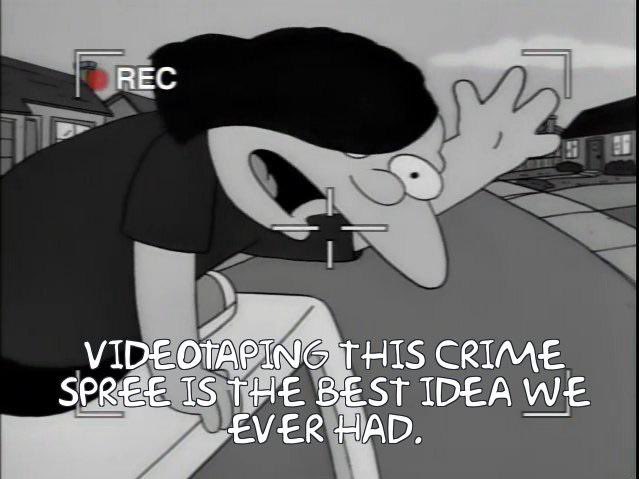
Image from The Simpsons: one of the bullies saying Videotaping this crime spree was the best idea we ever had

Anyway, The Nation has an amazing piece covering scenes from this week’s shitshow that concluded with this:

“This is not America,” a woman said to a small group, her voice shaking. She was crying, hysterical. “They’re shooting at us. They’re supposed to shoot BLM, but they’re shooting the patriots.””

And I am reminded of course, immediately, of an incredibly insightful little phrase from, of all things, the comment section of a rather neoliberal-leaning blog:

Conservatism consists of exactly one proposition, to wit: There must be in-groups whom the law protects but does not bind, alongside out-groups whom the law binds but does not protect. There is nothing more or else to it, and there never has been, in any place or time.


Decline?

Economist Brad DeLong and VC investor Om Malik face off on the question “Is America In Decline?” in a Pairagraph dialog. DeLong takes the “yes” side, noting that life expectancy in the US is lower than it ought to be, and that foreign students coming to study here often go home wondering why they bothered going to such a backward country that has nothing to teach them.

Malik takes the “no” side, arguing that while this year has forced the nation to look at its flaws, and that it’s reasonable to despair over our failings, we can fix them: “We can and will be better. Maybe it is my day job, or perhaps it is the delusion of an immigrant’s mind, but I believe the tradition of dreaming up something from nothing is still alive in this country. And that is what keeps me betting on America.” It’s inspiring, it really is.

I am, for one moment, sincere when I say this: I think that a lot of our flaws can be fixed and that the first step is in fact acknowledging them and recognizing them. We certainly can do better, and it’s possible that we will.

OK, that was excruciating. Back to bleak sarcasm.

Sure, we’re fucking up the distribution of vaccines in an entirely predictable and preventable way, and all of our economic inequities are revealed by how the wealthy stay healthy and the poor get sick, but at least the CIA is running death squads in Afghanistan, so, you know, we’re still in top form on hearts-and-minds foreign policy front. And we sure have some wicked awesome mansions, like this one owned by America’s wealthiest senator, Kelly Loeffler. And our conglomerates and trusts still do conglomerate and cross-subsidize and crush independent competitors like they did back in the day. And we’ve finally gotten Congress to share in the glory of active shooter drills for our school children! And, concentration camps in China notwithstanding, we’re still the number one incarcerator!

Cops

I don’t yet have enough details about the failures of the capitol police to handle this week’s riots, so here’s my recent roundup of other police brutality:

Misc

Kottke calls out a key detail in this article on credit card rewards programs:“The average cash-using household paid $149 over the course of a year to card-using households, while each card-using household received $1,133 from cash users, partially in the form of rewards.”

Patricia Lockwood is always a delight, even when writing about neurosis and elections.

Cultivating Joy

We Need to Talk About Kyle

It’s a macroeconomics truism that rising GDP is generally correlated with rising life expectancy, but the US is an exception to that rule. A 2017 UN report on extreme poverty in the US explained that inequality here is so great that a lot of Americans effectively live in a much poorer country. One key example the report cited was the lack of proper sewage and sanitation systems in the Black Belt. This week, the New Yorker profiles the followup efforts and the overall public health impact of poverty. It’s not a happy story at all. The solution isn’t quite as simple as laying some pipe (provisioning municipal sewer service to rural areas is impossibly expensive; the soil in the area is incompatible with many standard septic systems; sanitation is only one part of the ongoing public health disaster) but it’s a web of problems the US knows how to solve and just prefers not to.

We Need to Talk About Kyle

Kyle Rittenhouse, charged with two murders, is out on $2 million bail, with major contributions from right-wing celebrities. He does not, however, have a product endorsement from his favorite brand of right-wing militant coffee (yes, right-wing coffee is a thing now). People thought he did, though, because right after getting out of jail, he was featured in a photo wearing a Black Rifle Coffee t-shirt, embracing a right-wing influencer/podcaster who does have an advertising relationship with Black Rifle Coffee. The tactical coffee company had to issue a statement disavowing Rittenhouse, and …. well, some people got angry that their breakfast beverage does not sufficiently endorse vigilante gunfire.

Rittenhouse actually seems to have a great deal of support from the right, including a major endorsement from Florida State Representative Anthony Sabatini. Sabatini, interestingly, says that abortion is bad because it’s murder, but killing leftist protesters is just dandy. So, remember, fetuses are people, but leftists aren’t.

The Republican Party in one image:

Ben Yahr (@benyahr) November 22, 2020

Something Delicious

One of my favorite stock photo clichés turned niche internet phenomena is “women laughing alone with salad.” It’s great. KnowYourMeme explains the turn from showing up an awful lot in boring stock photography to a viral Hairpin blog post to, I am not kidding, a theatrical adaptation. In news coverage of the play, author Sheila Callaghan told the Washington Post that “nobody likes salad that much; it’s not built for that.”

But there is always an exception! And someone does in fact love salad that much! Her name is Emily Nunn, she’s an author who’s written about food for the New Yorker and Chicago Tribune, and in addition to her book-length projects produces a weekly newsletter called The Department of Salad. It’s delicious!

Twitter Curation

The ACLU has finally reached a settlement with CPB on behalf of two people who were arrested for speaking Spanish.

We’ve previously compared the current US situation with the decline and fall of the USSR (teetering gerontocracy, shortages and bread lines, quagmire in Afghanistan…) but here’s Noah Smith last year comparing it to the 1990s in Japan.

Followup

Back in September, I linked to an article from a Sri Lankan writer noting the similarities of his nation’s troubles and ours. He’s back with a followup titled “I Lived Through a Stupid Coup. America Is Having One Now.”

What is a coup? It’s literally a blow, a strike. Someone hitting your normal processes of government, trying to knock them over. The blow doesn’t have to succeed. It still wounds. In our case it was occupying Parliament without a majority. In yours it’s denying the President-Elect after an election. Whether it fails or not, deep structural damage is done. At the time, however, it just feels dumb.
….
You can just roll it back, right? Right? No. No no no. Oh God no. The tragic thing which you do not understand — which you cannot understand — is that you’ve already lost. You cannot know exactly what — that’s the nature of chaos — but know this. You will lose more than you can bear.

He closes his grim warning with a wish that we Americans get the benefit of the only thing that has kept him and his family safe so far: luck.

Also Worth Reading

Joy

Cats as hats.
Dog auditioning for role in Queen’s Gambit.
Fuzzy calf.
You can trick sea urchins into wearing tiny hats.

Apropos

The sci-fi epic series The Expanse features humanity spreading throughout the solar system and developing political, cultural and linguistic faultlines as it goes. The poorest and most marginal cultural group, scraping by in asteroid colonies and long-haul ships, spend enough time in full environment suits that their gestural communication has had to adapt as well: facial expressions are meaningless, while shrugs are whole-arm affairs that can convey uncertainty at a distance and through bulky safety equipment. (The language system got complicated enough, and central enough to the plot, that they actually hired a linguist for the TV adaptation).

Just thinking about that, you know, for no reason.

Arbitrage

Back in May, Ranjan Roy’s Substack post about DoorDash went mildly viral: a friend of his owned a pizza joint, and DoorDash had started offering delivery from his restaurant without consulting him. Only they had gotten the prices wrong when they scraped the website and were losing like eight bucks on every sale before even paying the drivers. Roy and his friend started ordering as many as ten pizzas at a time, and wound up taking DoorDash for a couple hundred bucks before the typo got fixed and the game ended.

Except it didn’t. DoorDash kept on spending huge amounts of money to acquire customers and influence regulations that allowed it to underpay its workers. Roy’s back with followup, now analyzing S-1 filing as DoorDash prepares for its IPO.

It’s all within the rules. The regulatory rules. The labor rules. The antitrust rules. The consumer protection rules. Full credit to Tony Xu and their team – they have out-executed every competitor. They are winning this weird and twisted game of heavily-funded food delivery apps.

But this is less a ‘good for them’ than a ‘bad on us’ sentiment.
…
While we were laughing about $8 in pizza arbitrage profits, Doordash built a $25 billion business powered by a combination of regulatory and labor arbitrage. While Doordash’s messy financial controls ended with us swapping a few pizzas, our broken regulatory system has fundamentally reshaped the economy in a way that allows Doordash to extract billions in revenue during a time of national crisis.

Social Media Edit

This:

This democratic backsliding is hilarious through the lens of the petty shit the US has overthrown governments around the world over, our president is screaming “Fake election! I won!” like dude we overthrew Allende because *the phone company* wanted him gone — Mass for Shut-ins (Podcast) (@edburmila) November 10, 2020

May You Live in Interesting Times

Joy

Why’s Everybody Look so Nasty?

I can’t remember if I’ve mentioned this before, but the lyrics to the Galaxie 500 song “Strange” seem to fit well with the current moment:

Why’s everybody acting funny?
Why’s everybody look so strange?
Why’s everybody look so nasty?
What do I want with all these things?

I find myself humming the song whenever I leave the house or go into a store these days. Everybody does look nasty in ill-fitting masks and DIY quarantine haircuts. What do I want with these things? Did I actually just risk my life to buy this bag of Peanut M&Ms?

I was mildly disappointed to discover that the song is actually just about going out to buy snacks while royally stoned. It kind of works anyway, though.

Anyway, speaking of looking nasty, check out this article in the Paris Review about the digital face, facial recognition algorithms, GIF-based digital minstrelsy, the a-reality of face-tuning, and so on.

Climate

As Andrew Dessler, a professor of atmospheric sciences at Texas A. & M. University, recently put it, “If you don’t like all of the climate disasters happening in 2020, I have some bad news for you about the rest of your life.”

What Rough Beast

So, yeah, they’re replacing the American flag with the cop flag at rallies now. Because it’s not about patriotism. It’s about obedience to power.

Wallace Shawn, writing in the NY Review of Books, has what may be the best take on the entire thing:

Trump has liberated a lot of people from the last vestiges of the Sermon on the Mount. A lot of people turn out to have been sick and tired of pretending to be good. The fact that the leader of one of our two parties—the party, in fact, that has for many decades represented what was normal, acceptable, and respectable—was not ashamed to reveal his own selfishness, was not ashamed to reveal his own indifference to the suffering of others, was not even ashamed to reveal his own cheerful enjoyment of cruelty…all of this helped people to feel that they no longer needed to be ashamed of those qualities in themselves either. They didn’t need to feel bad because they didn’t care about other people. Maybe they didn’t want to be forbearing toward enemies. Maybe they didn’t want to be gentle or kind. In a world in which the rich want permission to take as much as they can get without feeling any shame, and many of the not-rich are so worried about their own sinking fortunes that they find it hard to worry about the misery of anyone else, Trump is the priest who grants absolution.

The Old College Try

On October 26, Philly police gunned down a mentally ill Black man as his family begged for mercy. Protests have ensued, as they do. Police escalated the situation, beating protesters and bystanders alike, as they do. The administration of my beloved alma mater, known for requiring students to study social justice alongside math, science, and literature, sent out a profoundly counterproductive letter asking students to stop protesting. The students are now on strike.

Doomscroll

Slate on Kavanaugh’s incompetence as a jurist
Buzzfeed on white nationalists preparing for the post-Trump America
Brooklyn cops prohibiting people from handing out masks & PPE at a polling place
Austin cops encountered a right-wing revolutionary “Boogaloo Boi” with illegal firearms and turned him loose
The incredibly sad tale of Lauren Southern, the alt-right’s most famous woman
A comparison of US and European street safety (spoiler: we’re fucking it up over here)
Reuters on people who die in jail before trial

Joy

Adorable possum
Kind of creepy forty-thousand-year-old worms
Giant anteaters are really cool looking
Corgi x any other dog equals hilarious & adorable

Playlist

Here are some additional songs:
Deerhunter, “He would have laughed” (interesting rhythmic use of strings)
Fugazi, “I’m so tired” (a piano ballad, quite the departure from the usual sound)
M|O|O|N, “Dust” (chillwave excellence)

No Launch Party for Decay

For some reason the other day I woke up thinking about Bikini Kill’s 1992 rager “Feels Blind.” It’s mostly a cri de coeur about the cultural pressures of femininity, but it’s an inspiration to anyone who’s trying to break free from something but can’t quite imagine what’s outside of it. How do you even know what you don’t know?

If you were blind and there was no braille…
If you could see but were always taught
What you saw wasn’t fucking real yeah
How does that feel? It feels blind …
What have you taught me? Nothing
Look at what you’ve taught me
Your world has taught me nothing

And it’s clear we’re at a tipping point, where the old rules are falling away. Which ones do we need to keep, and which ones do we need to discard? Trump got booed at the memorial for Ruth Bader Ginsberg and lots of people said it was inappropriate to heckle a mourner at a funeral. But it’s clear to me we’re way past the point of inappropriate. Last night should prove that. Norms and politeness have gotten us nowhere.

Columbo-based writer Indi Samarajiva has an illustrative Medium post this week titled “I Lived Through Collapse. America Is Already There,” about what it’s like living mostly normally while the structure of society shakes and rattles around you.

If you’re waiting for a moment where you’re like “this is it,” I’m telling you, it never comes. Nobody comes on TV and says “things are officially bad.” There’s no launch party for decay. It’s just a pileup of outrages and atrocities in between friendships and weddings and perhaps an unusual amount of alcohol.

Perhaps you’re waiting for some moment when the adrenaline kicks in and you’re fighting the virus or fascism all the time, but it’s not like that. Life is not a movie, and if it were, you’re certainly not the star. You’re just an extra. If something good or bad happens to you it’ll be random and no one will care. If you’re unlucky you’re a statistic. If you’re lucky, no one notices you at all.

Collapse is just a series of ordinary days in between extraordinary bullshit, most of it happening to someone else. That’s all it is.

Or, as the (naturally, Russian) proverb has it:

Last night, I was talking to my dad and telling him I was concerned that 2021 would make us miss 2020. He responded with a Russian saying I’d never heard before: “On average, we live pretty well: worse than last year, but definitely better than next year.” — Julia Ioffe (@juliaioffe) September 28, 2020

Lee Drutman, writing in Foreign Policy, notes that this sort of cultural and political upheaval happens in the US fairly regularly, due to our voting system tending towards that strong two-party system. He suggests ranked-choice voting may be necessary to build future stability. I hope that works. I hope it’s not too late.

Remember: In the past 27 years, Republicans presidents have been in office for 12 years, but have won the popular vote only once. 2/3 of Republican time in executive power has been fundamentally illegitimate, and that’s only if you discount the fact that George W. Bush would never have won a second term if the Brooks Brothers Riot hadn’t bullied him into his first.

Or take it from Jeet Heer:

Thinking a lot about the USSR in the 1980s, a decrepit gerontocracy, unable to meet the basic human needs of many citizens, trapped in a nostalgia for its achievements in World War II while mired in a futile conflict in Afghanistan. How does a nation end up like that? — Jeet Heer (@HeerJeet) September 25, 2020

Rhetorical Question

Kind of illuminating that you can’t actually tell what the original rhetorical question was about:

(i mean racism is why but it’s a rhetotical question) — Matthew Yglesias (@mattyglesias) September 24, 2020

In this case, it’s about new rules that propose to deny 4-year student visas for people from dozens of countries, notably including Afghanistan and also most of Africa. But really it could be a footnote to any “what’s the reasoning behind this Trump administration policy?”

Except for the part where they stifled a report on electrical grid improvements because improving the grid turns out to be helpful for renewable energy generation and bad for coal plants.

Spoils the Whole Barrel

Here’s a lovely video of a cop deliberately crushing someone’s head with a bicycle.

The government of the City of Portland, OR issued a statement repudiating right-wing paramilitaries, and the District Attorney’s office has defended the first amendment rights of protesters. In response, the city police department arranged to have huge numbers of officers deputized as US Marshals, to help raise the usual trumped-up charges to the level of federal felonies.

Amusing Ourselves to Death

Driven mad by quarantine, a woman who re-enacts scenes from Sex & The City, playing all the parts except Samantha, who is played by a cat.

Joy

There is no joy.

No Such Thing as Dysfunctional

Business management types like to say that there’s not really any such thing as a dysfunctional organization. Every organization, they say, is already exquisitely tuned to function in the way that it does and achieve the results it achieves, and those functions and results work just fine for somebody there.

What we call dysfunction is often something formerly positive that’s now outdated, or a flaw it was easier to overlook in the past. Either way, it persists for a reason: it benefits someone. No matter how poisonous the ecosystem, something lives in it. Thrives in it. If you want to change something, you have to understand who benefits from the status quo, and what they might lose by changing it. The things that are lost might be financial or procedural, or more abstract losses of status or self-image.

The application of this principle to our current situation is left as an exercise to the reader, but this article in the Catholic intellectual mag Commonweal struck me as particularly relevant to the issue:

Americans are, of course, the most thoroughly and passively indoctrinated people on earth. They know next to nothing as a rule about their own history, or the histories of other nations, or the histories of the various social movements that have risen and fallen in the past, and they certainly know little or nothing of the complexities and contradictions comprised within words like “socialism” and “capitalism.” Chiefly, what they have been trained not to know or even suspect is that, in many ways, they enjoy far fewer freedoms, and suffer under a more intrusive centralized state, than do the citizens of countries with more vigorous social-democratic institutions. This is at once the most comic and most tragic aspect of the excitable alarm that talk of social democracy or democratic socialism can elicit on these shores. An enormous number of Americans have been persuaded to believe that they are freer in the abstract than, say, Germans or Danes precisely because they possess far fewer freedoms in the concrete. They are far more vulnerable to medical and financial crisis, far more likely to receive inadequate health coverage, far more prone to irreparable insolvency, far more unprotected against predatory creditors, far more subject to income inequality, and so forth, while effectively paying more in tax (when one figures in federal, state, local, and sales taxes, and then compounds those by all the expenditures that in this country, as almost nowhere else, their taxes do not cover). One might think that a people who once rebelled against the mightiest empire on earth on the principle of no taxation without representation would not meekly accept taxation without adequate government services. But we accept what we have become used to, I suppose. Even so, one has to ask, what state apparatus in the “free” world could be more powerful and tyrannical than the one that taxes its citizens while providing no substantial civic benefits in return, solely in order to enrich a piratically overinflated military-industrial complex and to ease the tax burdens of the immensely wealthy?

How can we even begin to fix these glaring problems when doing so would require acknowledging that they exist, acknowledging that we are not exceptional or great or universally admired or even particularly free?

Americans have grown up boasting about our nation being the land of the free and the home of the brave, and here we are, in thrall to capital and terrified, and our sole consolation is insisting against all evidence that we are free and brave. Just not free or brave enough to face our failings and do the work to fix them.

Some radicals say that the system is producing the results it was designed to produce. But “design” isn’t entirely accurate. Like almost all enormous systems, our society is built piecemeal, almost everything an unintended consequence of something else. A lot of people are doing their best within it.

On the other hand, some people are definitely trying to make it worse, like the folks at Turning Point running a troll farm hiring underage fascists to pump disinformation into the ether.

It’s Getting Hot In Herre

Twitter reminded me last week of this article from 2018, when California was facing its worst-ever fires, floods were rising everywhere else, and global temperatures broke record after record.

The whole thing is worth a read, but here are two key grafs:

As we made our way across a broad bay, I glanced up at the electronic chart above the captain’s wheel, where a blinking icon showed that we were a mile inland. The captain explained that the chart was from five years ago, when the water around us was still ice…

In 1991, [an Exxon researcher] found that greenhouse gases were rising due to the burning of fossil fuels… the rise in the sea level could threaten onshore infrastructure and create bigger waves that would damage offshore drilling structures. As a result of these findings, Exxon and other major oil companies began laying plans to move into the Arctic, and started to build their new drilling platforms with higher decks, to compensate for the anticipated rises in sea level.

I can’t find the origin, but there’s a little warning floating around my feeds these days: “Don’t think of this as the hottest year in the past century. This is the coolest year in the next century.”

Doomscroll

Cultivating Joy

An iPhone charger is somehow a shelf for a very small cat.
Cat + synth somehow sounding good.
Fig, again.
This may in fact be the best sports headline.
Baby flamingo.
Kitten, or gazing into an abyss of cuteness?
The photo’s a little low-contrast and all but the dog’s name is Fusilli and I love him.
Sound on for this narrative of joy.