Consider the college application essay

The college application personal statement is an odd genre, formulated not as an art or a trade but as an academic and administrative test. It begins with a generously flexible choice of prompts, but the other requirements are as strict and procrustean as a sonnet: it must be no more than 650 words, but not much less either. It must illustrate something important about the author, and who they’ll become — something not already shown in their report cards, portfolios, club memberships, sports trophies, reference letters, or supplemental statements. The intended audience will spend perhaps three minutes reading it, and their opinion will heavily influence where the author lives for the next four years. No pressure.

I don’t think it’s an especially good way to determine who gets to go to which college, but I like the way it requires introspection, self examination, revision, and meditation. Those aren’t things that tend to come naturally to most of us, especially at 17 or 18, and they’re not often required in schoolwork. But even when it’s uncomfortable, it’s healthy and useful to take a hard look at ourselves and our goals, to make them concise and explicit.

That’s my pitch to students, anyway. And I decided that if I was going to say things like that, I’d have to to write one for myself. As I expected, I found it hard going myself. I often advise students to write a draft, then set it aside for a few days and come back to it, and see how it looks with fresh eyes. I had the luxury of writing the first paragraph, setting it aside for months, coming back to it, deleting the entire thing, and starting over. I did that several times. I didn’t have a deadline, after all. But I knew it was going to be useful to write, so I kept coming back to it.

I chose the prompt “Some students have a background, identity, interest, or talent that is so meaningful they believe their application would be incomplete without it. If this sounds like you, then please share your story.” These are my 644 words:

The first time I called myself a writer, I was 21 and trying to impress an undergraduate at Wellesley. It didn’t work, and I didn’t say it again for years. I’d say I worked as a technical writer, but never claimed to be a writer with no qualifying adjective — not when my name went on the cover of a reference book, not when my web copy drove millions of page views, not when I ran direct mail campaigns for a billion-dollar student loan portfolio, not when I self-published my own poetry. Calling myself a writer felt like putting on my grandfather’s suit coat and pretending to be a businessman. I knew it was impostor syndrome, but I didn’t feel I’d earned the title. It felt uncomfortable, and I found myself trying to break it in like the pair of hot pink Dr. Martens I bought with my first paycheck as a freelance editor. 

By comparison, I began to describe myself as an activist after a mere decade. That title didn’t begin with a childhood dream and dogged determination, but with coincidence and spite. I’d attended a single community meeting about a daycare center on my street and been perplexed by the sea of opposition. A rival daycare didn’t want to share the local playground; a neighbor worried about traffic; the retailer next door didn’t want to share parking. When I said “a daytime business sounds like a good thing for the neighborhood,” a sea of gray heads turned to me and stared. I hated it. I signed up for newsletters and mailing lists and joined a local political group, and when I moved one city over a few years later, joined a nascent sister group. 

Naturally, I took on the role of writer there. I didn’t say “I’m a writer,” but I wrote: web copy, blog posts, explanations like “what is zoning” and “what is affordable housing,” editorials, and, of course, a newsletter. I’d joke that our unincorporated nonprofit was just a mailing list with opinions, but when we crossed a thousand subscribers I had to force myself to stop. In a city of 85,000, that readership made us a major political force, and false modesty would undermine our work, hold us back from exercising the influence we had so carefully built. Even then, I only admitted that I was an activist and nonprofit leader because it hurt the cause to pretend otherwise. 

There are precious few times in our lives when we say something and it becomes true simply because we’ve acknowledged it. It’s a kind of magic: we say the words, and in saying them, they take concrete reality. College-bound Americans cast the spell in personal statements, when a student says “I am an aspiring marine biologist” and suddenly is. Job-seekers do it with resumes: I am a chef, a marketer, an HR specialist, a project manager. The magic is there in every 12-step meeting where someone speaks the words “I’m an alcoholic” and reaffirms their place in recovery, and at every wedding where an oath transforms two individuals into a couple. I even found it at my father’s bedside in the last days of his life, writing his obituary with him, looking back at his life and deciding which parts of it were a legacy. 

Of course, it takes a long time to prepare that spell, to shape and build an identity, but the declaration makes it feel instant, as though by opening a shell we’re simultaneously creating the egg that pours out. I worked for years before I felt confident enough to say it, and then when I said it, the truth felt sudden, an instant becoming. Simply putting it in words made it real, as though I hadn’t been preparing for it my whole life: Aaron S. Weber is a writer, editor, and activist living in Somerville, Massachusetts. 

A republic, if you can keep it

Labels of generations and eras are simultaneously kind of silly and kind of useful. They’re vague ways of sorting trends, whether it’s as long as the renaissance or as short as The Summer of Love. We all know people aren’t really all that different from year to year, but we also know that Gen X talks like this, and Gen Z stares like that.

The one that always struck me as interesting was Eric Hobsbawm’s description of a “long 19th century” and “short 20th century.” I’ll admit right here that I haven’t actually read the whole book, but the general idea is that the concepts that we think of as representing the 19th century started with the French Revolution in 1789 and lasted more or less until World War I in 1914. After the Great War, the concepts we think of as being truly of the 20th century (the cold war, airplanes, increasingly dominant global trade and mass media) took over, but lasted only until the fall of the Soviet Union. The era we think of as the 21st century, defined for the most part by ever more rapid technological upheavals and multipolar politics, began well before New Year’s Eve 1999.

Of course, these are just different viewpoints and frameworks you can use to look at the world, not actual hard lines. But they are useful for making sense of the deluge of one thing after another that keeps happening to us. And that’s why I love Jamelle Bouie’s recent column about the death of the Fourth American Republic (check the unpaywalled version if you don’t have a Times sub).

The US has had, of course, only a single national government and constitution since its founding, while France has literally had to start from scratch five times since 1789, with the current 5th republic founded in 1958. But while we haven’t had officially new government structures, we’ve had definite eras which you might as well call different Republics. They certainly had different frameworks, major changes to the Constitution and to the overall principles of how the country was run. The first ran from Independence to the Civil War; the second was our brief attempt at Reconstruction; the third was basically Jim Crow, “states’ rights,” and a weak administrative state; the fourth then began with the Civil Rights Act and the Voting Rights Act and is now ending with Donald Trump smearing shit all over the walls.

What next? As Gramsci said (or is alleged to have said, or was mistranslated as saying), “The old world is dying, and the new world struggles to be born: now is the time of monsters.” Or perhaps it’s the time of ICE agents wearing AI goggles, arbitrarily smashing windows. (Wasn’t there a word for this in the middle of the short 20th century? Something about smashing windows at night?)

News

The Rule of Law is Dead in the United States. It’s not an exaggeration, really. Laws have always been a little permeable, but we’ve definitely reached an era when there’s a lot less pretense that laws are universal.

Updated list of books banned from K12 schools on military bases.

Oklahoma implements ideological purity tests for teachers with coastal origins.

Lawful permanent resident detained by ICE; citizen beaten unconscious by ICE.

Arrests follow chalk rainbows.

Mystery surrounds $1.2 billion contract to build a concentration camp in Texas.

Joy

This fully charged cat.

You sure that’s a dog?

Let’s ride bikes!

Windy.

Heresy

In my 9th grade European history class, a classmate of mine had a genuinely difficult time understanding the concept of heresy. “If you follow Christ, you’re a Christian, aren’t you?” he said. “How could they say those other people weren’t Christian?” He simply could not comprehend that the basic ideas of his Sunday school lessons had ever been in question. To him, a thing like that couldn’t even be controversial, much less something people literally died for. It’s just obviously true by definition: Christ, Christ-ian, what more do you need to know?

The answer, of course, is that the Pope and the Inquisition got to define Christianity, and if you disagreed, they would burn you at the stake.

At the time, I thought he was an idiot, but he’d run into something pretty profound there: it’s really hard to discuss things when you don’t agree on the basic premise or definition of the issue in question. Worse, these kinds of ideas are so basic, so fundamental, that it’s hard to even recognize them as assumptions. Of course a Christian is a follower of Christ. What else would it be?

Well, ask the starovery. Or Emo Philips.

I thought about him recently when reading Thomas Zimmer’s recent piece on the nature of America, where he explores Trumpism not as an aberration but as a recurrence of a long-simmering conflict. Is America an idea about unity and freedom and equality, imperfectly executed, bending slowly toward justice? Is it a nation defined by the white Protestant men who founded it, with tentative privileges granted to minority groups only to the extent that they don’t disrupt the natural order? Everyone in that fight says they’re defending truth, justice, and the American way. And not only are they disagreeing about what those things mean, they can’t even comprehend how someone else would disagree.

I thought about him again when I saw a Facebook exchange between a guy who was appalled by ICE disappearances and torture, and a friend of his who said he shouldn’t get so upset about those perfectly normal legal arrests. “It’s not like anyone’s actually being fed to alligators,” he said. “That’s just a harmless joke.” One of them could not understand how anyone could be so cruel, and the other could not understand why anyone would be upset.

Or think about the way some leftists regard America as fundamentally harmful, and have a hard time comprehending that someone like me might actually like it. If I say “America has not always lived up to its ideals, but it can and will do better: look at our progress on labor and human rights and the environment,” they will say “America has always lived up to its ideals: look at slavery and CIA-backed coups and ICE raids.”

Meanwhile, all of us reasonable right-thinking liberals are baffled that a teacher in Idaho had to take down a classroom sign reading “Everyone is Welcome Here.” How, we ask, could a sign like that be forbidden? Who doesn’t want to welcome students in a classroom?

Well, that depends on what we mean by “everyone” and what we mean by “welcome,” doesn’t it? Because, let’s be honest, it doesn’t mean that literally everyone is welcome. It means “We don’t bully LGBT+ students here.” It means “Don’t be racist in this classroom.” Bullies and racists see “everyone is welcome” and read “YOU are not welcome,” and they hate it, and then of course they must ban it.

Point is, the people who now dominate the Republican party recognize that their definitions of words like “American” and “Christian” and “Everyone” and “Welcome” are under threat from people who want to include gays and minorities, but not bigots and fascists. They see that their understanding of the entire world is under attack.

Point is, there are a lot of people whose reality is so completely alien to us that it’s hard to recognize the conceptual country they live in. It’s not just strange, but upsetting that they cannot see same world we do. These basic concepts are foundational, and like a building’s foundation, we often take them for granted until we look at them from a different angle and see how tilted they are.

Nobody likes that feeling. It’s part of why this fight is so bitter and intractable.

News

A few days ago I made a list of things that were worrying and upsetting me.

This is a different list.

Joy

Functional Threshold Power

Today’s song is Gimme Sympathy, by Metric. It’s a bop, of course, but it also supports my ongoing claim that while rock has lost its preeminence in the popular music pantheon, it remains relevant as a source of inspiration. In this case, Gimme Sympathy is a response to Gimme Shelter, but also to the rivalry between the Rolling Stones and the Beatles:

After all of this is gone
Who’d you rather be,
The Beatles or The Rolling Stones?
Oh seriously, you’re gonna make mistakes, you’re young.
Come on, baby, play me something, like “Here Comes The Sun”

So it’s an optimism thing, more or less. We could use it.

(Also: interpolation and sampling of rock songs seems less popular than interpolation and sampling of R&B and soul. Is that just the style, or do R&B samples just work better for today’s hot hits? Sure, you can point to Lil Nas X riffing on In Bloom for his song Panini, which even gave Nirvana their highest-charting single decades after the band broke up, but that’s kind of a rare exception, isn’t it?)

Stray Thoughts On Bikes

Some of these may be entirely obvious to everyone else but I find them interesting:

  • Prowess in weightlifting is measured in kilos. Prowess in running is measured in miles per hour or minutes per mile. Prowess in cycling is measured in watts per kilogram, and in particular the measurement of functional threshold power (FTP), which is roughly the highest wattage you can produce over a sustained period of time.
  • When driving a car, you pick a speed and try to stick to it by changing the gearing and amount of power you expend. When riding a bike, it’s better to choose a sustainable power output, and change speed and gearing to maintain it.
  • The derisive name for a cyclist you do not like is “Fred.” Fred spends money like a pro but rides and (most importantly) dresses like an amateur. I can’t remember the equivalent term for a motorcyclist you dislike, but I think it might be “dentist.”
  • “Cycling” refers to competitive road (and sometimes gravel) riding in the same way that “weightlifting” refers specifically to Olympic weightlifting. That is, it’s a distinction that matters almost exclusively to insiders, and knowing or making the distinction is part of what makes you an insider.
  • The French origins of cycling as a sport persist in terms like gilet (vest) and bidon (water bottle).

Fear

Matt Yglesias was always the divisive hot take guy, sometimes trenchant, sometimes wildly wrong, generally clever, but not all that helpful. But let’s take a look back at this article from 2015 and sort of collectively say “oh shit, he might have been right about that one.”

And some more recent commentary:

  • The Atlantic: “What its advocates want is not a restoration of explicit Jim Crow segregation—that would shatter the illusion that their own achievements are based in a color-blind meritocracy. They want an arrangement that perpetuates racial inequality indefinitely while retaining some plausible deniability, a rigged system that maintains a mirage of equal opportunity while maintaining an unofficial racial hierarchy. Like elections in authoritarian countries where the autocrat is always reelected in a landslide, they want a system in which they never risk losing but can still pretend they won fairly.
  • Foreign Affairs: “U.S. democracy will likely break down during the second Trump administration, in the sense that it will cease to meet standard criteria for liberal democracy: full adult suffrage, free and fair elections, and broad protection of civil liberties… What lies ahead is not fascist or single-party dictatorship but competitive authoritarianism—a system in which parties compete in elections but the incumbent’s abuse of power tilts the playing field against the opposition.”

But come back to optimism for a moment. Because we’ve been here before, and we’ve won. Nazis marched in Boston this week, and they kept their masks on, because they know that if they showed their actual faces they’d be ruined, because they know they’re wrong.

We can still recover from this. We can take action, big or small, and move back toward the sort of world where healthcare isn’t over-politicized, where people control their own bodies, where we fund and achieve and celebrate amazing scientific breakthroughs.

Joy

[Ominous music intensifies]

For the past few years, the Super Bowl been a weird exercise in melancholy for me, largely because it’s a reminder of one of the last nights I spent with my father, in 2021. The whole family all gathered around him in his bed with an iPad while he tried to straddle the line between pain and opioid-induced unconsciousness. As my brother says, crying at the Super Bowl may be an unusual way to mourn, but it’s not a bad one.

But it’s not just a moment of reflection for me because it’s close to the anniversary of his death. It’s also because football still remains America’s game, but I don’t follow it closely, so watching it feels like being a foreigner looking in at the diminished mainstream of our culture, eroded as it is by hyper-segmentation and factionalism.

(In 2017, I went to a Super Bowl party with a friend who brought her new roommate, Dora, badly jet-lagged and less than 48 hours into living in America. We assured Dora that she didn’t need to follow the game, because this was just an excuse to eat some snacks. But it was the legendary Pats/Falcons overtime game, and at some point I looked over at her trying to parse six very loud conversations and an unfamiliar game in what I think was her third or fourth best language, and felt amazed that it was even possible to comprehend. I try to imagine what it felt like sometimes. It’s probably good for us to imagine being in a situation like that from time to time, even if we don’t experience it directly ourselves).

Anyway, this year, like in 2017, like in 2021, the Super Bowl felt just weird as hell. Above all else, above even Samuel L. Jackson making explicit the subtext of a profoundly political halftime show, was the paranoia. I cannot stop thinking about how many ads were built from a base of twisted conspiracy: Tom Brady is a robot, celebrities are aliens, football exists solely to sell us unhealthy food, the pharmaceutical industry is trying to keep us sick and poor on purpose (so get an online doctor to prescribe you these off-brand compounded weight loss injections, which have bypassed normal safety reviews).

Yes, I know, everything is driven by a conspiracy theory these days. And I know that some of those conspiracies are real, slipping in alongside arrant nonsense both silly and dangerous. But it feels more than a little tasteless to joke about the paranoia to sell batteries or frying pans or off-brand injectables.

I mean, we all went back and read The Paranoid Style in American Politics during the first Trump administration, didn’t we? (If not, go read it again. It’s not long.)

…. or is that just me being paranoid?

Daily Doomscroll

Joy

I’m Trying

Today’s song is Trying by Bully, which has a sort of a fin de siècle riot-grrl aesthetic. You can almost feel the band tapping through their iPhones looking for the right filter to mimic a badly calibrated Super 8 camera, trying to figure out which vibes of the past to throw into the pastiche, which ones to discard.

Also about trying and also with 1990s vibes, a Slate piece that epitomizes the genre I have come to think of as “Gen-X career disillusionment personal essay.” Obviously this is a generalization so broad as to be nearly meaningless, but these pieces all do seem to follow a pattern, and represent a specific strain of thought and style from people who are roughly my age. The authors are mostly (but not entirely) white men, and they’ve all obviously read Denis Johnson and Douglas Coupland at a formative age. The pieces generally run to a few thousand words: too long for print, too long for 21st century attention spans, perfect for what the authors probably feel was the best era of internet writing.

A typical example is heavy on cynical participation in corporate life. It’s almost always got some vague reference to bad behavior and low places that somehow still manages to provide too much embarrassing information. In this case we find it in the first paragraph: “…in the Johnson County, Iowa, jail, where I spent July 4 and 5 some years ago for reasons I’d rather not go into…”

In the past five or ten years, the Gen-X personal essay has also added a mandatory acknowledgement that its cynicism is passé. It pauses to note that nobody says “sellout” anymore, to remind contemporary readers that the author’s quaint career-related ambivalence and inner turmoil are coming from the era of the payphone and the rented VHS tape.

Critically, such an essay builds up to a conclusion that is well-styled, evocative, and, if you think about it, somewhere between obvious and pointless. Oh, the author has definitely done a great deal of introspection, and I’m sure there’s some personal growth in the writing of this essay, or in the therapy that made the introspection possible, but at the end of it, has the reader gained any insights? Is the reader any richer after what is, in essence, a short description of the sales and persuasion business in three of its least prestigious forms: jailhouse raconteur, telemarketer, and panhandler?

Gosh, are you telling me that sales is a dirty business? That people doing white collar jobs aren’t actually any better than people doing blue-collar work? That seamy and depressing soul-sucking labor and dead-end jobs can happen at any point on the economic spectrum? A truly novel insight. Arthur Miller couldn’t have done better with a smile and a shoeshine and a dead dream.

The narrator of all of these essays is almost always an example of elite overproduction, or at least someone with a degree working a job that they feel is beneath their dignity. It helps if they’re self-aware enough to realize that they’re being both pretentious and classist to look down upon their job rather than just find it irritating. Was the first of these groundbreaking, or was it already a cliche when it was printed?

And yet, as much as I mock them, these sorts of essays hit me right in the gut, because how do you persuade yourself to care enough about something to do it well, without caring so much that you tear yourself apart when things go wrong, or when you have to admit that it’s not, in the grand scheme of things, very important?

To really fall right into it: sometimes this genre feels especially relevant to my work life right now, and it makes me feel uncomfortable. Yes, we all know that being an adult in the working world is occasionally alienating. It’s a job. I get up every day and do it. It’s fine. I don’t want to discount the fact that it’s actually a good job, and many parts of it are also important, and helpful, and worthy. I’m proud to have written a flyer about addiction treatment that can be read and understood by someone who is too ashamed to even pick it up. I’m proud to have been able to explain antiretroviral HIV medications in a way that’s legible to people with only marginal English skills. That’s pretty good work. And I work with kind and thoughtful and collaborative people.

But some of my days could easily be the fodder for any number of these depressing cliches about corporate life. For example, I’ve been working on a project to change a corporate tagline from “funded in part” to “brought to you” in the footers of approximately 2,000 health insurance documents. It’s frustrating, and tedious, and it’s a reminder that I’m just a cog in a giant machine. Especially haunting this month are the constant reminders that the particular machine I’m working for is so widely reviled that a lot of folks were pretty happy to see one of its leaders gunned down in the street. (Following the murder, the headline insurers limit coverage of prosthetic limbs, questioning their necessity is a little too on the nose, you know?)

But as I said, cynicism about one’s career is mostly an outdated and embarrassing cliché at this point. So what if I work for an industry everyone hates? It’s a job. It’s fine.

Nailed It

Did I get that formula right? Let’s play that song back and run the checklist:

  • Contains one or two very specific details that don’t quite make up for how vague the rest is.
  • Acknowledges that nobody’s really too good for any job; still oozes pretentious disdain for this particular job in question.
  • Notes that generalizations are inaccurate; still makes broad generalizations.
  • Admits that it’s coming from an outdated worldview; does nothing to actually change said view.
  • Throws in something heavy or shocking at the close to distract from the fact that the entire piece can be summarized as “having a job can be a grind sometimes.”

Yep.

News

Good news: BBC roundup of some climate & nature breakthroughs in the past year.

Bad news: Guardian profile of Curtis “Mencius Moldbug” Yarvin, a neoreactionary influencer whose ideas form most of the intellectual framework (such as it is) of contemporary fascism.

Joy

New favorite subreddit: /r/meow_IRL, featuring cats with expressions that match how you feel when you don’t exactly feel your best. It’s got some great ones.

Whatever the hell this dog is doing.

Is it actually worse?

Declinism is a generalized tendency to believe that things are getting worse over time.

For example, in July 2023, The Atlantic published a short piece about how America’s obsession with long hours is destroying churchgoing, which frays interpersonal ties, which disrupts communities, which, give-a-mouse-a-cookie style, will probably destroy America or something. But we’ve heard that song before (remember Bowling Alone?) We’ve been hearing it since 1929 at least. We’ve been hearing that Boston isn’t what it used to be since Ben Franklin complained that the taverns were better before independence. We’ve been hearing that Kids These Days Are Lazy since ancient Greeks lamented youth were just writing things down instead of memorizing the great epics. But of course, while churchgoing is on the downswing, other forms of involvement are up. We’re not bowling in formal leagues anymore, but Strava users know each other well enough.

But as much as that pessimism was misplaced last time, we always worry. We ask ourselves, well, are things getting worse this time? Are we working too much? Is the latest social media or structural change or trend fraying our communities?

The latest buzzwords in my feeds are polyworking and overemployment, and although the you must work very hard all the time doing as many things as possible theme isn’t new, it’s certainly showing its face in a new style.

Some people, of course, love the whole thing, laughing all the way to the dual-income-one-person bank. There are anecdotes of clever software engineers pulling in two or even three six-figure salaries at once. And why shouldn’t they? Your bosses pay you as little as possible for the most work they can squeeze out of you. Why shouldn’t you work as little as possible for the most money you can squeeze out of them?

When the Teamsters do it, it’s a punchline, but that punchline is basically just clever PR by Pinkertons and their ilk. “Labor unions = lazy workers” is one of the most successful, most malevolent memes in America, even more than auto companies inventing the concept of jaywalking to reserve public streets for their customers rather than the general public.

Substacker Kyle Fitzpatrick sketches out the trend as he sees it today:

In the 2000s, when I first started working, you could just have one job and survive. In the 2010s, you could have one job and a fun, goal-related little something on the side that you hoped became the thing. Now? You have a job and a side-hustle but also another job and none of those ladder into your goals so you still have to keep doing them all despite none of them really being fulfilling. Did I mention you’re doing this while freelance, without set health care or other corporate amenities like holidays?

Anyone in this position knows this isn’t anything new, just that the noise… is getting louder.

The concern here is that creative workers in particular find themselves needing to both do their jobs and spend a great deal of time and energy becoming, essentially, professional influencers selling themselves. It’s not merely enough to be good at something, in other words, you also have to be good at marketing yourself for it.

And to a certain extent I feel that thrum of anxiety myself. I’ve got my main freelance assignment (no benefits, no PTO, but flexible) plus my two or three side hustles, plus my volunteering and my unpaid writing. All of that is both work and a sort of meta-work: marketing and managing my reputation for being good at this sort of intellectual work. And there’s an awful lot of it. An overwhelming amount of it, sometimes.

On the other hand, it’s worth remembering that mandatory polywork may be a new trend for white-collar workers like Kyle and me, but it isn’t at all new for others. And more importantly, being good at something, whether that’s being a village blacksmith or a leading subject matter expert, has always been subtly different from being known to be good at it, and successful people have always had to be both. It’s always been necessary be both good and known to be good, to be both just and seen to be just.

I catch myself doom-mongering about this a lot, I’m afraid, and have to force myself to take a step back. I have to remember I’ve got it way easier than most people in America today, that most people in America today have it way easier than the rest of the world, and that the rest of the world has it way easier than they did fifty or a hundred years ago. I don’t risk being maimed by my job, I don’t get forced to do unpaid overtime, I don’t even commute. I’ve been unemployed and under-employed, and the situation I’m in is far, far better. Hell, it’s far better than certain full-employee I’m-a-real-boy jobs I’ve had. I chose this. I continue to choose it.

I wouldn’t necessarily advocate that everyone choose this multiple-hustles life, and making it mandatory for everyone would be truly horrific. But it’s working for me, for now. I know I’ve got it pretty good, is what I’m saying.

Or at least, it could always get worse.

Joy

Film-Shaped Object

As befits my age and station, I’ve spent the past few weeks in a rabbit-hole of road cycling. I haven’t yet got all the kit to go full MAMIL (Middle-Aged Man in Lycra), but I’m on my way to mastering the jargon. I’m learning about the merits of carbon and aluminum frames, Shimano and SRAM groupsets, and different styles of stems and dropouts. I have spent hours shopping for the right clothes and considering the merits of various app subscriptions.

And critically, I’ve learned the snob’s term for low quality products: bike-shaped object, a thing with wheels and a seat that isn’t truly fit for riding.

The term draws the distinction between good and bad products, of course, but most importantly, it draws the distinction between the speaker as an expert and the masses who don’t know any better. Someone who talks about a “bike-shaped object” is also saying this guy (it’s usually a guy) knows what he’s talking about.

Every subculture and area of expertise seems to have a term like this, an insult that establishes the speaker’s insider knowledge and status. Wine connoisseurs reject plonk or, if they’re especially distinguished, disparage the international style (too sweet, don’t you know). Weed connoisseurs won’t bother smoking schwag or boof or mids, and car and motorcycle lovers obviously have endless disparaging ways to refer to rival marques and styles (except perhaps Mustang fans, who don’t know any better, bless their hearts).

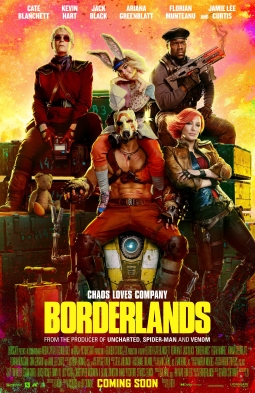
Bike-shaped object resonates with me because the formulation really works for so many other domains. For example, even though I’m not a film expert by any means, I recently encountered something I immediately recognized as a film-shaped object: Borderlands, horror director Eli Roth’s PG-rated adaptation of the ultraviolent video game.

Just like a bike-shaped object, Borderlands has all the pieces of a film but somehow fails to work as one. It’s got actors, including Cate Blanchett, Gina Gershon, and Jamie Lee Curtis. It’s got a hero’s journey, a cast of characters each with their own flaws and strengths, some character development, a bit of pathos, and of course some comic relief courtesy of Kevin Hart and Jack Black. It’s got special effects and a marketing budget and an established intellectual property tie-in.

And it’s unrelentingly, irredeemably terrible. We kept watching simply to see how much lower it could go. Perhaps it will be a cautionary tale for film school students, or a cult classic. But it is, undoubtedly, a film-shaped object rather than a real film. There’s only one reason to avoid calling it that: it’s so obviously bad that even non-experts like me can tell it’s a disaster. And if you can’t use your disdain to be exclusive and special, what’s even the point?

Outrage

I am yet again glad we stopped paying for the New York Times, as their pursuit of false equivalence leads them to try to compare “housing policies.” On the one hand, you see, is the Democratic party policy of housing construction and homeownership. They contrast that with the totally legitimate Republican party “housing policy” of militarized deportations of people with brown skin.

(Oh, sure, just undocumented immigrants, right? No note of how as many as one percent of all people in ICE custody are actually citizens? Gosh, who would ever have thought that an anti-voting policy that makes it harder to get citizenship documents might also harm citizens?)

Joy

Blame it on the dog.

There is no way you could get me to do this with a tiger, no matter how friendly.

Good Enough to Do Bad Work

404 Media recently did a report on the use of AI-generated images as food illustrations on DoorDash and other food delivery services. InstaCart has also been making algorithmically suggested recipe suggestions with uncanny illustrations. The restaurants most likely to use fake pictures of fake food seem to be ghost kitchens — restaurants that exist only as a brand on a delivery site, operating out of the back of a different restaurant. There are more than a few in my city, like “Send Noods,” a delivery-only joint run from the kitchen of a Korean sushi place. (It sends noodles. Get it?)

Their judgement:

This is all incredibly depressing. A local pizzeria can’t get by unless it makes sandwiches for ghost kitchen brands, the people who make a living taking photographs of food are being displaced by AI tools, and gigantic food delivery apps are still making money by taking a cut from restaurants and screwing over gig delivery drivers.

It’s not good, it’s not accurate, but it’s good enough to be a vague illustration, good enough for a glance if you don’t look closely, if you’re not counting on the product you buy to match the picture on the menu. And who is? We all know food photography is fake anyway. This is just faker and cheaper, just like shitty fast fashion gets you an outfit that’s half as good for a third of the price, and it works OK as long as you don’t think too hard about the pollution, the exploitative labor practices, the millions of coal-fired GPUs churning away to produce the gray goo that passes for “content” these days.

More Bad News

In Oklahoma, where anti-trans and anti-gay rhetoric and laws have been among the most aggressively poisonous, a 10th grader named Nex Benedict has died. One day they were fine. The next day, they were beaten into unconsciousness for not dressing the right way. The day after that, they were dead. Everyone’s in full coverup mode. Coverage from Slate and The Cut has some disagreement about details, but both sources agree that the full story won’t be known for some time, if ever. What does it mean? What kinds of behavior are allowed and tolerated and encouraged at every level to produce a situation where a fifteen year old is dead after a fight in a high school bathroom? Just another pointless death that folks like Chaya Raichik claim they didn’t intend to inspire.

Meanwhile:

Good News/Bad Opinions

In Hoboken, New Jersey, adjustments to traffic enforcement and parking have resulted in a remarkable record: no traffic deaths on city-controlled streets in seven years. The major changes were narrowing intersections to slow traffic, and “daylighting,” or preventing cars from parking right next to a corner, which improves visibility. Noted conservative intellectual Jordan Peterson responded to AP News coverage of this milestone on Twitter with outrage:

Two Excellent Pieces of Film Criticism

An exploration of Dune Part Two, and the ways in which it both subverts and supports the Chosen Hero narrative, which it gives the rather unfortunate but not entirely inaccurate nickname magic dick theory:

In Dune, though? It’s all a con. There is no benevolent higher power.

The connection between patrilineal inheritance, male heterosexuality, and just governance is not a fact of nature; it’s a convenient fiction. The prophecy that makes the Fremen accept Paul as the savior figure… was planted in Fremen culture generations ago… It’s a plainly imperialist fiction designed to exploit an indigenous population, and it works.

A very good meditation on the 1989 film Do The Right Thing, art criticism, and the kinds of violence that make us feel safe:

I think the reaction to Do the Right Thing revealed that the burning of a white-owned pizzeria and a fight over inclusion represented violence that scared white audiences, while a persistent police presence in a Black neighborhood that might at any moment turn into the murder of a resident of that neighborhood did not represent violence that made white people feel scared. It might have even been the sort of violence that made many white people feel safe. In fact, most of the talk by mostly white pundits and audiences didn’t even seem to acknowledge the act of policing on Black neighborhoods to be violence at all.

Like I said, sometimes when people talk about art, the art starts talking about them.

Joy

The old-school comic strip Nancy has been running since the 1930s, but has had something of a resurgence since the latest artist, Olivia Jaimes, took the helm in 2018. Two recent gems: one about the transcendence of art, and pondering the eternal question “is that all there is?

Also:

Until Tomorrow

Today’s song is Ta Fardah, by PAINT, a Farsi-language tale of falling in love with the airport security agent by LA-based Pedrum Siadatian.

PAINT is just one of a perhaps-surprising number of bands revisiting the surf/garage/psychedelia vibe these days, with what may or may be greater depth than the first time around. I’m especially fond of Habibi, which mixes Farsi influences with punk and 1960s girl groups to produce catchy jams that veer from covering a fun night of dancing (I Got the Moves) to upsetting and unfulfillng sex (Siin). Another great pick is La Luz, which has a more lush and less punky sound but still carries the banner for what you might call woman-group rather than girl-group garage rock. Highly recommended.

Bad news

Big Ideas

The Ink: Future Shock. Progress is good, but how do we help people adapt to it?

Consider that we have completely changed the meaning of being a man and what you can do and not do as a man in the last 20, 30, 40 years. Thank god. But let’s be honest: We have done a better job of dismantling some of the old stories and practices and structures of masculinity that needed dismantling than we have of teaching men new ways to be men. The result is a vacuum, and certain podcast charlatans are very deft at getting in there and pied-piping men into new misogynistic visions to fill the void.

Dynomight: Taste Games. Yeah, I’ll drink Budweiser or a local craft beer but not Heineken because, wait, am I just falling into the Pierre Bourdieu trap again? Yes, we have YET MORE ruminations on Bourdieu, conspicuous consumption, beer, status, taste, travel, high-end sneakers, and the Correct Way to Pour Wine:

Something about how people talk about travel has long made me uneasy. After all, travel is expensive. No one in my circles would dream of going to a party and showing off their new Rolex. But somehow, travel is this unusual form of conspicuous consumption that isn’t subject to conspicuous consumption taboos. Why? … A deeper conspiracy theory is that Travel is popular because it allows people who aren’t socially permitted to play Fancy Cars a way to do that while pretending that they’re only playing a normal, respectable game of Glass Beads.

Joy