When I have nothing to say, my lips are sealed

Earlier this month, Hamilton Nolan came out with a truly excellent analysis of the phenomenon of overpaid, under-talented columnists. Alongside a review of my older posts, it confirmed my belief that I shouldn’t write this newsletter unless I had something I needed to say. (Hence, of course, the subject line of this message, which you surely don’t need to have explained to you.)

As he describes it, “Most columnists are mediocre. This is not their fault. Almost no one on earth is capable of having two good ideas per week. (I say this as someone who writes at least twice a week.)”

But why, he wonders, would a venue such as the New York Times have so many mediocre columnists? A Times column is, after all, probably one of the best jobs in writing, so even if most columnists are not very good, the Times could find truly excellent ones. But they do not.

I want to quote him at length here, because what he’s saying is insightful, and sharp, and hilarious:

The existence of these uninspired and uninspiring people occupying the very best jobs in their industry is evidence of the limits of the ideals that liberal society purports to value. Sure, the institutions of journalism name truth and enlightenment and justice and equality as their goals, but the unspoken qualification, “within the pool of people who went to, at least, Brown,” is every bit as important as the more noble part that is spoken louder. There is no reason for there to be even one shitty New York Times columnist. They can hire anybody they want. Anybody. The existence of shitty New York Times columnists, therefore, is an unimportant thing that reveals some important things about the myths of meritocracy. The most self-assured liberal institutions are in some ways more profoundly corrupt than some of the more raffish institutions that they look down on. I mean, the NFL is one of sickest symbols of America’s barely subdued imperial impulses, but you don’t see a guy playing nose tackle on the New York Giants because he was the owner’s kid’s college roommate at Yale. Can the New York Times say the same?

Short-form

Long-form

I’ve been reading sci-fi and fantasy by Ann Leckie, and both her sci-fi (starting with 2014 Hugo winner Ancillary Justice) and fantasy (2019’s The Raven Tower) take enormous structural risks that pay off beautifully.

Ancillary Justice features a narrator who isn’t quite human, and may or may not count as a person, or as a civilized person. The plot — interstellar machinations, political wrangling, epic quest for revenge — manages to dance along merrily as it makes us think about the nature of gender, of self, of humanity, of how a society perpetuates and defines itself, of what happens when it that definition needs to change.

The Raven Tower alternates chapters narrated in the first and second person. It’s not immediately obvious that it’s the same narrator in both cases, nor that this narrator is, in fact, a pagan god embodied in a boulder stuck in a castle subbasement. Until the very end it’s not clear that all the human characters are, in essence, pawns in its plans. How is this a setup for a good story? I don’t know, but it works.

Cute
Dog spots its dog-walker out of context.

Gang of illegally small kittens.

Good Enough to Do Bad Work

404 Media recently did a report on the use of AI-generated images as food illustrations on DoorDash and other food delivery services. InstaCart has also been making algorithmically suggested recipe suggestions with uncanny illustrations. The restaurants most likely to use fake pictures of fake food seem to be ghost kitchens — restaurants that exist only as a brand on a delivery site, operating out of the back of a different restaurant. There are more than a few in my city, like “Send Noods,” a delivery-only joint run from the kitchen of a Korean sushi place. (It sends noodles. Get it?)

Their judgement:

This is all incredibly depressing. A local pizzeria can’t get by unless it makes sandwiches for ghost kitchen brands, the people who make a living taking photographs of food are being displaced by AI tools, and gigantic food delivery apps are still making money by taking a cut from restaurants and screwing over gig delivery drivers.

It’s not good, it’s not accurate, but it’s good enough to be a vague illustration, good enough for a glance if you don’t look closely, if you’re not counting on the product you buy to match the picture on the menu. And who is? We all know food photography is fake anyway. This is just faker and cheaper, just like shitty fast fashion gets you an outfit that’s half as good for a third of the price, and it works OK as long as you don’t think too hard about the pollution, the exploitative labor practices, the millions of coal-fired GPUs churning away to produce the gray goo that passes for “content” these days.

More Bad News

In Oklahoma, where anti-trans and anti-gay rhetoric and laws have been among the most aggressively poisonous, a 10th grader named Nex Benedict has died. One day they were fine. The next day, they were beaten into unconsciousness for not dressing the right way. The day after that, they were dead. Everyone’s in full coverup mode. Coverage from Slate and The Cut has some disagreement about details, but both sources agree that the full story won’t be known for some time, if ever. What does it mean? What kinds of behavior are allowed and tolerated and encouraged at every level to produce a situation where a fifteen year old is dead after a fight in a high school bathroom? Just another pointless death that folks like Chaya Raichik claim they didn’t intend to inspire.

Meanwhile:

Good News/Bad Opinions

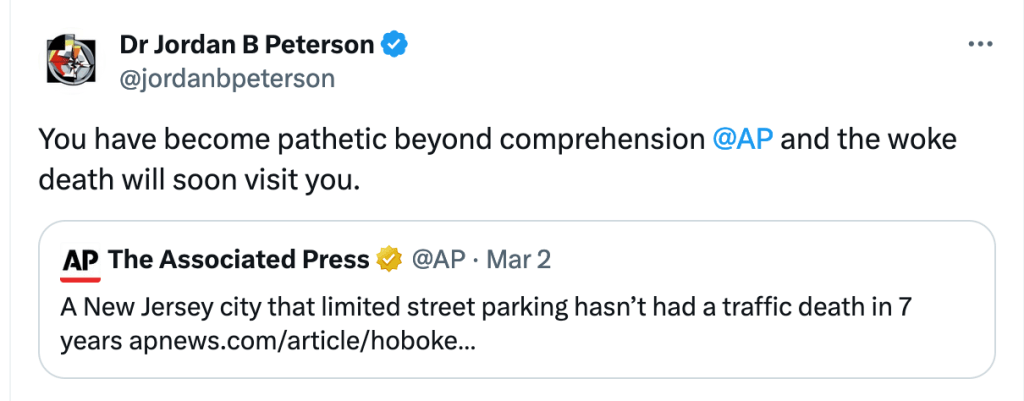
In Hoboken, New Jersey, adjustments to traffic enforcement and parking have resulted in a remarkable record: no traffic deaths on city-controlled streets in seven years. The major changes were narrowing intersections to slow traffic, and “daylighting,” or preventing cars from parking right next to a corner, which improves visibility. Noted conservative intellectual Jordan Peterson responded to AP News coverage of this milestone on Twitter with outrage:

Two Excellent Pieces of Film Criticism

An exploration of Dune Part Two, and the ways in which it both subverts and supports the Chosen Hero narrative, which it gives the rather unfortunate but not entirely inaccurate nickname magic dick theory:

In Dune, though? It’s all a con. There is no benevolent higher power.

The connection between patrilineal inheritance, male heterosexuality, and just governance is not a fact of nature; it’s a convenient fiction. The prophecy that makes the Fremen accept Paul as the savior figure… was planted in Fremen culture generations ago… It’s a plainly imperialist fiction designed to exploit an indigenous population, and it works.

A very good meditation on the 1989 film Do The Right Thing, art criticism, and the kinds of violence that make us feel safe:

I think the reaction to Do the Right Thing revealed that the burning of a white-owned pizzeria and a fight over inclusion represented violence that scared white audiences, while a persistent police presence in a Black neighborhood that might at any moment turn into the murder of a resident of that neighborhood did not represent violence that made white people feel scared. It might have even been the sort of violence that made many white people feel safe. In fact, most of the talk by mostly white pundits and audiences didn’t even seem to acknowledge the act of policing on Black neighborhoods to be violence at all.

Like I said, sometimes when people talk about art, the art starts talking about them.

Joy

The old-school comic strip Nancy has been running since the 1930s, but has had something of a resurgence since the latest artist, Olivia Jaimes, took the helm in 2018. Two recent gems: one about the transcendence of art, and pondering the eternal question “is that all there is?

Also:

Until Tomorrow

Today’s song is Ta Fardah, by PAINT, a Farsi-language tale of falling in love with the airport security agent by LA-based Pedrum Siadatian.

PAINT is just one of a perhaps-surprising number of bands revisiting the surf/garage/psychedelia vibe these days, with what may or may be greater depth than the first time around. I’m especially fond of Habibi, which mixes Farsi influences with punk and 1960s girl groups to produce catchy jams that veer from covering a fun night of dancing (I Got the Moves) to upsetting and unfulfillng sex (Siin). Another great pick is La Luz, which has a more lush and less punky sound but still carries the banner for what you might call woman-group rather than girl-group garage rock. Highly recommended.

Bad news

Big Ideas

The Ink: Future Shock. Progress is good, but how do we help people adapt to it?

Consider that we have completely changed the meaning of being a man and what you can do and not do as a man in the last 20, 30, 40 years. Thank god. But let’s be honest: We have done a better job of dismantling some of the old stories and practices and structures of masculinity that needed dismantling than we have of teaching men new ways to be men. The result is a vacuum, and certain podcast charlatans are very deft at getting in there and pied-piping men into new misogynistic visions to fill the void.

Dynomight: Taste Games. Yeah, I’ll drink Budweiser or a local craft beer but not Heineken because, wait, am I just falling into the Pierre Bourdieu trap again? Yes, we have YET MORE ruminations on Bourdieu, conspicuous consumption, beer, status, taste, travel, high-end sneakers, and the Correct Way to Pour Wine:

Something about how people talk about travel has long made me uneasy. After all, travel is expensive. No one in my circles would dream of going to a party and showing off their new Rolex. But somehow, travel is this unusual form of conspicuous consumption that isn’t subject to conspicuous consumption taboos. Why? … A deeper conspiracy theory is that Travel is popular because it allows people who aren’t socially permitted to play Fancy Cars a way to do that while pretending that they’re only playing a normal, respectable game of Glass Beads.

Joy

Erasure

It’s hard to figure out which disaster to look at — the climate-change-driven storms, the rampage shootings, the hate crimes, the war crimes, the online meltdowns of people allergic to nuance. No, I’m not linking to any of those things.

The recent Polish elections, in which young people drove a surge of turnout and pushed back a severe right-wing trend in government, give me reason for optimism. But while the right was in power, things were pretty grim, and a single electoral victory doesn’t mean permanent success. For years, national and local governments in Poland have been championing an anti-LGBT ideology — see this profile from 2020 of a woman living in what was deemed an “LGBT-free zone.”  It’s not just something that shows up in human-interest stories, either: a recent working paper identified a surge in all-cause deaths, suicide deaths, and suicide attempts among LGBT people in Poland during the anti-gay crusades.

And there’s no reason to think it couldn’t happen here. Hate crimes of all kinds are way up, and rising percentages of Americans support political violence. There is a coherent, consistent movement to erase anything that isn’t exactly perfectly straight and white. Yeah, sure, it’s hilarious that Alabama libraries just banned a children’s book because the author’s last name was “Gay.” But take a look at the incredible reporting from Judd Legum’s Popular Information: Scholastic has just added a quick and easy checkbox for schools running book fairs: should we include any diversity? Basically, if you’re a school librarian and you want to avoid any hassle, you can just pick the “all white, all straight” selection. Bio of John Lewis? Bio of Harvey Milk? Story about two penguins raising a chick? Too controversial, skip ’em all.

Legum has been a key source of information on the book-ban situation in Florida, the vanguard of the “anti-woke” movement. He was the first to report that Manatee County school librarians had been ordered to purge all books with any gay characters. Local news picked up the story, although two Hearst-owned TV stations claimed it was fake, then, when confronted with evidence, put the whole thing into the memory hole. In other words, not only is there a movement to erase and normalize queerness, there is also a concerted effort to make you think it’s not happening.

The New York Times, as usual, fumbled the ball earlier this month with their profile of two families “moving out of state because of political polarization.” On the one hand, a family leaving Iowa because their child’s medical care is now a crime. On the other, a family leaving Oregon because they didn’t like looking at homeless people and were angry about freeway tolls. Because sure, pal, there’s gotta be exactly two sides to every story, and they’re equally valid.

Better: The New Yorker’s profile of a family of American domestic refugees fleeing anti-LGBT policies.

Other Reading

New Yorker: Evan Osnos China’s Age of Malaise
Philadelphia Inquirer: Will Bunch on the right’s “Red Caesar” plan for a US dictatorship
Chicago Magazine: Profile of a woman getting $500 a month in a UBI pilot program

Bad Cop No Donut

Joy

Hot Masculine Summer

Maybe it’s the climate change, maybe it’s all the hot air surrounding our latest “crisis of masculinity” right now — the Times, the Post, the New Yorker, the Atlantic, the Economist, Politico, all have various lengthy discussions of it, and have been doing it for most of this decade so far. As much ink as they’ve wasted on it, it seems to be ramping up even more now. Men are falling behind, or at least, not doing as well as they used to, and right-wing grifters like alleged rapist and human trafficker Andrew Tate and alleged intellectual powerhouse Jordan Peterson are popping up everywhere to show men back to the glory days of strength and vigor and power.

One of the hottest of these macho scam artists right now is actually someone I met at a party maybe 20 years ago. He was fond of drunkenly challenging people to play chess without a board, something he claimed he could do because he was smart enough to remember where all the pieces were without seeing them, without the pieces even existing. Today he’s a neo-fascist philosopher with a PhD who goes by the pseudonym “Bronze Age Pervert.” He still thinks playing chess is a great test of intellect but now there’s a whole homoerotic BDSM fitness thing to go with it, real Hugo Boss for the SS vibes. It’s cheap and tacky but apparently young men just eat that shit up.

Meanwhile, other right-wing grifters are melting down over the popularity of the Barbie movie. Some of this is just an attempt to garner more hate-clicks as the Twitter ecosystem dies out.

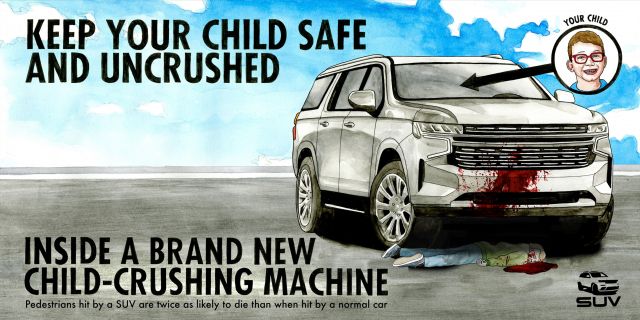
But some of it does appear to be a genuine obsession with performing masculinity in exactly the right way. They don’t appreciate the irony of their performance being, basically, drag. They think it’s innate. Tell a dude in a lifted pickup that his $75,000 expression of masculinity isn’t all that different from a pair of high heels, and he very well might get so angry he tries to crush you with it.

None of it seems new to me, though. I mean, men have been worrying whether other men are pussies for longer than I can remember. Teddy Roosevelt’s football reforms, for example, were driven by a concern that young men needed to play violent sports to be truly manly. It probably goes back at least as far as Socrates being executed for corrupting the youth of Athens, if not further.

I sometimes recall the way my peers taught me about what it means to be a man one summer. You see, as a child, I loved bright colors. When middle school hit and it was time to go to sleepaway summer camp, I picked out a bright purple sleeping bag. I packed my favorite neon pink shirt, because neon was rad in the late 80s and early 90s. I also had a very close friend who stayed at that camp for half the time I did, and I hugged him goodbye when he left.

I got called a faggot for it, of course, for that and for everything else about the way I was — I cried at sad movies; my taekwondo lessons had never actually taught me how to fight; I talked about things I’d learned from books; I brought sci-fi novels on hikes. I don’t remember who said what exactly, but I remember it culminated in a shoving match on a narrow trail several days into a camping trip.  We’d been rock-climbing. There was a cliff.

I don’t think I even told the counselors. Tattling only made it worse, and besides, it was normal. Just typical teen boys bickering, the typical way young men learn not to be pretty or thoughtful or affectionate.

This might be a broad generalization, but it seems to me that anyone who worries about the definition or nature or behavior of masculinity, or doing it correctly, is a colossal piece of shit willing to destroy other people rather than face his own insecurity. I don’t care if you’re a sincere seeker, a pseudo-intellectual, or an edgelord fascist: once you start trying to argue about whether this kind of joyful, fluid, self-expression “counts” as “manly” you’re taking a step down the path that leads to O’Shae Sibley getting stabbed to death in a parking lot for the way he dances.

Further Reading

Joy

Have you ever told or heard an anecdote that begins to curdle about halfway through?

Have you ever told or heard an anecdote that begins to curdle about halfway through? That friend whose amusing hijinks, you realize as you recount them, were really symptoms of a serious drug and alcohol problem? A fun childhood adventure that was horrifyingly dangerous and just turned out OK through blind luck? A harmless prank that was, in retrospect, way over the line? That tough first job that … wait, are sexual harassment, wage theft, and illegally dangerous working conditions good fodder for anecdotes?

They’re slippery things, our memories and our stories, and they mean things to us that they don’t mean to others. And of course they’re inaccurate: we play down things we don’t want to be bothered by, exaggerate things that we feel ought to be more important.

Take “the hometown scandal,” a perennial cocktail party topic. Everyone’s got a wild hometown scandal story to tell — the dueling car dealerships, the local real estate magnate’s marriage collapsing in public, that lady who murdered her husband and hid his body in a storage unit and told everyone he’d run off and only confessed on her deathbed.

Here’s mine: In elementary school, my friends and I all took taekwondo lessons from an affable due named Jim. He had what seemed like a pretty common-sense rule about the (rather small) changing rooms: when you were done changing, you should leave the door open and the light off, so other students would know the room was available. I forgot about the lessons and the oddly specific lights-and-doors rule until a few years later, when a local paper published an expose about the trick mirror he’d installed to spy on students undressing. When the story broke, he killed himself with a sword in a public park.

Is that a weird and sordid story? A recollection of trauma? I certainly don’t feel traumatized by it. I usually changed at school anyway, and he never touched me inappropriately, and by the time the scandal happened, the dojo had moved from the location where I’d studied, so the peephole/mirror probably wasn’t even there when I was. Probably. Right?

How about “how I fit into middle school stereotypes?” We may exaggerate the hierarchy of nerds and jocks for TV drama, but at the time the whole thing felt very real to me, with a special emphasis on “nerds like me don’t play team sports.” One year, an unpopular student a year behind me tried to join the junior-junior-varsity lacrosse team, and several of his teammates beat the shit out of him. One of the assailants was expelled, one was suspended, and the remaining team had to run a lot of laps for their failure to intervene, but I wasn’t surprised it had happened. That’s just what team sports just were to me: a clique that hated me and would hurt me if they got me alone.

I have no idea how badly he was actually beaten. (Of course I don’t: there was no way a prey animal like me was going to go into that fucking lion’s den). I heard he had to go to the hospital. I heard he exaggerated his injuries because he was a pussy. I heard a concussion wasn’t actually a big deal. Whatever it was, it seemed to me like the obvious outcome of joining the team, and I felt that it was his fault. I don’t think I talked to my parents about it, because it didn’t affect me, because I wasn’t stupid enough to try out for the lacrosse team.

My younger brother remembers it differently. He played lacrosse a few years later, and vaguely remembers that there had been an incident in the past, and the coach had placed a good deal of emphasis on being a good teammate, so maybe they fixed it. Maybe the scandal I remember was actually an isolated incident. I don’t know. It wasn’t about me, it didn’t happen to me, it was just something that happened in another room to someone I didn’t even know very well.

The kid they beat up left our school, of course, but kids getting bullied out of our school wasn’t that unusual. Not unusual enough to be notable, really. Although I did remember it. And when I was joking with a friend recently about how nerds like me didn’t play sports in the early 90s, I told her that story, and she said “Jesus Christ, I’m so sorry.”

But memories are slippery, and they mean things to us that they don’t mean to others.

Linkages

Joy (all cat edition)

The vibes are endlessly remixable

I’ve been thinking a lot about two mostly-unrelated articles I read recently. The first, titled Everything Is Interpolated, discusses music licensing. My takeaway is that there are few enough arrangements of common notes that any new melody has decent odds of sounding a bit like someone else’s song. And if it’s close, you better license a sample or at least the tune to avoid getting sued. And at that point, why even try to create a new melody when you can just buy one and remix it? So today, we get a lot of remixes, samples, and interpolations (that is, quotations). For example, I recently heard a new track from Lil’ Uzi Vert and Nicki Minaj and thought I recognized something familiar about the tune. We looked it up on Genius: it’s the piano hook from “Blue (Da Ba Dee)“, a bit of late-90s europop known for… well, that hook and nothing else. But that hook is popular.  Rapper Flo Rida used it in 2009, a slowed-down version anchors “Tus Celos” by Puerto Rican trap artist Anuel AA, Bebe Rexha and David Guetta featured it in a club track in 2022, and so on for dozens and dozens of variations. And just like this one, any remotely catchy tune is likely to be licensed and slotted into a new location, each new song just a fresh coat of paint on an existing tune.

The second article, The Banality of Conspiracy Theories, begins with what used to be a convent in what is now my city of Somerville, MA. Specifically, it begins with Protestant rioters burning it to the ground in August 1834 because they believed the nuns were being forced into sexual depravity, and that their resulting children were being murdered and buried in the basement.

The Ursuline convent was targeted because of conspiracy theories that, in many ways, were the 1830s version of the contemporary panic on the right regarding child sexual abuse… Although it is tempting to see these moral panics as something new, they have been part of American culture for nearly two centuries, and they recur at key moments in history for specific, identifiable reasons. Combating them requires first understanding that they are not only not novel, but in fact rote—almost to the point of banality. In other words, like a remix of an old tune, conspiracy theories just keep cropping back up, serving the same purpose. Only instead of something to dance to, these remixed vibes are something to riot about, a substitute for engaging with change or understanding the actual nuances of the actual world.

Car Brain

Let’s take another visit to The Atlantic, this time for the article Everyone has Car Brain, about a new study of “motonormativity:” 

Should people smoke cigarettes in highly populated areas where other people would have to breathe in the smoke? Forty-eight percent of respondents strongly agreed that they should not. Should people drive cars in highly populated areas where other people would have to breathe in the exhaust fumes? Only 4 percent strongly agreed that they should not. If you leave your car in the street and it gets stolen, is it your fault? Eighty-seven percent said no. If you leave anything else in the street and it gets stolen, is that your fault? Forty percent said yes.

Meanwhile, Education

Joy

Days Like These

Today’s song is More, by Low. It’s about how difficult it is to dismantle structures of gender-based oppression. It’s also fantastic. The way the distorted riff plays against Mimi Parker’s clean, high tone just works. The whole album, HEY WHAT, is strange and filter-heavy, the culmination of a long journey from their slow, quiet origins, which had sprung, in the mid-1990s, from the inspirations of “Eno, Joy Division, and the boredom of living in Duluth.

Bonus track: Speedy Ortiz, “No Below.”

More than what it should have cost

In the past few years, Walgreens and other retailers have closed quite a few locations, blaming gangs of shoplifters. They now admit they were lying about it, just like I told you they were.

All of what I didn’t have

Joy

It Sucks and You Like It

One of the canonical, oft-repeated anecdotes of my marriage is that one time, years ago, my wife and I were at the cheesemonger’s when the radio began playing Belle & Sebastian. I said “Oh, I haven’t heard this song in ages!”

Disgusted, she asked “What is it, Sublime?”

“What? No!”

“Whatever, it sucks and you like it!”

In that spirit, I present you some of the best single posts from the website which sucks and which we nevertheless like, Twitter:

And these longer threads that make me laugh until I cry:

Twitter is dying, and new platforms struggle to be born. Now is the time of Elon and his muskrats.

Vocabulary

This week I have picked up a book called Shadow & Claw, recommended by internet acquaintances who describe it as the great American sci-fi/fantasy epic. The New Yorker describes author Gene Wolfe as a “difficult genius” and relates that he’s been called the Melville of sci-fi by no less than Ursula K. LeGuin. I can see why.

The book has clearly been written to compete with Tolkien, not with elves and such, but with an enormous, carefully imagined world and a backstory so vast as to be incomprehensible even to the protagonists. Most importantly, the prose style asserts (perhaps too much) that the genre is worthy of literary respect. Wolfe stretches for antique words in a way that shouldn’t work, but somehow does: a man is strangled with a lambrequin rather than a simple garotte; peasants step aside for armigers rather than minor nobility; cavalry ride destriers to meet carracks arriving at the shore; an officer leads a lochus of peltasts; a weary traveler leans upon a paterissa. I haven’t had to guess at meanings or open a dictionary so frequently since I was a tween tearing through the grownup sci-fi/fantasy section at my hometown library. Trying to make sense of unfamiliar words in almost-familiar contexts manages to create a a sort of unheimlich sensation, the familiar tropes of a genre rendered once more uncanny… when it’s not just a colossal pain in the ass.

Joy

This cat is two sauces long.
AI-generated packages for different regionally popular candies.
Cat or underwear model?
The hazards of having a retriever at Halloween.
Rather longer but well worth your time, this absolutely scathing article about the state of the UK Conservative Party.

Content Curation & Recommendations

People who write paid newsletters or newsletters with a big audience take on an obligation to send them out regularly. Since I’ve only got a couple dozen folks and I’m not trying to make money on this, I have the luxury of making it sporadic. I don’t have anything specific today, but I’ve found a number of quite interesting pieces I thought you might like.

Long(ish) Reads

At the NY Times:The Subversive Joy of Lil Nas X’s Gay Pop Stardom. Read this even, or especially if you’re not a hip-hop/pop/R&B fan. He’s just twenty-two and he is killing it. Obviously when you see a young person thrust into stardom, you worry for them, but right now, in this shining moment, Lil Nas X is a ray of goddamn sunshine, especially for young gay Black people, and they could really use some goddamn sunshine. His new single, Industry Baby, is out now, and he’s using the platform to raise money for bail funds.

At GQ: Jason Sudeikis is Having a Hell of a Year. If you’ve seen and enjoyed Ted Lasso, then definitely read this. But even if you haven’t, it’s a really well-written piece. It profiles the actor, of course, but it also offers interesting thoughts about fame, the intersection of art and real life (both the protagonist and the actor have remarkably similar recent relationship trajectories), and more.

At Capital Daily (Victoria, BC): Penniless: Why a Victoria Man Has Gone Two Decades Without Using Money. This guy is fascinating, eccentric, frustrating, and kind of inspiring.

At Mainer: Proud Boys in Maine Meeting At Portland Dive Bar. Starts off as a completely normal “bartender refuses to serve Nazis” story, but it becomes a WILD ride. If you want a glimpse behind the regular story and a look at some very Maine characters, this is your tale.

Kind of Upsetting Items

Memes

Joy